Court quashes village another excommunication order in Nagaland
• Says customary authority cannot override fundamental rights
• Holds decisions of Putu Menden, Senso Mungdang amenable judicial review
Moa Jamir
Dimapur | November 1
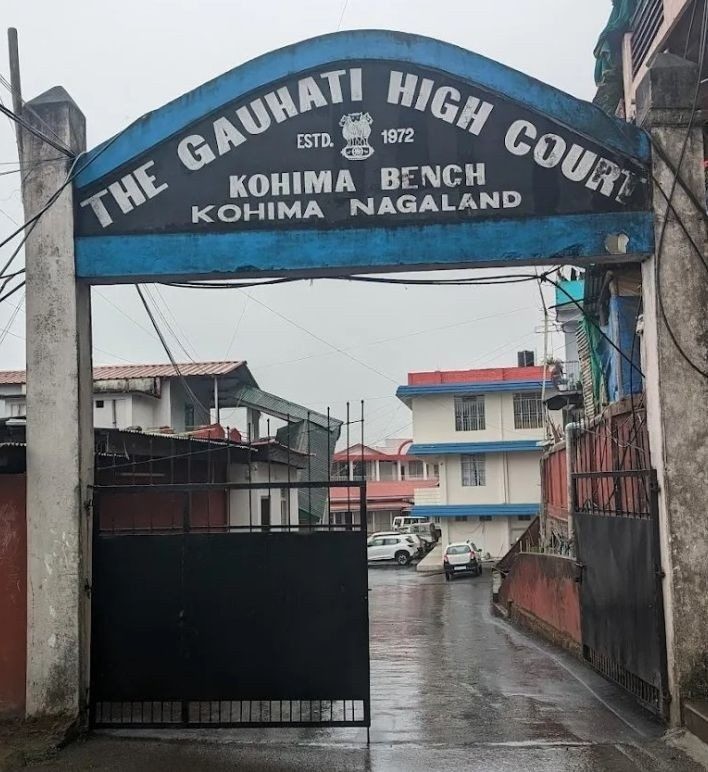
In a consequential judgment, the Gauhati High Court Kohima Bench (GHCKB) struck down sweeping excommunication orders issued by a village in Mokokchung, ruling that customary institutions cannot infringe upon constitutional guarantees of liberty, equality, and free movement.
In a judgment pronounced on October 27, Justice Yarenjungla Longkumer set aside four orders and announcements issued by the Yaongyimsen Riongsanger Putu Menden and the Yaongyimsen Senso Mungdang, holding that their actions violated Articles 14, 19 and 21 of the Constitution.
The court held that both institutions were amenable to writ jurisdiction under Article 226, even if they did not qualify as “State” under Article 12, as their decisions affected legally protected interests and involved a public-law element.
Case background
As per the Court’s record, the dispute centred on the establishment year of the Chumoukedima Yaongyimsen Union, with one group maintaining it was formed in 1989 and another asserting 2001.
Through a circular dated March 14, 2024, the Putu Menden dissolved the existing union and directed the group recognising 2001 as the establishment year to start a new office. The decision was opposed by those supporting 1989.
Following an incident in April 2024, a criminal case remained pending before the Chief Judicial Magistrate, Mokokchung, the judgment noted.
Subsequently, on April 4, 2024, the Putu Menden issued an ‘information’ excommunicating three petitioners and their children from Yaongyimsen village citizenship.
On October 21, 2024, the Senso Mungdang (Citizens’ Forum) announced the excommunication of 42 persons residing in Chümoukedima, including the 38 petitioners and their families, through a notice published in the Ao language daily. The Putu Menden issued a separate announcement affirming the excommunication the following day in the same publication.
Meanwhile, on December 10, 2024, the Senso Mungdang issued another communication conveying a decision taken at an emergency meeting on November 26. It stipulated that those affected would face permanent excommunication if they did not return to the village within seven days, along with additional restrictions.
Subsequently, the petitioners subsequently approached the High Court, seeking to quash the four communications and directing the State authorities to ensure that the Putu Menden, Senso Mungdang or any other village authority did not take unlawful action against them and their families for challenging their excommunication.
Competing contentions
In the court, the petitioners argued that the excommunication infringed their fundamental rights and that their village identity could not be taken away by customary or community institutions. They also contended that the sanctions affected family members, including children, who had no involvement in the dispute.
The State government opposed the excommunication, submitting that denying individuals their village identity and imposing restrictions on them and their families infringed fundamental rights. The district administration had also sought an amicable settlement and revocation of the sanctions.
The respondents challenged the maintainability of the writ petition, arguing that the Putu Menden and Senso Mungdang were customary and private institutions and were not subject to writ jurisdiction.
The action was defended as necessary to preserve village harmony after attempts at settlement had failed and invoked Articles 29 and 371A of the Constitution.
They also argued that the petitioners had no legal right to insist that 1989 be recognised as the union’s establishment year. The Village Council separately sought deletion from the proceedings, maintaining that it had not issued the impugned orders.
Court’s findings
Rejecting the preliminary objection, the court held that an institution need not qualify as “State” under Article 12 to be amenable to writ jurisdiction under Article 226.
The relevant considerations included whether it exercised authority recognised by customary law, whether its decisions affected rights beyond a voluntary association, and whether they had consequences for civil status, identity documents, public benefits or other legally protected interests.
The court found that the Putu Menden exercised authority recognised by customary law, while the Senso Mungdang exercised pervasive control over Yaongyimsen villagers residing within and outside the village.
The impugned decisions had consequences for the petitioners’ village identity, Scheduled Tribe and indigenous inhabitant certificates and other legally protected interests.
On the merits, the court held that Articles 29 and 371A could not protect excommunication and restrictions that violated fundamental rights. It referred to Mangyang Lima v. State of Nagaland, in which a coordinate Bench had held that customary orders imposing banishment and excommunication violated Articles 19 and 21.
The court also distinguished Sardar Syedna Taher Saifuddin Saheb v. State of Bombay, relied upon by the respondents, observing that it concerned a religious body and was distinguishable from a traditional institution such as the Putu Menden.
The court noted that the respondents had failed to demonstrate how the excommunication had restored village harmony or identify the customary law violated by the petitioners and their families.
It further observed that the restrictions adversely affected the right to move freely throughout India, noting that such restrictions could be imposed by the State only through valid law and not by another institution.
Specifically highlighting the impact on wives and children who had nothing to do with the dispute, the court held that the restrictions on their identity and movement were incompatible with fundamental rights.
Orders
Accordingly, the court quashed all four communications issued by the Senso Mungdang and Putu Menden.
Holding that the impugned orders violated Articles 14, 19 and 21, the court allowed the writ petition. It also held that the Village Council was not a necessary party to the proceedings.
However, the court did not adjudicate whether the Union was established in 1989 or 2001, leaving the disputed question open for an appropriate forum.
It directed that the period spent litigating before the High Court be excluded from the computation of limitation if a suit is instituted.
The ruling is not the first time the Kohima Bench has held customary authority in Nagaland subject to constitutional scrutiny. In Mangyang Lima v. State of Nagaland and others, 2019 the court recognised that customary bodies exercising extensive control over villagers could be amenable to writ jurisdiction and that banishment and excommunication orders were not beyond judicial review. The Yaongyimsen judgment also relied on T Chalukumba Ao v. State of Nagaland (March 21, 2024) and K Tia Longkumer v. State of Nagaland (June 23, 2026) to support the amenability of Putu Menden and customary orders to writ jurisdiction.
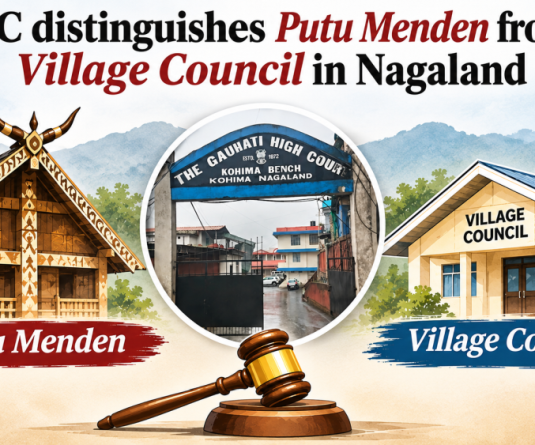
Tradition Vs Statute: HC distinguishes Putu Menden from Village Council
The Gauhati High Court, Kohima Bench distinguished the traditional Ao Naga institution of Putu Menden from the statutory Village Council constituted under the Nagaland Village and Area Councils Act, 1978.
Putu Menden and Village Council
Referring to published works on Ao Naga society and customary practices, the court observed that Putu Menden existed before the 1978 Act and is the highest authority in an Ao village, with its members responsible for upholding customs and traditions and enforcing customary law.
The court noted that Putu Menden originated at Chungliyimti, identified in the cited works as the place from which the Ao Nagas are believed to have originated. According to Ao custom, a Putu Menden usually functions for about 30 years before being succeeded by another Putu, generally understood as a generation, with five Putus succeeding one another in a pattern the court noted had continued since time immemorial.
The court further observed that Putu Menden operates through a three-tier system, unlike the Village Council. In some Ao villages, the two institutions overlap in membership. Members of Putu Menden may also serve on the Village Council, although not all Village Council members necessarily belong to Putu Menden.
The judgment noted that some Ao villages have two or more Putu Mendens, depending on their Khels. As a village can have only one Village Council, selected members from the different Putu Mendens constitute the council.
The court also distinguished the institutions on the basis of tenure and government control. A Village Council has a five-year tenure under the 1978 Act, and the State government has the power to remove its members. Members of Putu Menden, however, are inducted according to Ao customary laws and traditions, and the government has no equivalent power to remove them.
The court noted that the 1978 Act recognises the traditionally established Putu Menden, which continues to function according to the respective customs and usage.
It held that the two are separate institutions despite possible overlap in membership: Putu Menden members uphold customs and traditions and enforce customary law, while they function under the 1978 Act in their capacity as Village Council members.
The judgment’s central legal finding is that the traditional status of Putu Menden does not place its decisions beyond judicial review.
The Court held that Putu Menden and Senso Mungdang could be subjected to writ jurisdiction under Article 226 of the Constitution, even though they did not qualify as “State” under Article 12, if their decisions affect legally protected rights and involved a public-law element.