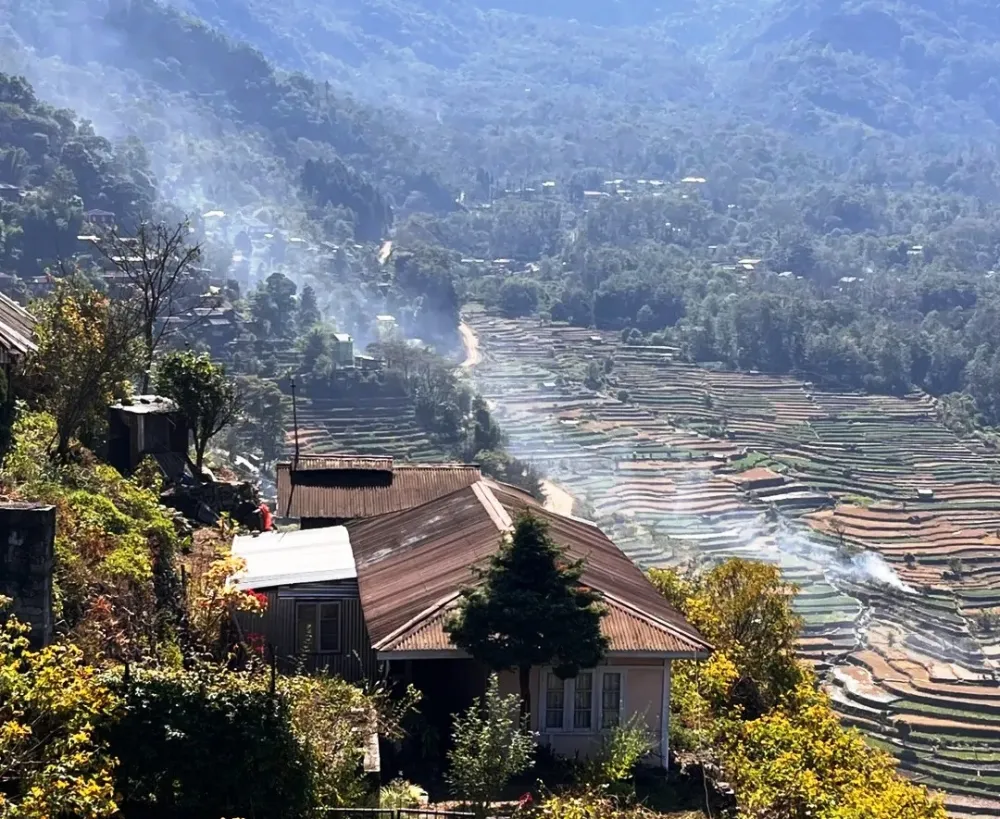
View of Khonoma village with its scenic terraced paddy fields. (Morung File Photo)
Morung Express News
Lumami | November 20
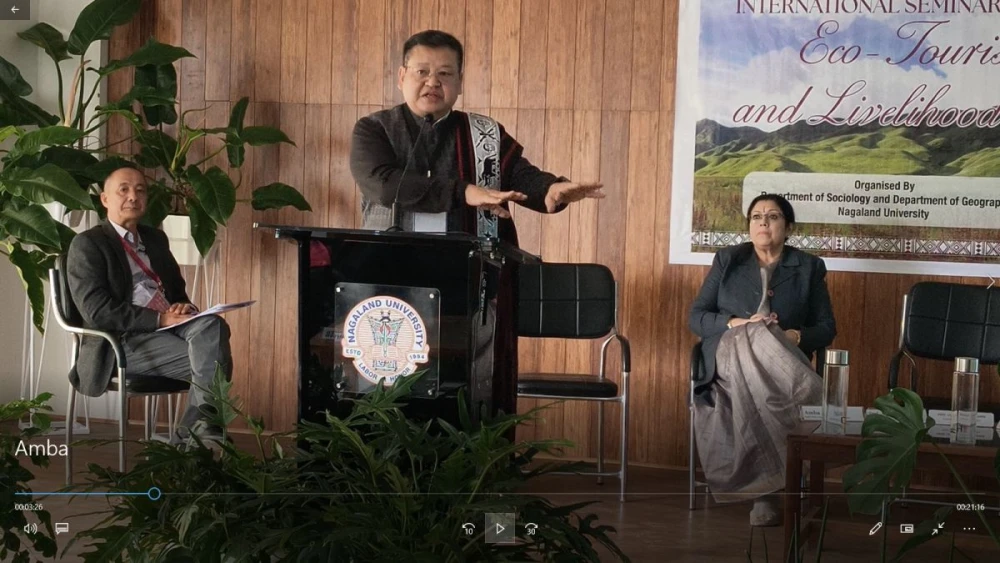
Tourism in Northeast India does not enter an empty system and must be treated as a governance issue involving land, assets and culture, senior policy analyst and development strategist Amba Jamir said on Thursday at an international seminar at Nagaland University, Lumami.
Delivering a talk titled “Governing the Living Commons: Anchoring Ecotourism in Customary Tenure, Agrobiodiversity, and Indigenous Food Systems in Northeast India,” Jamir cautioned that tourism projects can cause lasting harm if they ignore the institutions and ecological systems that communities have maintained for generations.
The two-day seminar on “Ecotourism, Livelihood and Development in Northeast India,” held on November 19 and 20, was organised by the university’s Departments of Sociology and Geography. It brought together academics, policymakers, tourism practitioners and community representatives to discuss tourism’s impact on livelihoods, culture and the environment.
Jamir pointed to constitutional protections such as Article 371A in Nagaland and the Sixth Schedule provisions across the region. Under these, he said, communities and not the state own land, and tourism must operate within that framework. The hills and mountains of the Northeast, he said, are not empty or pristine but lived-in landscapes governed by communities through multiple interacting institutions.
Four questions before a rupee is sanctioned
Jamir proposed that every community and investor ask four questions before any project is approved: who decides, who invests and why, why the project is coming and for whom, and what happens if it fails.
He said a project’s funding source, whether government, corporate social responsibility or an NGO, should not determine who makes decisions. Communities, he said, must be clear about where their decision-making power lies at each stage.
He noted that village institutions extend beyond village councils, since kinship groups, clans and extended families often own the land.
On project failure, Jamir said investors and departments may simply file a report on financial and physical targets, while communities are left to manage and maintain the assets. He also warned that tourism can create inequity, with households holding land with better views receiving more attention and investment than others.
Dimensions of the living commons
Jamir identified three interconnected dimensions of the living commons: customary tenure, agroecological spaces, and epistemic sovereignty with social norms. Tourism is sustainable, he said, only if it reinforces all three.
On tenure, he said the greatest threat often comes from within communities. Customary tenure is commonly described as a shield against outsiders, but elite capture by those with access to schemes and power is a major challenge. Communities often struggle to refuse government schemes for fear of being left out later.
On agroecological spaces, he said forests, rivers, and mountains that may not look productive are old food systems. He cited shifting cultivation cycles that create a mosaic of forest plots of different ages as a system that must not be disturbed. Tourism often coincides with periods when communities, especially women, are busy in forests and fields, and hunting bans and seasonal restrictions overlap with popular hiking trails.
Jamir said food tourism poses one of the biggest threats to indigenous food systems, even as the region offers rich culinary experiences. He urged that the shifting cultivation systems, kitchen gardens, and forests that supply this food be secured.
He said many projects build infrastructure before institutions are ready to manage it. He asked how many traditional councils and community members have been trained in tourism management, planning, and engagement with visitors, and how many have benefit-sharing mechanisms that ensure equity. Without such preparation, friction can arise within villages, with tourism becoming a project of a few rather than a shared venture.
Water stress, gender roles and leakage
Most tourism in the region takes place in winter, when water scarcity is at its peak, Jamir said, calling for a balance between visitor numbers and hydrological stress.
He said women and youth are often involved only in cultural performances, cooking and serving, while negotiations and engagement with tourists are largely handled by men.
He also flagged intermediary leakage, saying that in places like Nagaland, which lack large tourism agencies, tourists often pay substantial amounts for packages but the local community receives only a small share. He added that geophysical seasonality means tourism can only be a part-time, seasonal activity in the region.
Policy recommendations
Jamir urged that tourism projects ensure ecosystem services are not disturbed and consider payments for ecosystem services to upstream and downstream communities. He cautioned against an exclusive focus on civil works and concrete structures.
He said there is an excessive obsession with new village gates and tourist amenities while traditional houses and designs are ignored. Visitors, He said, come to experience a living rural community and not a concrete five-star facility.
He also called for tourism to be an all-department effort involving culture, forestry, fisheries and arts departments.
Noting that communities often struggle to obtain government certification as eco-tourism villages, Jamir proposed a participatory guarantee system in which tourists and providers agree together that an activity is sustainable.
“The real measure of success is not how many visitors arrive, but whether our communities remain custodians of the land, water, seas and institutions,” He said.