Officials and participants during the Public Private Practitioner Training (PPPT) on the National Vector Borne Diseases Control Programme (NVBDCP) held at the Chief Medical Officer’s Conference Hall in Dimapur on April 18.
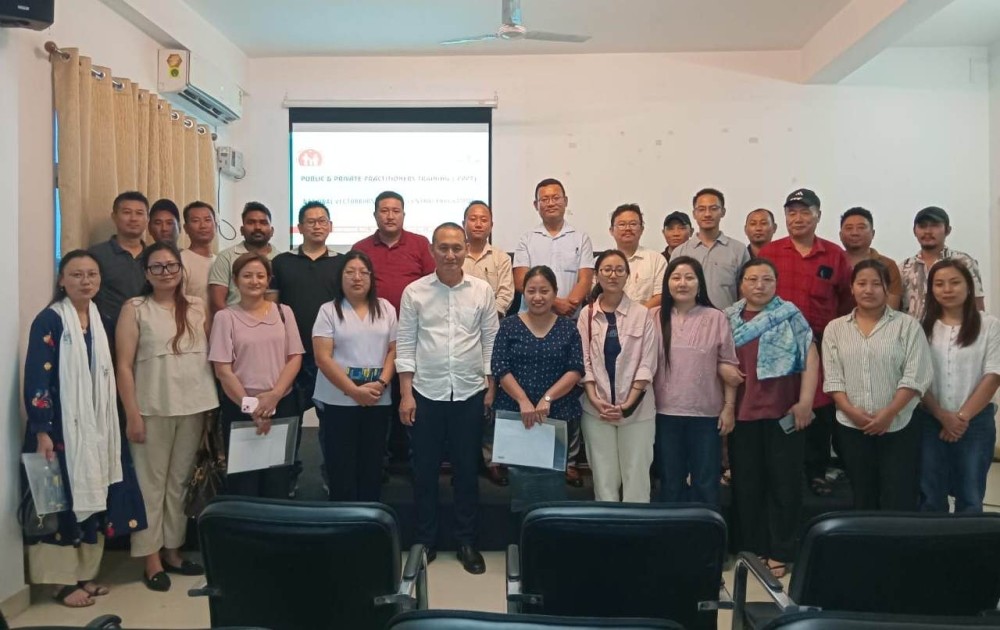
Dimapur, April 19 (MExN): A Public Private Practitioner Training (PPPT) on the National Vector Borne Diseases Control Programme (NVBDCP) was held at the Chief Medical Officer’s Conference Hall in Dimapur on April 18 to strengthen disease diagnosis, reporting and outbreak response among healthcare providers.
The session was chaired by Joint Director Dr Tinurenla Anichari, who highlighted that most malaria cases in the region are imported rather than indigenous. She urged healthcare workers from both public and private facilities to record detailed case histories, including travel history, address and contact details, to enable timely intervention.
The programme began with a welcome address by Dr Imnapokim, Joint Director and State Programme Officer (NVBDCP), Nagaland. He stated that six vector-borne diseases—malaria, dengue, chikungunya, Japanese encephalitis, kala-azar and lymphatic filariasis—are notifiable under the programme, making it mandatory for private hospitals to report detected cases to authorities. He emphasised that timely reporting is critical for effective disease control.
Chief Medical Officer Dimapur Dr T Yetovi Tuccu, in his keynote address, reiterated the importance of accurate and prompt reporting by health facilities. He said such data is essential not only for rapid response but also for resource allocation and policy formulation. He urged adherence to government guidelines and protocols aligned with national health goals.
Technical sessions covered key aspects of vector-borne disease management. Dr N I Singh, Additional Director and Senior CMO (HAG), Regional Office for Health and Family Welfare, Government of India, Imphal, conducted a virtual session on diagnosis and treatment.
A session on vector types in Dimapur and control measures was presented by Kikolul Khieya, who also demonstrated the use of larvivorous fish. He appealed to the public to cooperate with indoor residual spraying and keep doors and windows open during fogging operations in affected areas.
Further sessions included Dr Pewezo Khalo, Senior Specialist Microbiologist, District Hospital Dimapur, who spoke on testing facilities for Japanese encephalitis, dengue and chikungunya. Dr Nilam Somalkar, Regional Director, Bhubaneswar, delivered a virtual lecture on early outbreak detection and response in malaria.
Imsubenla, Public Health and Training Consultant, presented on Integrated Health Information Platform (IHIP) reporting, while Aomar Imchen, Data Manager, IDSP Dimapur, demonstrated reporting procedures on the IHIP-IDSP portal.
The training concluded with a vote of thanks by Heanglih T Konyak, District Vector Borne Disease Consultant (DVBDC), Dimapur.
Officials said the programme aimed to equip private practitioners with updated protocols on vector-borne diseases, strengthen integrated health information reporting and improve coordination between public and private healthcare sectors in the district.