Officials along with media persons during the disaster management training for first responders held at Hotel Saramati, Dimapur on February 26. (DIPR Photo)
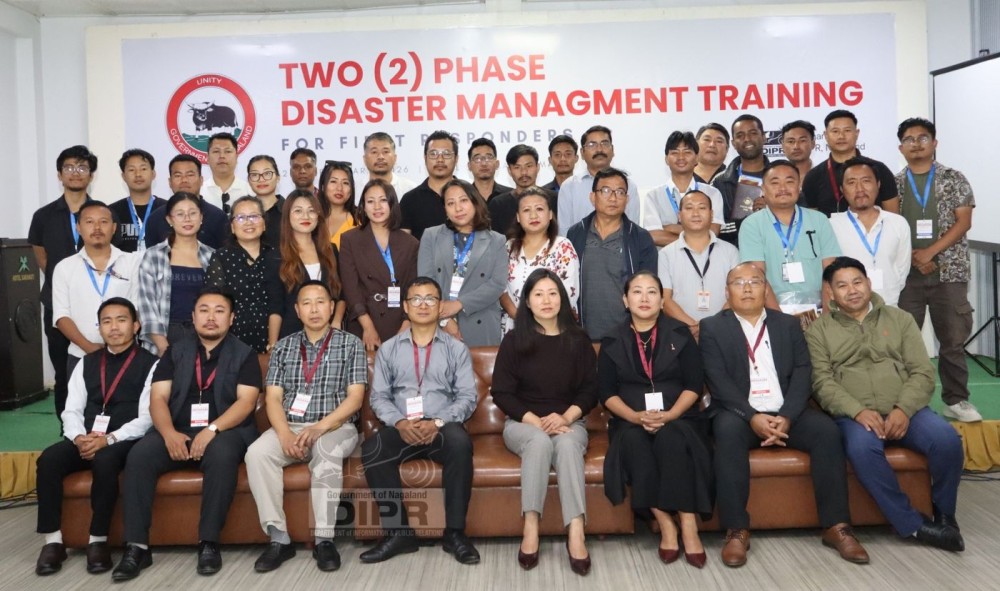
Dimapur, February 26 (MExN): A two-day Disaster Management Training for First Responders commenced on Thursday at Hotel Saramati, Dimapur, organised by the Directorate of Information and Public Relations (IPR), Nagaland. The programme aims to strengthen emergency preparedness, response skills and coordination during disasters.
The training brought together journalists and media personnel from print, electronic and digital platforms on Day 1, while Day 2 will be attended by in-service officials and staff of the IPR Department.
The first session, moderated by Achumo Khuvung, LDA, Directorate of IPR, focused on the “Role of Media in Disaster Management” and was led by Keren Rose, Assistant Manager, Media & Public Relations, Nagaland State Disaster Management Authority (NSDMA), Government of Nagaland.
Rose described the media as a key partner in disaster governance, stating that responsible journalism can save lives. She stressed that accurate, timely and verified information during emergencies prevents panic, curbs misinformation and ensures critical safety instructions reach affected communities.
Highlighting ethical reporting, she outlined key do’s and don’ts for journalists covering disasters. She urged verification of information from official sources before publication, promotion of preparedness and safety guidelines, fact-checking of casualty figures, use of official communication channels, and providing context on disaster causes and prevention. She cautioned against spreading rumours or unverified social media content, sensationalising tragedies, disclosing victims’ identities without consent, obstructing emergency operations, or exaggerating damage and casualty figures.
She also emphasised principles of truthfulness and integrity, respect for privacy and dignity, humanitarian and empathetic reporting, and awareness of compassion fatigue. Journalists were encouraged to focus on resilience and recovery alongside destruction and avoid intrusive questioning or graphic imagery that exploits suffering.
On the operational role of media during disasters, Rose underlined the need to deliver timely and factual updates, advise the public on safety measures, evacuation routes and shelter locations, and relay welfare information on missing persons, relief distribution and support services.
She further explained provisions of the National Disaster Management Act, 2005, outlining the disaster management structure from national to district levels, including the National Disaster Management Authority, Nagaland State Disaster Management Authority, District Disaster Management Authority (DDMA), and response forces such as the National Disaster Response Force and State Disaster Response Force (SDRF). Understanding this framework, she said, enables accurate reporting and effective coordination during crises.
Practical preparedness measures were also discussed, including earthquake safety practices such as securing heavy objects on lower shelves, keeping emergency kits ready, clearing exit pathways, and identifying safe family meeting points.
The second session was conducted by Kenny Khing, Fire Prevention & Audit Officer, Fire & Emergency Services, Government of Nagaland, on “Basic Fire Safety & Relevant Sections of the Nagaland Fire & Emergency Service Act, 2021.” He stressed coordinated response during fire and disaster situations.
It was informed that under Section 23(3) of the Act, multistoried buildings above 15 metres and special buildings such as educational institutions, hospitals, nursing homes, assembly buildings, business, mercantile, industrial, storage and hazardous occupancies must obtain a Fire Safety Certificate (NOC). Mixed occupancies exceeding 500 square metres are also required to secure the certificate for the entire building.