Participants and faculty with the speaker, Karma Yoezer, during the second edition of the FAC Annual Lecture Series at Fazl Ali College, Mokokchung, on November 3. (Photo Courtesy: FAC)
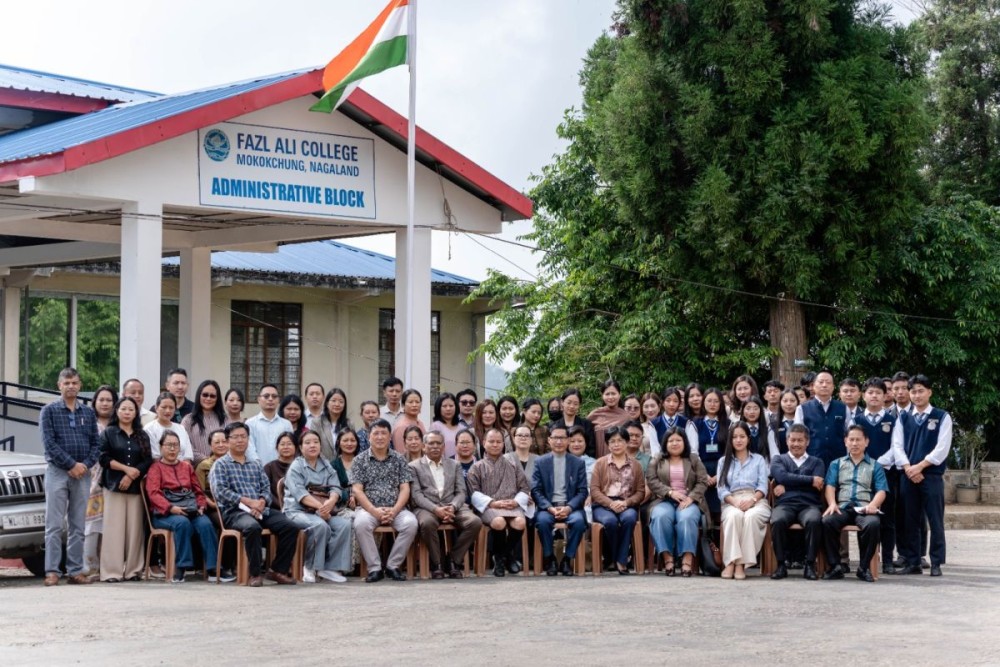
Mokokchung, November 3 (MExN): Gross National Happiness (GNH), Bhutan’s approach to measuring development beyond economic growth, was the focus of the second edition of the Fazl Ali College (FAC) Annual Lecture Series held in Mokokchung on November 3.
Organised by the college’s Internal Quality Assurance Cell (IQAC) to commemorate its Founding Day, the lecture was held under the theme “Higher Education and the Philosophy of Gross National Happiness: Indigenous Perspectives on Well-being and Sustainability,” informed a press release from college.
Karma Yoezer, Head and Lecturer in the Department of Humanities and Social Sciences at Sherubtse College, Royal University of Bhutan, delivered the lecture, explaining how GNH places people’s overall well-being at the centre of development.
Introduced under the vision of Bhutan’s Fourth King, Jigme Singye Wangchuck, the philosophy rests on four pillars: good governance, sustainable socio-economic development, preservation of culture and environmental conservation.
Yoezer emphasised that these pillars offer a more holistic understanding of progress than economic indicators alone.
Relating the philosophy to higher education, he said institutional success should not be assessed solely through pass percentages, enrolment, publications and accreditation. Instead, institutions must also consider what contributes to students’ well-being and development, including aspects that cannot always be quantified.
Yoezer outlined four ways to integrate GNH principles into higher education: preserving indigenous knowledge and traditional ways of life through oral histories and immersive learning; promoting research that addresses community needs and local realities; creating a balanced campus environment that nurtures well-rounded graduates; and strengthening community engagement through extension activities.
He emphasised that higher education must prepare students not merely for employment but also for meaningful participation in community life.
As per the release, the lecture was followed by an interactive question-and-answer session on GNH, higher education and the relevance of indigenous perspectives in contemporary society.
The programme was chaired by I. Narola Imchen, Associate Professor and Head of the Department of Chemistry. Dr I Wati Imchen, Principal of Fazl Ali College and Chairperson of IQAC, delivered the introductory note.
The programme also featured the release of FAC Annual Lecture: Lecture Series I, Inaugural Edition 2025, by Dr Imchen, documenting the first edition of the annual lecture series.