

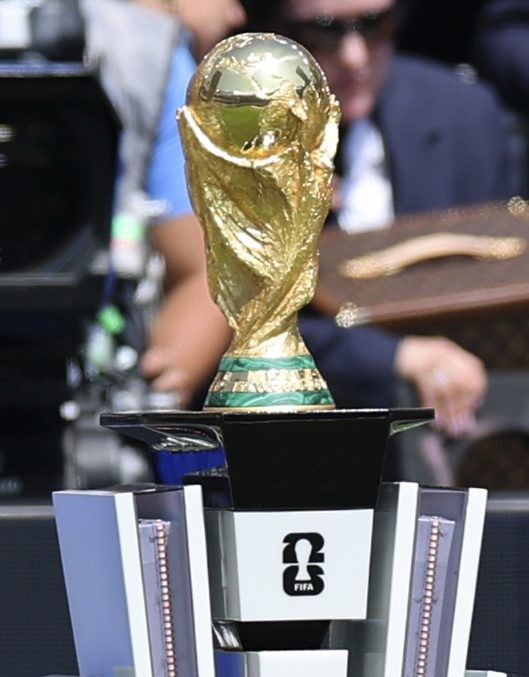
FIFA World Cup trophy is seen before the final match between Spain and Argentina at the 2026 FIFA World Cup at the New York New Jersey Stadium, the United States, July 19, 2026. (Photo: Xinhua via IANS)
Besesayo Kezo, IPS, Retd DGP
Introduction: Despite its foundational claim of political neutrality, the Fédération Internationale de Football Association (FIFA) has long maintained a mutually beneficial relationship with political power. The World Cup, football’s crowning showcase, offers an unprecedented global audience, making it a powerful vehicle for authoritarian regimes, military juntas, and populist leaders seeking political legitimacy, soft power, and public distraction.
The Fascist Blueprint: Mussolini and Hitler (1930s):
The precedent for weaponising global football was set during the sport’s formative international era. Benito Mussolini was among the first autocrats to recognise football’s potential as a tool of state propaganda. In 1934, Fascist Italy, hosting the World Cup, channelled vast public funds into monumental stadium construction, controlled media narratives, and pressured match officials. The tournament was designed less as a sporting contest and more as a demonstration of fascist discipline and national superiority. Mussolini famously commissioned the Coppa del Duce—a trophy six times larger than the official FIFA Cup—to ensure his regime’s presence overshadowed the sport itself.
Following suit, Adolf Hitler sought to harness football's power after Austria's annexation in 1938. The regime forcibly dissolved the elite Austrian national team and coerced its top players into representing Nazi Germany at the 1938 World Cup in France, using the tournament to project an illusion of a unified and dominant Reich.
Cold War Terror and “Sportswashing” in Latin America (1970s):
During the Cold War, FIFA routinely awarded host rights to regimes that committed severe human rights abuses, prioritising commercial expansion over ethical considerations.
In Brazil, General Emílio Garrastazu Médici heavily leveraged the national team’s legendary 1970 World Cup victory. Pelé and his teammates were co-opted into state propaganda under the nationalist slogan “Brazil: Love It or Leave It,” which effectively distracted the public from internal repression and political disappearances.
A few years later, after Augusto Pinochet’s 1973 military coup in Chile, Santiago’s National Stadium was converted into a torture and detention centre. When the Soviet Union refused to play a World Cup qualifier on the bloodstained pitch, FIFA refused to move the venue. Instead, Chilean players were allowed to walk onto an empty field to score against an absent opponent—a surreal event remembered as the “Match of Ghosts.”
Perhaps the starkest example of 20th-century “sportswashing” occurred during the 1978 World Cup in Argentina. General Jorge Rafael Videla’s military junta hosted the tournament at the height of the “Dirty War,” when tens of thousands of citizens were tortured and forcibly disappeared. Matches at El Monumental stadium were held mere miles from the ESMA clandestine detention facility, where political prisoners could hear the roar of the crowds. Videla used Argentina’s victory to drown out international criticism and project a facade of peace and stability.
The Modern Era: Capital, Autocracy, and Populist Alignments:
By the 21st century, FIFA had evolved into a multi-billion-dollar commercial entity, making its bidding processes increasingly susceptible to state-backed financial influence:
• Vladimir Putin’s Russia (2018): Following the 2014 annexation of Crimea, Russia utilised the 2018 World Cup to project a friendly, modern image to millions of visiting fans, thereby softening its international standing amid escalating geopolitical tensions.
• The Qatari Monarchy (2022): The decision to award the 2022 tournament to Qatar highlighted how sovereign wealth could buy global soft power, despite widespread international scrutiny of labour rights, migrant worker fatalities, and human rights abuses.
Under FIFA President Gianni Infantino, the governing body shifted from maintaining a veneer of political distance to actively courting political leadership. This shift reached a milestone during the 2026 World Cup, co-hosted by the United States, Mexico, and Canada. Infantino routinely aligned FIFA governance with populist national politics and maintained a close relationship with Donald Trump. High-profile appearances at Trump Tower, political interventions on player eligibility, and joint trophy presentations underscored how modern sports governance increasingly intersects with national political leadership.
Results:
When FIFA aligns with or allows itself to be influenced by authoritarian regimes, several significant risks fundamentally compromise the organisation's credibility, integrity, and core purpose.
1. Erosion of Political Neutrality
• The “Neutrality” Paradox: FIFA’s statutes declare the organisation strictly non-political. However, granting hosting rights, ceremonial honours, or platform access to autocratic leaders directly violates this neutrality by endorsing the host state's political agenda.
• Loss of Moral Authority: When FIFA claims to promote universal human values—such as fairness, peace, and human dignity—yet turns a blind eye to political repression or human rights abuses, its ethical framework is exposed as selective and hypocritical.
2. Institutional Vulnerability to “Sportswashing”
• Regimes often leverage the global influence of the World Cup to improve their international image, hide internal abuses, and present a modern face while concealing aggressive foreign policies.
• Complicity in State Propaganda: By failing to set human rights conditions or enforce ethical safeguards, FIFA shifts from a neutral governing body to an active accomplice in state propaganda.
3. Financial and Governance Corruption
• Opaque Bidding and Influence Buying: Authoritarian regimes, unconstrained by domestic legislative oversight or an independent free press, can deploy vast state capital or sovereign wealth funds to secure hosting rights through bribery, backroom deals, or covert lobbying.
• Governance Compromise: The infusion of state-backed capital skews FIFA’s internal decision-making, prioritising short-term financial windfalls and political favouritism over long-term sporting integrity, fan welfare, and human rights.
4. Alienation of Fans, Players, and Commercial Partners
• Public and Fan Backlash: Persistent alignment with oppressive regimes erodes global goodwill, triggering fan boycotts, athlete protests, and public disillusionment with the sport.
• Sponsor Risk: Commercial partners face significant reputational risk when their brands are directly linked to tournaments held in countries facing international condemnation for human rights violations.
Key Takeaway: When FIFA cedes its independence to authoritarian regimes, the World Cup ceases to be a celebration of international athletic excellence and becomes a blatant instrument for endorsing dictatorial rule.

