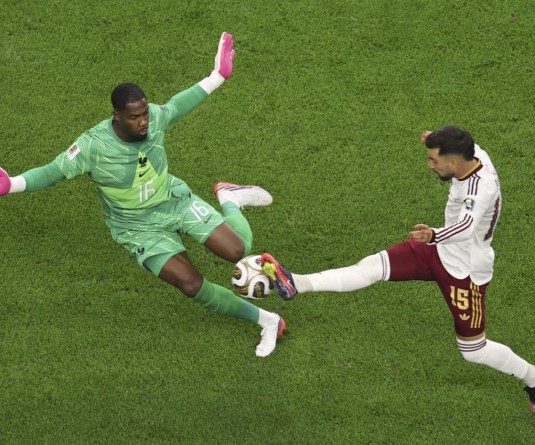
DIMAPUR, JUNE 6 (MExN): Group I presents a stern examination for France, with Senegal and Norway possessing the quality and firepower to challenge one of the tournament favourites. Add a disciplined Iraq side capable of frustrating more fancied opponents, and the group promises a demanding route to the knockout stages for all four teams.
FRANCE
Didier Deschamps’ Les carry their customary mandate to reach the tournament's final weekend. Navigating a commanding UEFA qualification campaign, France continues to boast the absolute highest individual talent floor in international football, seamlessly blending veteran tournament muscle with a terrifying influx of young, dynamic athleticism.
Real Madrid’s talismanic forward Kylian Mbappé spearheads a devastating frontline, supported by the clinical mobility of Marcus Thuram and the creative ingenuity of Bradley Barcola out wide.
Supported by the midfield engine of Warren Zaïre-Emery, France excels at dictating tempo and pinning opponents deep through rapid ball circulation. However, tracking metrics highlight their primary tactical vulnerability: a historical tendency to look highly impatient and defensively exposed when facing compact, low-block systems that refuse to yield space behind the line.
SENEGAL
The Lions of Teranga enter the tournament looking to assert their status as Africa's premier global competitor, navigating a physically demanding CAF qualification cycle with an authoritative defensive record. Under disciplined structural guidance, Senegal plays a highly flexible, intensely physical brand of soccer designed to choke central passing lanes and physically overwhelm creative midfielders.
The squad's tactical spine features elite European tournament pedigree, anchored by Chelsea's high-octane forward Nicolas Jackson and the veteran defensive steel of Kalidou Koulibaly. Senegal operates with an exceptional athletic foundation, using a relentless mid-block to force midfield turnovers before launching rapid vertical releases to their dynamic wingers.
NORWAY
Returning to the global tournament stage after a highly anticipated UEFA qualification breakthrough, Norway arrives as the group’s most lethal wildcard. Under a direct, high-variance tactical blueprint, the Norwegians play an expansive brand of soccer explicitly engineered to maximize the world's most devastating final-third focal point.
Manchester City’s prolific striker Erling Haaland provides an unstoppable, physically dominant aerial and transitional spearhead up front, complemented by the world-class creative vision and set-piece delivery of Arsenal captain Martin Ødegaard. This combination gives Norway the unique capability to breach any defensive line in the world in a single sequence. However, their high-line philosophy leaves an unproven central defense heavily exposed, creating a high-scoring, volatile dynamic that makes them a thrilling attacking force but a defensive gamble against elite transition units like Senegal and France.
IRAQ
The Lions of Mesopotamia are an outsider, comfortably securing their historic tournament return by dominating their multi-stage AFC qualification bracket. Operating under a highly synchronized, low-risk defensive blueprint, Iraq functions as an incredibly unified, resilient out-of-possession unit structured to dry up the rhythm of matches.
Lacking the luxury European top-flight club depth of their group counterparts, Iraq relies on an uncompromising, deeply set low-block and a relentless team work rate to frustrate technical opponents. Up front, they leverage the physical hold-up play of clinical striker Aymen Hussein to win aerial duels and execute isolated counter-attacks.
Argentina's crown faces first tests in Group J
DIMAPUR, JUNE 6 (MExN): Defending champions Argentina headline Group J, but their route to the knockout rounds is complicated by a trio of opponents built around discipline, organisation and tactical intensity. Algeria and Austria possess the quality to challenge the holders, while debutants Jordan will be looking to frustrate more fancied rivals and keep the group race alive deep into the tournament.
ARGENTINA
Lionel Scaloni’s Albiceleste have the immense prestige and pressure of defending their global crown. Navigating a commanding CONMEBOL qualification campaign, Argentina has seamlessly integrated a dynamic younger generation into its core, transitioning into a highly fluid, possession-dominant side that relies on elite ball-retention and intricate central combinations.
While the ageless Lionel Messi remains the spiritual and creative heartbeat of the squad, the frontline heavily leverages the clinical mobility of Inter Milan’s Lautaro Martínez and Atlético Madrid’s Julián Álvarez. Supported by the elite midfield engine room of Alexis Mac Allister and Enzo Fernández, Argentina excels at suffocating opponents in the middle third.
ALGERIA
The Desert Foxes look to reassert themselves as a threat under the disciplined tactical guidance of manager Vladimir Petković. Navigating a physically demanding CAF qualification cycle with an authoritative defensive record, Algeria operates as a highly resilient out-of-possession unit structured to completely choke the rhythm of matches.
The squad features premium European top-flight quality, anchored by Manchester City’s dynamic left-back Rayan Aït-Nouri and Borussia Dortmund’s robust defender Ramy Bensebaini. In the middle third, Eintracht Frankfurt's Farès Chaïbi provides tactical flexibility alongside Al-Ittihad’s Houssem Aouar, fueling direct service to the explosive wide pace of veteran winger Riyad Mahrez.
AUSTRIA
Ralf Rangnick’s squad have a formidable reputation as one of Europe’s most structurally resilient counter-pressing units. Securing their tournament berth via a high-intensity UEFA qualification run, Austria plays an uncompromising, high-octane brand of vertical soccer explicitly engineered to force catastrophic turnovers in advanced areas.
Austria’s competitive leverage lies in its elite, Bundesliga-rooted midfield engine core, featuring Borussia Dortmund’s Marcel Sabitzer alongside the high-energy ball-winning metrics of RB Leipzig's Nicolas Seiwald and Bayern Munich's Konrad Laimer. Real Madrid's veteran captain David Alaba provides critical structural leadership from the backline. Rangnick’s high-line philosophy aims to simply overwhelm possession-heavy teams through sheer physical work rate and rapid transition depth.
JORDAN
The Chivalrous arrive in North America as one of the most remarkable and historic stories of the expanded tournament field, securing their debut World Cup finals appearance after a historic, multi-stage AFC qualification run. Operating under a highly synchronized, low-risk defensive blueprint, Jordan functions as an incredibly unified, low-variance unit structured to rely entirely on spatial denial.
Lacking the luxury European top-flight club depth of their group counterparts, Jordan relies on an uncompromising, deeply set low-block and a relentless team work rate to frustrate technical opponents.