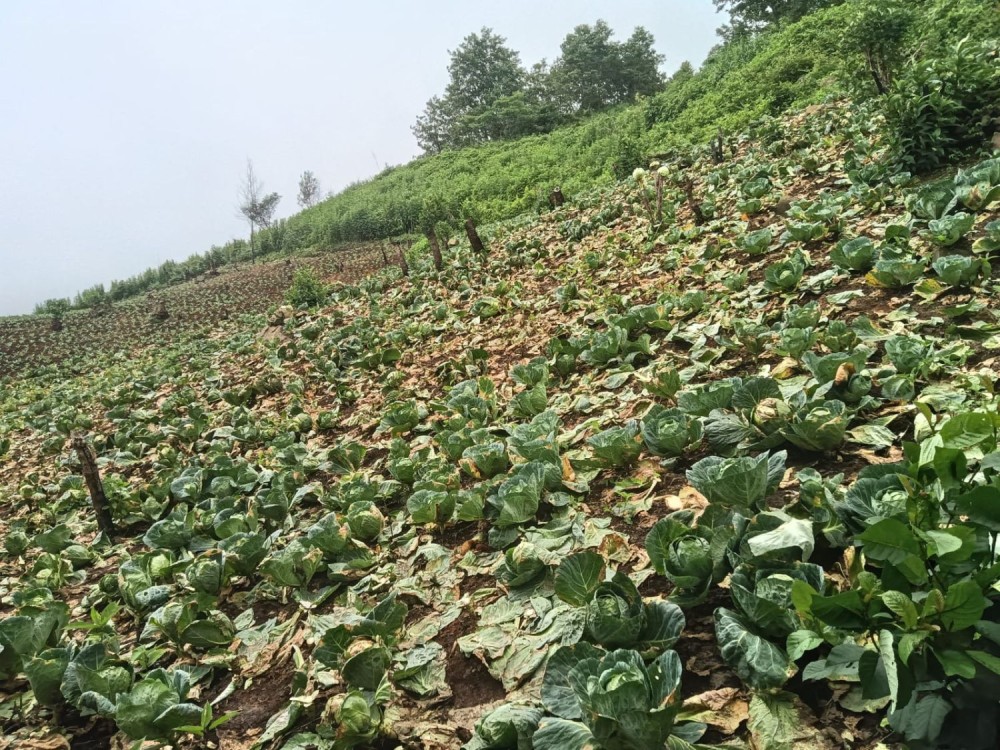
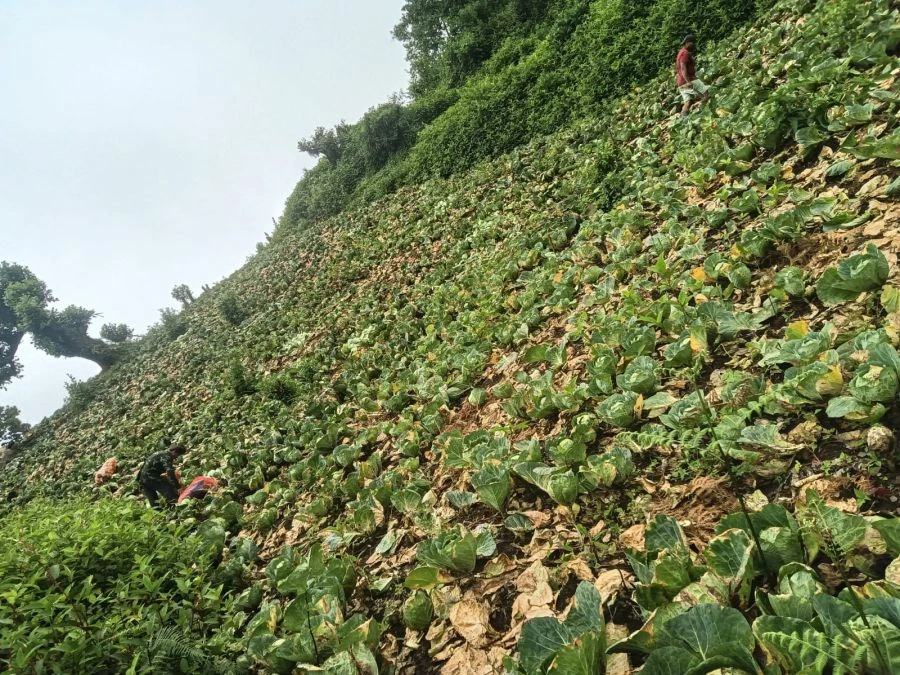
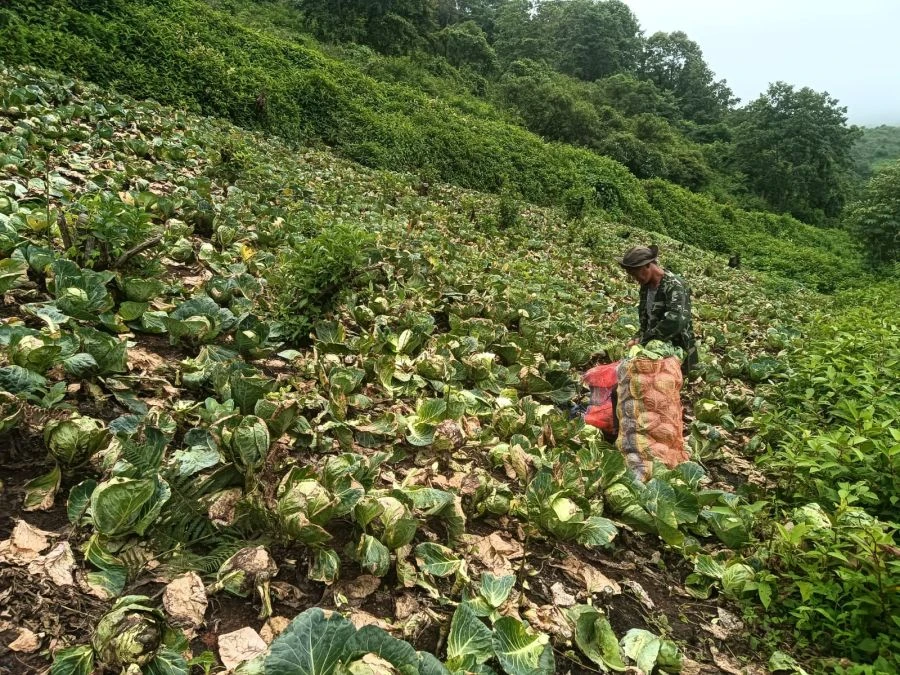
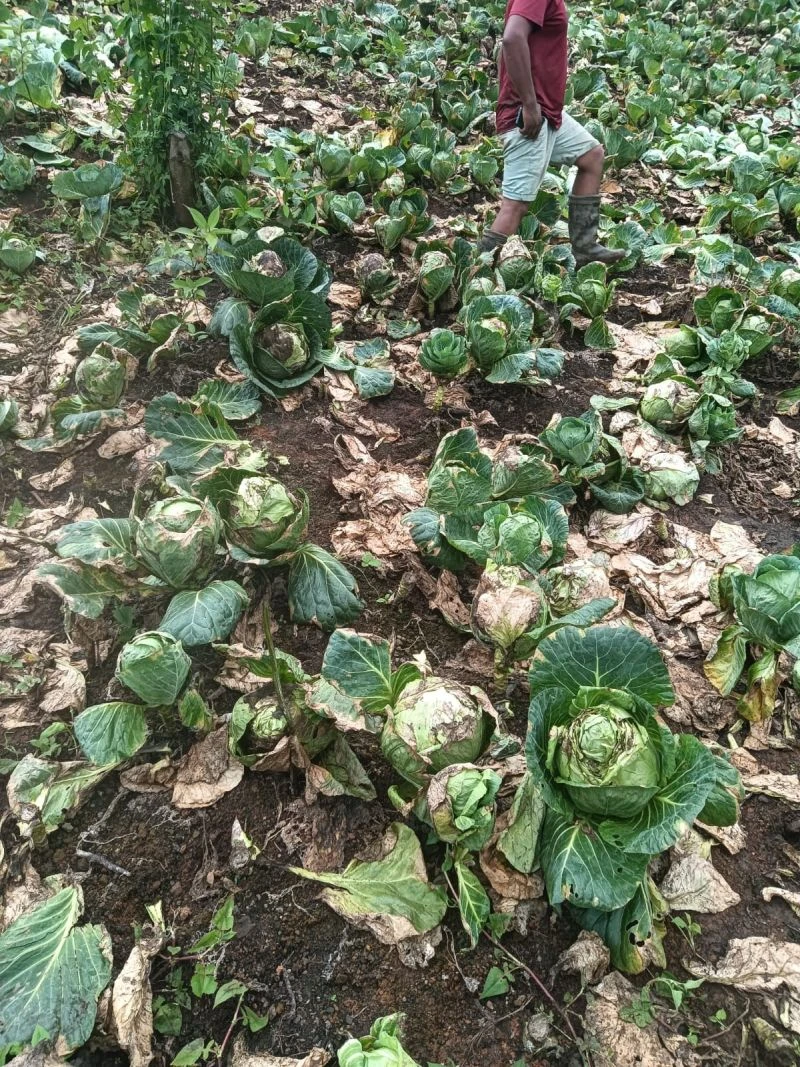
View of cabbages rotting away in the fields in Zhavame village for lack of buyers. (Photo Courtesy: Modongaolu Krocha)
Vishü Rita Krocha
Kohima | July 7
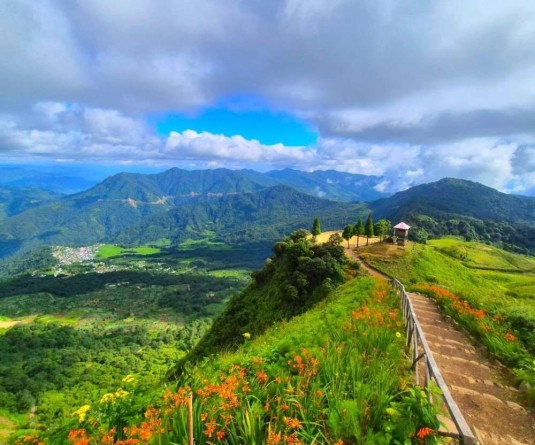
The perfectly aligned rows of lush, green cabbages that once adorned the foothills of Kapamodzü peak and the fields and valleys of Zhavame village now paint a picture of gloom even as acres of cabbage plantation are currently rotting away in the fields owing to the lack of proper market linkages and access.
Ever since Zhavame was declared a “Vegetable Village” by the Nagaland Horticulture Department in the year 2010, the village has been known for its organic produce of hundreds of metric tonnes of cabbage with almost every household engaged in the cultivation for the last two decades. Currently, more than 350 households cultivate cabbage, that has unmistakably enabled hundreds of farmers in the village to become self-sufficient.
Parents, who earlier struggled to send their children to school for lack of sufficient income, could afford to keep them in better schools and colleges while a good number of school dropouts have also found a new purpose in life even as they are hired for tasks such as packaging and loading.
Past records indicate that the revenue generated from the sale of these vegetables crossed Rs 50 lakhs during 2009-10 while the annual income was Rs 99.5 lakhs in 2010-11 and the year 2011-12 saw an annual income of Rs 1.5 crores and subsequently Rs 1.7 crores in 2012-13.
The village suffered immense loss during the COVID-19 pandemic. However, the pandemic also sparked a major shift in consumer habits, and increased the demand for organic vegetables, leading to the revival and surge of cabbage cultivation in the village.
The organic produce of cabbage in Zhavame has been consistent in the recent past until this season after severely being hit by marketing crisis.
41-year-old, Modongaolu Krocha, who has been associated with marketing the produce for the last 3-4 years related to The Morung Express that, “despite the quality of the cabbage being much better this year, it is really sad that we are facing this marketing crisis.”
“With the better quality produce, cabbage farmers were also expecting to sell better, and more,” he said.
As the last village bordering Manipur state, about 70% produce of Zhavame cabbages goes to Manipur while about 30% goes towards Kohima and Dimapur. However, the current ethnic tensions in Manipur state has severely affected the marketing of these produce, he pointed out.
With the imposition of travel restrictions from Senapati to Imphal, he highlighted that they have to travel via Ukhrul that takes about 12 hours, double the time as opposed to taking the main highway.
Last year, while a pickup truck, carrying about 70-80 bags of cabbages cost about Rs 12,000 per trip, this year, it has escalated to Rs 26000-Rs 30000 for a trip for about 60-65 bags.
‘If this crisis continues, it will be too big a loss’
For most years in the past two decades, buyers would come to Zhavame village and book the cabbage fields to further market them. Till last year, a bag of cabbage yielded a farmer Rs 700 if bought at the spot.
This year, a bag of cabbage has drastically dropped to Rs 180 containing an average of 40-45 kgs, highlighted Vivotso Domeh, Chairman of Zhavame Village Council even while reiterating that several of them are rotting in the fields.
“If this continues, it will be too big a loss for the village,” he remarked. Although the overall loss is very difficult to assess at the moment, VDB Secretary, Ngapunyi Albert Krocha cited the instance of the Pame Women who are cultivating cabbage together in a community land while highlighting that in such an instance, the group would be at a loss of about 7-8 lakhs of rupees. If individually counted, a single household earns at least Rs 40,000 annually from cabbage cultivation while others who cultivate on a larger scale earns more than a lakh, he impressed upon.
In Zhavame, either individually or collectively, cabbage cultivation is extensively carried out on community-owned land that spreads across a rough estimate of about 250 acres. Beyond this, many other households also cultivate cabbage in their own ancestral land.
Ngapunyi Albert Krocha further commented, “we have excess of cabbage even after feeding pigs.” This year, the cabbage season starting from May through October does not seem to hold much promise for the farmers. However, Krocha also exuded hope that the intervention of the government would change the course in the following weeks and months.
It may be mentioned here that an official team from the Phek District Horticulture Office also visited Zhavame Village today (July 7) to take a stock of the situation. The team also met with members of the Zhavame Village Council and also visited the cabbage fields.