Moa Jamir
Dimapur | August 15
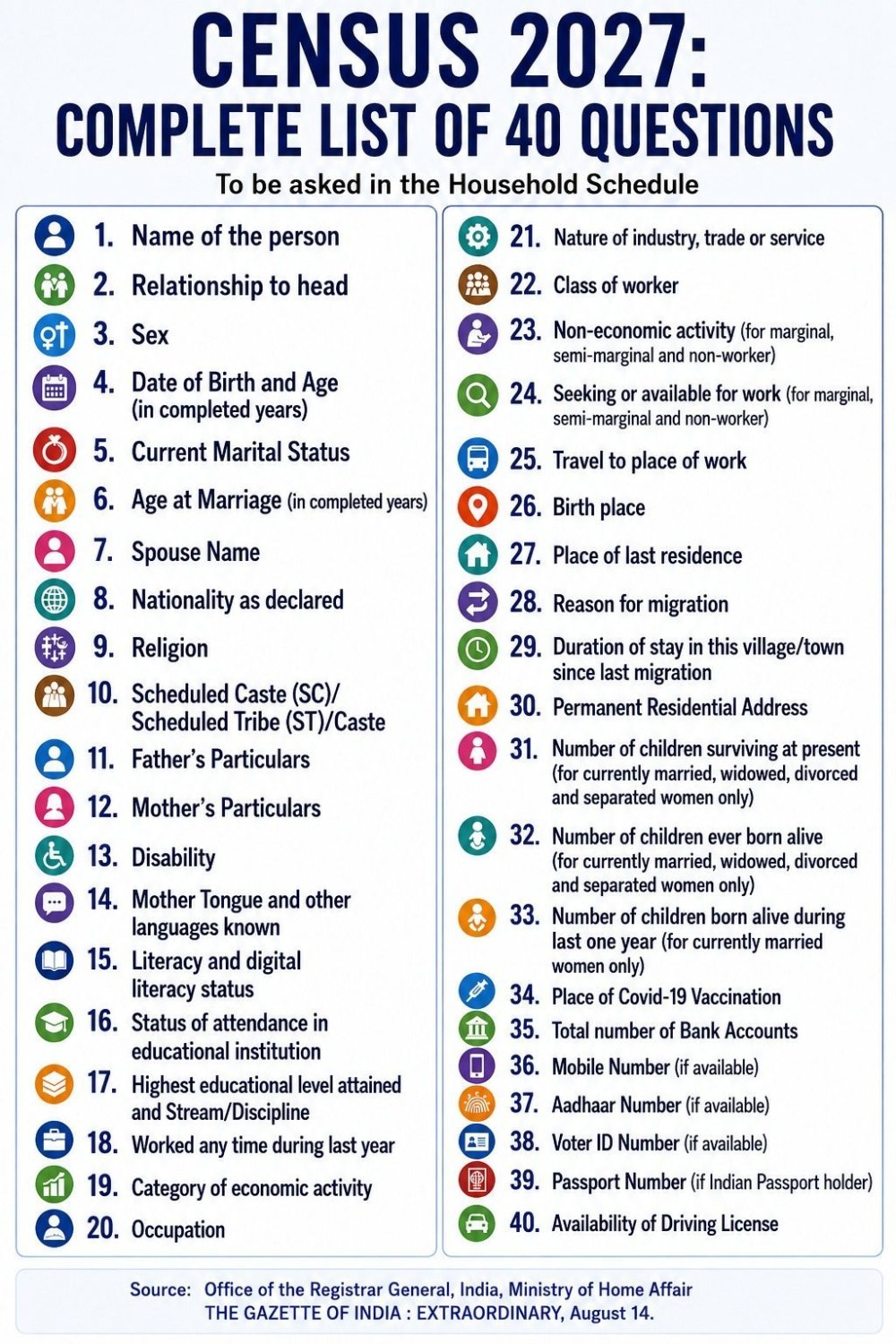
With the Office of the Registrar General (ORGI) notifying the 40 questions for Census 2027, will the expanded questionnaire and additional identity details help streamline Nagaland’s population count and address the State’s unusual census history?
The question assumes significance against Nagaland’s strikingly divergent population figures in the last two Censuses.
In the 2001 Census, Nagaland recorded a decadal population growth rate of 64.41%, the highest among all States in India, against the national average of 21.54% for 1991–2001.
A decade later, the demographic picture flipped dramatically. The 2011 Census recorded Nagaland’s decadal growth at -0.58%, making it the only State in India to register negative population growth during 2001–2011.
In effect, the State went from recording the country’s highest growth rate to its only negative one within a decade.
The 2001 figure was subsequently disputed and the Census officially ‘disowned’ by the State.
Nagaland has completed the first phase—House Listing and Housing Census, including self-enumeration. The second phase, Population Enumeration, is scheduled for February 2027, aspects of newly notified questions.
Nagaland has completed the training of 130 Field Trainers from all 17 districts, with more than 6,000 government officials expected to be engaged in the Census exercise.
Can the additional IDs improve the count?
Against this backdrop, and with the introduction of new parameters, the expanded Census exercise raises the question of whether it can streamline Nagaland’s unusual demographic trajectory.
The new schedule notified by the ORGI under the Union Ministry of Home Affairs contains 40 questions, compared with 29 in the 2011 Population Enumeration.
Alongside demographic, education, employment, migration and fertility details, it seeks information on spouse and parents, nationality, caste, digital literacy, educational stream, permanent address, COVID-19 vaccination, bank accounts and identity documents.
For Nagaland, Aadhaar and other identification details could provide additional verification points and potentially help detect duplicate entries. However, Aadhaar coverage remains incomplete.
According to UIDAI Aadhaar Saturation data as of July 31, 2026, Nagaland had a projected population of 22,94,000, against 15,39,767 Aadhaar numbers assigned and 14,34,571 live Aadhaar numbers, translating to 62.54% saturation.
Aadhaar, thus, cannot account for Nagaland’s entire population but, where available, could complement household and residence data to identify duplicate entries.
Meanwhile, Nagaland had little or 13.45 lakh voters as of January 1, 2025, and a Special Intensive Revision (SIR) of electoral rolls is currently underway, with October 1, 2026 as the qualifying date.
However, as the electoral roll is limited to eligible voters and subject to its own inclusion and exclusion criteria, reliance on voter records alone would provide an incomplete basis for population enumeration.
The new questions on bank accounts and mobile numbers also have limitations as verification parameters. As of March 31, 2025, Nagaland had 249 bank branches, 383 ATMs and 995 Common Service Points (CSPs), according to NABARD’s State Focus Paper 2026-27released in February 2026. However, nearly 72% of the State’s bank branches are concentrated in Dimapur, Chümoukedima, Kohima and Mokokchung.
Mobile numbers may similarly have limited value as a unique identifier. Data cited in The Indian Telecom Services Performance Indicators, January–March 2026, indicate 1.6 mobile/wireline subscriptions per person in the State.
But multiple-SIM ownership as well as wireline connections can make subscription numbers an unreliable proxy for the number of individuals.
Nagaland had achequered Census figure, the expanded 2027 questionnaire provides additional reference points for verification, but with data limitation, streamline the population count.
State Census authorities have urged cooperation with enumerators, reminding the public that furnishing false information during the Census is punishable under law. However, how the expanded questionnaire and verification measures are implemented on the ground will ultimately determine the quality and reliability of Nagaland’s 2027 Census data.
More questions, more concerns
The expansion to 40 questions has also raised concerns, with new fields covering spouse’s name, nationality, caste, parents’ particulars, digital literacy, educational stream, permanent address, COVID-19 vaccination, bank accounts and identity documents.
Some details, including Aadhaar, Voter ID and Mobile Number, are qualified by “if available”; how this qualification is communicated and observed will depend on field-level administration.
The caste question, recorded as declared, could pose classification challenges due to variations in names and spellings. Meanwhile, the scale of digital data collection raises privacy and data-security concerns, despite confidentiality safeguards under the Census Act, 1948. Questions on parents’ particulars and nationality have also revived discussion over similarities with earlier NPR exercises, although Census 2027 is a separate exercise.