

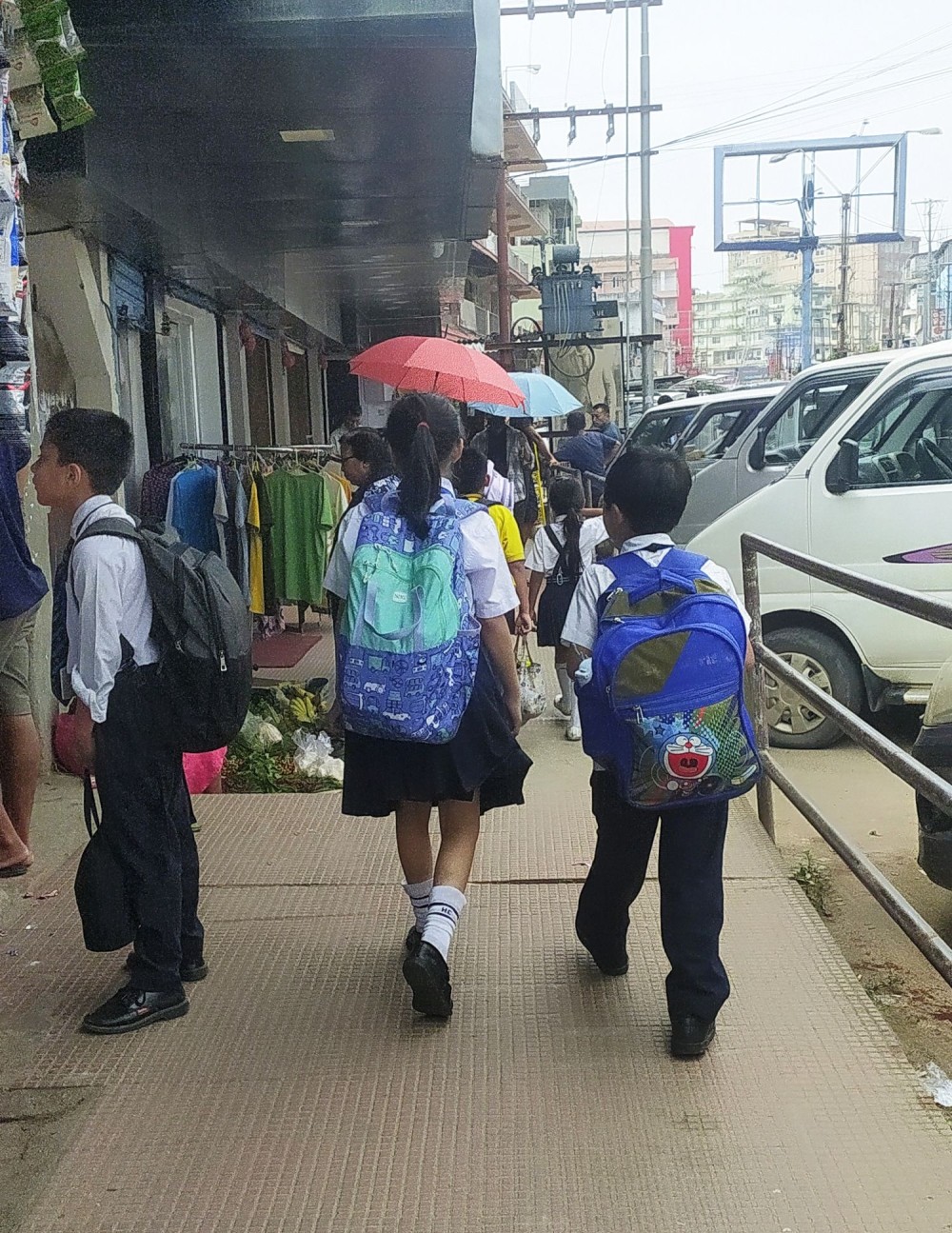
Students walking back home after school carrying heavy bags on their rather small backs. (Morung Photo | For Representational Purpose only)
Dr Pournamy
To witness a school going child without a school bag is quite uncanny. Every morning the child gets transformed into a beast of burden as he or she lugs minimum five kilograms of bag on their rather small backs. This is a problem that has been witnessed for generations, but little has been done about the same. It is not that this problem hasn’t been brought to the attention of political leaders. For instance, a Private Member Bill entitled Children’s School Bag (Limitations on Weight) Bill 2006, was placed for discussion in the Parliament but not much has been done about the same. Following this, High Court of Madras in its judgment in the case M. Purushothaman vs. Union of India had directed the Union to formulate a policy on Children’s school bag.
Policy Level Directives
Following this, an Expert Committee was set up to come up with recommendations on reducing the burden of school students as far as school bag was concerned. This committee was set up especially in pursuance of the directives that was received from the Honourable High Court of Madras and consisted of bureaucrats at the Joint Secretary Level as well as Academics from CBSE and SCERT. As per the Expert Committee’s report, up to class five, the school bag should not be more than 2.5kg. The Policy on School Bag itself states that the “very posture and the expression on the face of the child gives the impression that the bag is heavy for the child.” Infact, the ‘Learning Without Burden Report of’ (erstwhile) MHRD (now MOE) which came out in the year 1993, also known as the Yash Pal Committee Report indicated the ‘School bag as a source of physical discomfort besides the curriculum load.”
At the state level, the state of Maharashtra in the year 2015, took firm steps to reduce the burden of bags borne by students, for instance the state mandated that a child should not carry a bag that exceeds more than 10 percent of their weight, primarily with the aim of preventing injury to the children.
Even though International Organizations like American Occupational Therapy Association and American Physical Therapy Association have recommended, not carrying school bag heavier than 15 percent of the student’s body weight, not much has been done about the same, at the policy level or at the school level.
Moreover, despite studies showing that, ‘The school bag is a common cause of backache in school going children and that heavy bag causes children to lean forward thereby causing straining of muscles in neck, shoulder and back,’ various schools(both belonging to public sector and private sector) haven’t done much to address this issue. This can then have a ripple effect in the form of physical or mental disorders, or disabilities or nervous diseases from shouldering too much burden on one’s back.
Grimmer and Williams, 2000 study have shown that “the duration of carrying a school bag may increase the risk of adolescent back pain”, thereby implying that students who do not have access to school bus and have to walk several miles to access school, might have more chances of injuring their back and affecting their posture.( Koroveissis et al 2005, Siambenes et al 2005)
Studies done by Viry et al, have reportedly showed that student who walked to school have higher prevalence of back pain than students who were transported to school in a more passive manner.
In Indian Context: Rural-Urban Divide
This study when juxtaposed in Indian context goes to show that in rural areas students have to walk for longer hours through choppy terrain, in order to access schools which fall under the one kilometer radius as per Right to Education Act. Thereby increasing the share of burden for young pupils who don’t have easy access to school bus services. This also brings to fore the rural-urban divide as far as the case of Indian children is concerned.
NEP 2020 and The Thrust Towards Experential Learning
It is also interesting that in an era of experiential learning the child is being tied down to this heavy burden of books from which he or she cannot free themselves till they reach the stage of adulthood. With NEP 2020, focusing more in vocational skills, 15 days of bag less period can be encouraged for students, as they take time to intern and develop hand-on skills as carpentry, gardening and pottery. These skills can help them train as apprentices and learn attributes that they otherwise might not learn through bookish knowledge. Further these bag less days will help students and teachers to focus on holistic learning and growth rather than rote learning. Thus, it becomes essential to go beyond textbook and focus primarily on experiential based learning or problem based learning, thereby developing creative thinking skills.
Thus, to ease this burden the National Curriculum Framework 2005 had recommended flexibility in school time-table, implying that classes I and II will only have three subjects, while classes III-V will have four subjects and classes VI to X only six subjects. At the pre-primary stage there was supposed to be no textbook at all. While some schools have taken this issue into account and shifted to semester system or introduced locker system in schools, but still majority of the schools across the country are yet to transition to this model. With increase in every class the average weight of the school bag also increases in comparison. This is because, besides textbooks the students also carry lunch pack, water or energy drinks, notebooks that are thick in size, science or math’s kit and sports kit, library books, etc that add to additional weight on the students back.
Hence, the only solution to this is to have standardized bags like in the case of Japan called Randoseru, which has high functionality features and is easier on the back of the child. While other solutions suggested by the School Bag Policy of 2020 is concerned, it would include, ensuring that notebooks and copies are kept in school. Furthermore, weighing machines should be introduced in schools to ensure that school bags are adequately weighed from time to time to avoid any discrepancy in the weight. Ensuring that there is only one notebook for all subjects and thereby ensuring that going to school is more of an enjoyable and pleasurable experience rather than an ordeal or a chore.
The author is Assistant Professor in the Department of International Studies, Political Science and History, Christ University.

