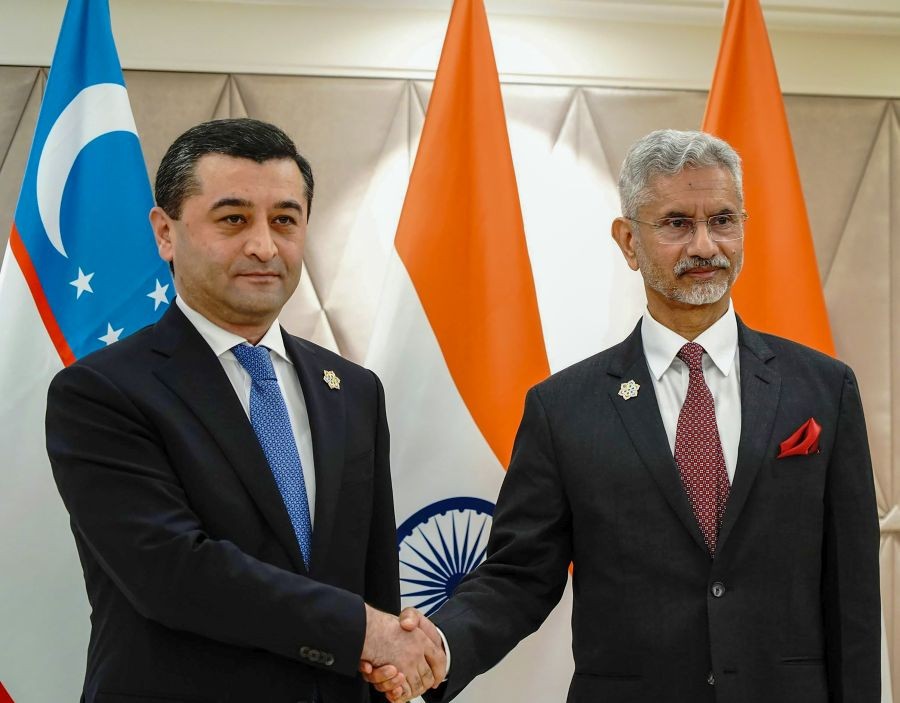
External Affairs Minister S. Jaishankar meets Republic of Uzbekistan Foreign Minister Bakhtiyor Saidov, in New Delhi on June 5, 2025. (IANS/X/@DrSJaishankar File Photo)
New Delhi, June 19 (IANS): India and Uzbekistan on Friday agreed to deepen trade ties, address the issue of non-tariff barriers and work towards doubling bilateral trade in the next three years, according to a statement issued by the Ministry of Commerce and Industry on Friday.
Rajesh Agrawal, Department of Commerce Secretary, co-chaired the 14th Session of the India-Uzbekistan Intergovernmental Commission on Trade, Economic, Scientific and Technological Cooperation with Shokhrukh Gulamov, Deputy Minister of Investment, Industry and Trade of Uzbekistan.
The meeting was held in Tashkent, with the Indian co-chair participating through video conference.
"The Commission discussed several product categories where Indian exports to Uzbekistan can be expanded. These include pharmaceuticals, medical devices, agricultural products, processed foods, agricultural machinery, engineering goods, electrical machinery, electronics, smartphones, automobiles and auto components, tractor accessories, textiles and textile machinery, chemicals, healthcare services, education services, tourism, logistics and other business services," the statement said.
The Commerce Secretary said that non-tariff barriers relating to approvals, standards, testing, certification, customs procedures and market-access requirements need regular review; and businesses need predictability, regulators need dialogue and standards bodies need direct contact.
A time-bound mechanism on resolving non-tariff barriers to trade would help convert goodwill into trade outcomes.
Both sides also recognised India's capabilities in agriculture and allied exports, processed foods, agricultural machinery, seed development, agricultural research and climate-resilient farming technologies.
Besides, the two sides discussed ICT and digital cooperation.
India highlighted its capabilities in IT, digital public infrastructure, telecom, fintech, cybersecurity, health services, digital education, engineering consultancy and digital logistics.
The Indian side suggested cooperating on customs data exchange and exploring interlinking of payment infrastructure for secure and efficient payments, with a view to supporting tourism, trade and commerce.
Energy was discussed as an area of strategic cooperation.
India noted that its fast-growing digital economy, including rising demand from artificial intelligence, data centres and advanced computing, requires reliable and clean baseload power.
In this context, ensuring critical minerals supply was identified as an important area for advancing India-Uzbekistan energy cooperation.
Both sides recognised that robust transport and logistics connectivity are essential for unlocking the full economic potential of the relationship.
The Uzbek side proposed sharing experience in digital logistics platforms and customs facilitation mechanisms.
Commerce Secretary Rajesh Agrawal invited Uzbek businesses to participate more actively in trade fairs, buyer-seller meets, investment forums and sectoral events in India.
Both sides agreed to encourage closer engagement between Chambers of Commerce, Export Promotion Councils, enterprises and sectoral bodies.
Both sides welcomed the sustained growth in bilateral trade. Uzbekistan reported that trade turnover with India reached $1.3 billion in 2025 (growth of 33.3 per cent over the previous year) and Uzbekistan's exports to India stood at $164.6 million (growth of 25.4 per cent), while its imports from India reached $1.15 billion, growing by 34.6 per cent. Indian exports to Uzbekistan have grown at a CAGR of 12.9 per cent over the last decade, while India's services exports to Uzbekistan stood at $372.2 million in 2024.
The Commission also agreed to hold the 15th meeting of the India-Uzbekistan Intergovernmental Commission in India on a mutually convenient date.