

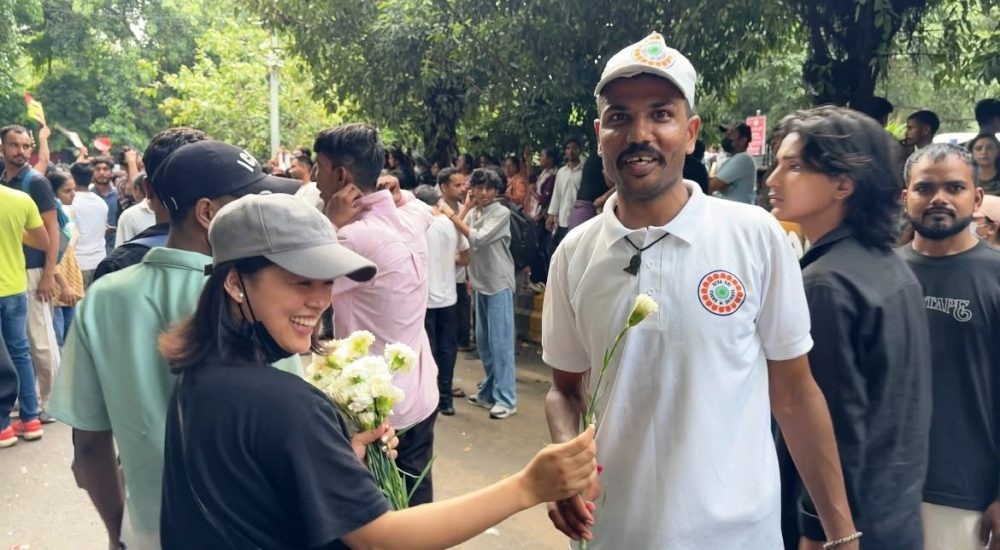
A Naga youth distributes flowers to protesters at Jantar Mantar, New Delhi, during the student-led protest.
Shinglai Thothuingam
Ph.D Scholar, JNU
The Union Education Minister Dharmendra Pradhan’s resignation and the subsequent appointment of Pralhad Joshi marks a rare instance where a government known for its unwillingness to back down under pressure was forced to concede. For weeks, the Cockroach Janta Party (CJP), a movement initiated by Gen-Z students on Instagram, turned satire, memes, and short-form videos into a powerful political force. What began as an online pushback against systemic examination failures culminated in ground mobilization at Jantar Mantar, hunger strikes led by world renown climate activist Sonam Wangchuk and a march toward Parliament. The protest did not confined in Delhi alone, but across major cities/states where it matter. The event raises critical questions about modern protest tactics, government responsiveness, and whether removing a minister actually fixes a broken system.
After much silence, the Prime Minister of India was compelled to release a video message, a signal of conceding to the young generation’s pressure. Traditional political opposition in India relies on organizational hierarchies, party flags, and predictable news-cycle dynamics, elements the ruling establishment has consistently countered successfully. The CJP movement disrupted this dynamic through several unique factors. Lacking formal political affiliation or electoral ambitions, the CJP made it difficult for the administration to frame the agitation as an opposition-sponsored ploy. Using memes, Instagram Reels, and social media trends, the movement bypassed traditional media filters. Complex institutional failures were communicated as shareable, relatable content that reached millions of affected students and parents. The adoption of self-deprecating satire, turning a disparaging remark into a badge of identity, deprived critics of traditional political targets. Facing an agile social media push alongside real-world disruptions, the government faced an expanding reputational risk among young voters, eventually choosing a tactical concession.
Every administration experiences cycles of political strength and vulnerability. Critics argue that the current government is showing signs of fatigue, citing inflation, currency fluctuations, and a revitalized opposition led by figures like Rahul Gandhi.
However, calling this a complete breakdown of governance oversimplifies the reality. Rather than systemic collapse, the event highlights a shrinking margin for error. In previous years, the government could absorb public pushback without making ministerial changes. Today, economic pressures and heightened political competition mean that youth discontent over employment and educational integrity carries higher political costs.
The high price of delayed Inevitable?
A central criticism of the handling of the protest is the delay the use of brute force by law enforcing agencies. Had the government acted earlier, significant state expenditure, police deployment, property damage, and hardship for thousands of student protesters could have been avoided. Relegating a minister immediately sets a precedent that public pressure can directly dictate Cabinet compositions. Administrations typically attempt to exhaust alternative options—such as police action, media management, or targeted negotiations—before making a high-level political sacrifice. The delay allows the minister to absorb the brunt of public anger before being replaced, shielding the broader executive leadership from direct fallout.
While politically strategic for the government, this approach shifts the cost onto the public through prolonged instability, disruption, and wasted public resources.
Is Dharmendra Pradhan the Real Culprit?
Focusing solely on the Education Minister overlooks deeper structural issues in India's examination framework. While ministerial accountability is a vital democratic principle, Dharmendra Pradhan’s exit does not automatically solve the systemic vulnerabilities surrounding national competitive exams. Agencies like the National Testing Agency (NTA) handle millions of candidates across vast geographic areas. Outsourcing exam infrastructure to private centers create structural vulnerabilities susceptible to local corruption. Paper leaks are often driven by organized syndicates involving local coaching hubs, print contractors, and administrative insiders operating for high financial returns. The disproportionate gap between available seats in top institutions and the vast number of applicants creates an environment where the perceived value of cheating remains high. Removing a minister provides a temporary political reset, but true resolution requires institutional restructuring, stricter oversight, secure digital infrastructure, and a reduction in the centralization of high-stakes entrance exams.
Can Social Media-Driven Movements Sustain Democracy?
The CJP agitation demonstrated that decentralized, internet-native movements can force accountability from powerful institutions. However, whether this model can sustain long-term democratic health remains uncertain. Social media movements excel at highlighting immediate crises and demanding single-point outcomes (like a resignation). They often struggle to sustain the long-term policy work needed to reform complex institutions once the initial social media interest fades. Without formal leadership or organizational structure, viral movements can easily be distracted, polarized, or co-opted by established political interests over time.
Conclusion
The CJP protest showed that digitally empowered youth can challenge institutional inertia and secure concrete outcomes. Yet, swapping a minister at the top does not automatically fix a flawed system. Unless the government and opposition move beyond short-term political victories to implement structural reforms in India’s examination systems, the underlying causes of student discontent will remain.

