Highlights waterway push in North-East
Morung Express News
Dimapur | January 30
Inflation in Nagaland has eased steadily over the past four years, falling to 2.79 per cent during April–December 2025–26, even as India continues to post strong macroeconomic performance with a projected 7.4 per cent real GDP growth in Fiscal Year 2026 (FY26), according to the Economic Survey 2025–26.
According to the Survey data tabled in Parliament on January 29 by the Union Finance and Corporate Affairs Minister Nirmala Sitharaman, Nagaland’s inflation trajectory shows a clear moderation over the medium term.
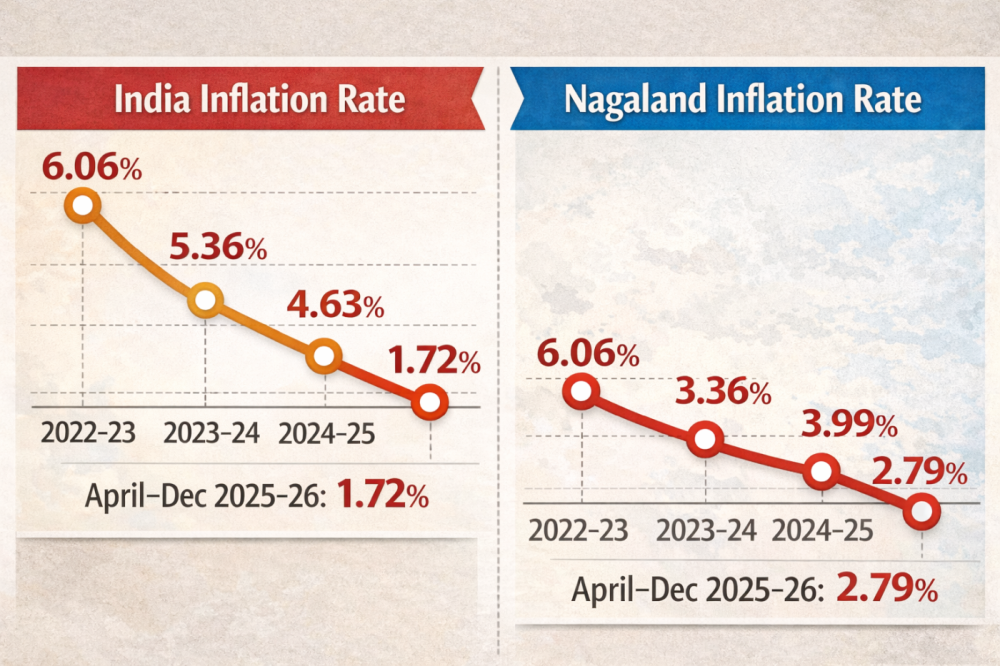
Inflation in Nagaland stood at 6.06 per cent in 2022–23, declined sharply to 3.36 per cent in 2023–24, rose marginally to 3.99 per cent in 2024–25, and eased further to 2.79 per cent in the current financial year (April–December).
The trend broadly mirrors the national pattern. At the all-India level, inflation declined from 6.66 per cent in 2022–23 to 5.36 per cent in 2023–24, moderated to 4.63 per cent in 2024–25, and fell sharply to 1.72 per cent during April–December 2025–26.
Nagaland’s rate, however, was the highest among the North-Eastern states, with most maintaining inflation levels below the national average of 1.72 per cent.
Incidentally, Manipur recorded (-)0.15 per cent, indicating mild deflation, while rates were marginal in Assam (0.16 per cent), Tripura (0.57 per cent) and Meghalaya (1.50 per cent).
Along with Nagaland, inflation was above the national average in Sikkim (2.45 per cent) and Mizoram (2.47 per cent). Arunachal Pradesh data was not reported in the Survey.
Inland waterways
The Economic Survey highlighted that, as of November 2025, 32 National Waterways (NWs) were operational, spanning 5,155 km, with cargo operations on 29 NWs, cruise operations on 15 NWs, and passenger services on 23 NWs. As many as 11 NWs support all three modes, reflecting strong multimodal integration.
In the North-East region, Inland Water Transport (IWT) projects are underway on NW-2 and NW-16, while Detailed Project Reports for Nagaland and Mizoram are under finalisation, it noted.
Tripura is implementing a ₹24.53 crore project to connect the Gumti River with the India–Meghna river system, strengthening linkage with Bangladesh, it added.
It must be noted here that after the 3rd Inland Waterways Development Council meeting held in Kochi on January 23, Nagaland Power and Parliamentary Affairs Minister K G Kenye informed that the Tizu–Zungki river had been declared National Waterway–101.
Welcoming the declaration, he urged the Inland Waterways Authority of India to implement the project with due seriousness, citing its strategic location along the India–Myanmar border and its potential to boost trade and commerce with Southeast Asian countries.
The minister further sought the extension of waterways from Lakhimpur to Nagaland through the Barak River and submitted a separate representation for the development of water bodies in the state.
Grassroots finances remain weak
Meanwhile, the Economic Survey flagged persistent weaknesses in grassroots-level finances across several states and Union Territories, noting that Panchayati Raj Institutions (PRIs) remain heavily dependent on grants from the Central and State Finance Commissions, limiting their ability to meet public expectations.
Although several states and UTs have framed rules enabling Panchayats to levy and collect taxes, duties and fees, many, including Nagaland, do not have such provisions, it highlighted, underscoring the importance of strengthening Own Sources of Revenue (OSR) to improve efficiency, accountability and service delivery at the local level.
However, it must be noted here that Nagaland does not have PRIs as envisaged under the 73rd Constitutional Amendment. Village-level governance in the state is carried out through Village Councils functioning under customary practices, and the Survey’s observation is made within the framework of a national PRI system.