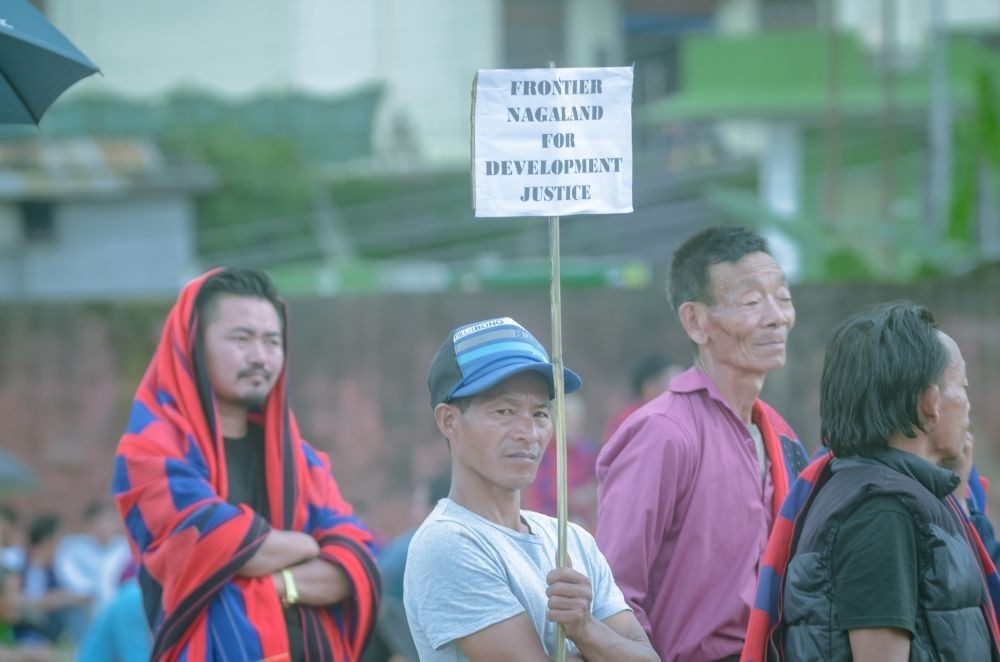
A man holds a placard during a rally demanding establishment of the Frontier Nagaland Territory. (Morung File Photo)
Powers, limits, finance, jobs, cultural promotion, performance reviews
Morung Express News
Dimapur | March 5
Previously, on March 3, The Morung Express published a report featuring a condensed outline of the Memorandum of Agreement (MoA) that was signed on February 5, 2026, between the Union Ministry of Home Affairs (MHA), Eastern Nagaland People’s Organisation (ENPO) and Nagaland state government for establishing the Frontier Nagaland Territory (FNT).
Among the points featured included a Rs 5,000 crore development package and plans for a 62-member Frontier Nagaland Territorial Authority (FNTA) with seats reserved for women. It also highlighted several infrastructure projects.
Here is a follow-up, providing a peek into the objectives and other clauses.
Core objectives
The MoA defined the establishment of the FNTA as a move toward “democratic de-centralised self-governance.” The document lists five core objectives, including the fulfillment of social, political, and linguistic aspirations of the people of Eastern Nagaland. It noted the “geo-strategic-security importance” of the FNT, stating that the agreement aims to safeguard national security interests along the international border. Central to the objectives is a performance review provision of the FNTA after 10 years “to assess its efficacy to fulfill the aspirations of the people.”
Legislative & Executive
The MoA defined the limits of the FNTA’s legislative power. While it can make laws on 46 transferred subjects, these laws will not take effect until they are forwarded to the Governor and published in the official gazette. In the event of the FNTA failing to discharge its functions, the Governor may dissolve/suspend FNTA on the recommendation of the state government, and appoint an interim “Administrator.”
The membership of the FNTA’s Executive Council will be limited to a maximum of 9 members. It explicitly excludes ex-officio members (MLAs) from holding positions in the Executive Council.
Transferred subjects
The list of 46 subjects transferred to the FNTA includes management of customary courts, regulation of money lending by entities, other than banks, collection of land revenue and local taxes, and supervision of Village Councils and Urban Local Bodies.
In the natural resource sector, the FNTA will take oversight of water resources, and forests not classified as reserve forests. The subject of “Geology and Mines” will remain under the state government with a regional office set up under the FNTA.
It will manage renewable energy, mini-hydel projects, and power distribution, though all revenue from power bills will be deposited into the state exchequer.
Infrastructure and public service responsibilities include district roads, primary healthcare, and school education. The transfer also includes regional trade, and the promotion of local tourism and cottage industries.
Designated Regional Heads will be set up to supervise the Rural Development sector; and Planning, Coordination, Development and Statistics. The FNTA may set up its own Bamboo Mission project.
Financial management
The section on ‘Financial Autonomy’ outlines a framework for oversight between the state and the FNTA. “The State Government shall not divert funds earmarked to FNTA by allocating/sub-allocating it for other purposes,” it stated. Sharing of development outlay for the FNT will be proportional to its population and area.
All developmental funds allocated to the FNTA will be subject to audit by the Comptroller and Auditor General. Audit reports, along with an Action Taken Report, must be placed before the state Assembly at the close of each financial year. The CES of the FNTA will be vested with the sanctioning powers of an administrative Head of Department.
Jobs & vacancies
The MoA mandates the state government to constitute a committee to identify the number of backlog vacancies in various grades. The vacancies are to be filled based on the existing reservation policy for the 8 indigenous tribes of the FNT.
As per this section, the army, paramilitary, and Central Armed Police Forces (CAPF) will organise recruitment rallies, while the Government of India “may consider establishing a CAPF battalion” for the youths of the FNT.
Village Guards
The FNTA will be tasked with modernising and preserving the heritage of the Village Guards — a force founded in 1957 in Pangsha village, now in Noklak district. It involves restructuring, recruitment, and updating weaponry and training. The process will be carried out in consultation with and financial assistance from the MHA.
Education & cultural
The MoA further lists several specialised institutions. These include a Nursing College, a Hotel Management Institution, an Agricultural University/Research Centre, and a Research Centre for Herbal Medicines and Ayurvedic Hospital. The state government and FNTA will ensure the promotion of tribal languages in educational institutions in the FNT, alongside English and Hindi.
Oversight
A Joint Monitoring Committee (JMC) will be established to monitor the execution of the MoA. This committee, comprising representatives from the MHA, state government, FNTA, and ENPO, will be responsible for undertaking periodic reviews. The Governor will submit a report to the President of India, annually.
Background
The MoA followed a two-decade agitation by the ENPO, which represents the Phom, Konyak, Yimkhiung, Sangtam, Chang, Tikhir, Eastern Sumi and Khiamniungan from the districts of Tuensang, Mon, Longleng, Kiphire, Noklak and Shamator. The ENPO submitted a memorandum for a separate state in November 2010, citing “socio-economic backwardness.” In July 2011, a state government committee recommended, to the Central government, the formation of an “autonomous council/authority.”