Moajungshi Menon
Dimapur
Every morning in Nagaland, fewer hands reach for a newspaper while more fingers scroll through a smartphone. News now arrives in seconds through WhatsApp groups, Facebook posts, YouTube channels, and online news portals. Information is available at the touch of a screen, often long before the printing presses begin to roll.
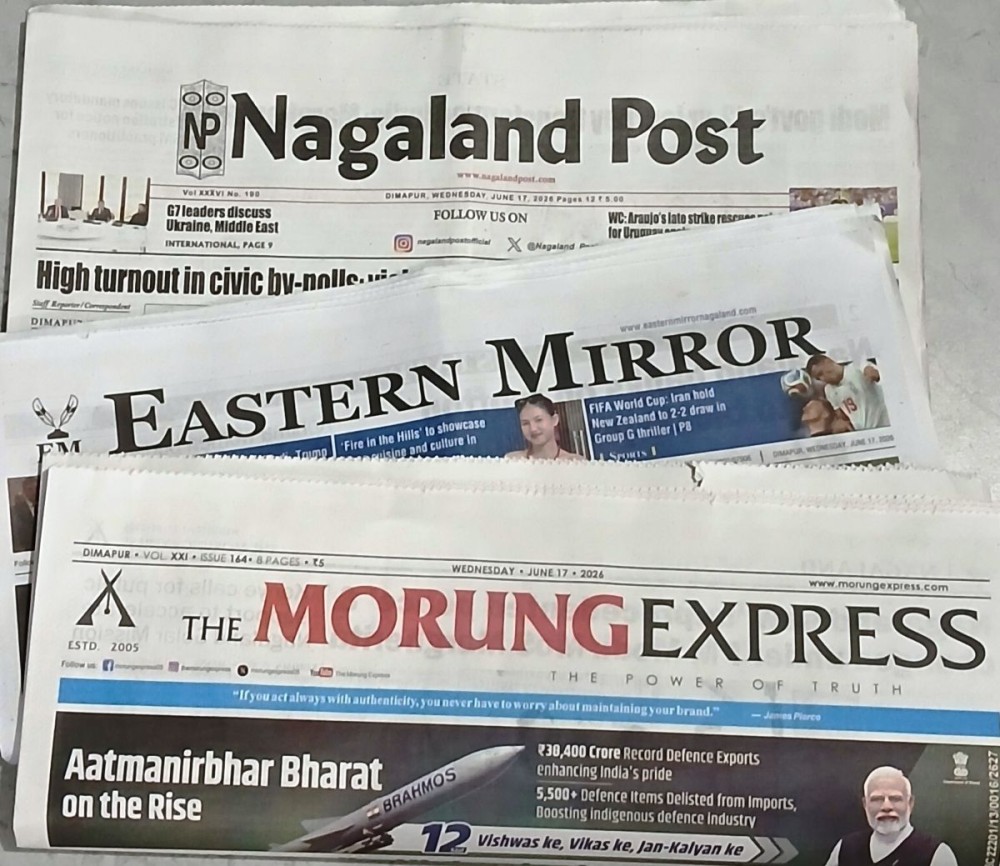
For a state with a population of just over two million people, this transformation raises a profound question: Can print media in Nagaland survive in the age of social media? At first glance, the answer may appear pessimistic. Newspapers across the world are facing declining readership, shrinking advertising revenue, rising operational costs, and fierce competition from digital platforms. Nagaland is no exception. Yet the survival of print media is not merely about sustaining a business model; it is about preserving one of the pillars of a democratic society.
For decades, newspapers in Nagaland have been more than just sources of information. They have been platforms for public discourse, social reform, political debate, and community engagement. They have amplified voices from remote villages, highlighted public concerns, and documented the aspirations of the people. In many ways, newspapers have served as the collective memory of Naga society. Their contribution extends beyond routine reporting. Newspapers have provided an important platform for public discussion on the Naga political issue, one of the most significant subjects in the state's history. Through editorials, opinion pieces, and public debate, they have helped citizens engage with complex political developments while preserving diverse viewpoints within Naga society.
Today, however, the industry finds itself at a crossroads.
Financial Sustainability in a Small Market
One of the greatest challenges facing print media in Nagaland is financial sustainability. Unlike newspapers in larger states that cater to millions of readers and attract substantial advertising revenue, newspapers in Nagaland operate within a limited market. The state's relatively small population naturally restricts circulation and commercial advertising opportunities. As a result, many publications depend heavily on subscriptions and government advertisements. While such support is important, dependence on a narrow revenue base creates financial vulnerability.
The closure of Nagaland Page after more than two decades of publication serves as a reminder of the economic realities confronting the industry. If a well-established newspaper can face financial difficulties, the sustainability of smaller publications becomes an even greater concern. Rising costs of newsprint, printing, transportation, and distribution have further intensified these pressures.
To sustain newspapers must diversify their revenue streams through digital subscriptions, sponsored public forums, educational initiatives, business partnerships, and community events. Sustainability in the twenty-first century requires innovation as much as journalistic excellence.
Declining Readership and Changing Habits
Another major concern is the gradual decline in newspaper readership, particularly among younger generations. Today's youth consume information through smartphones, short videos, social media feeds, and digital platforms. The traditional habit of reading a newspaper is slowly disappearing. If newspapers fail to attract younger readers, they risk losing not only their audience but also their future relevance.
The Way Forward: Newspapers must meet readers where they are. Digital editions, mobile applications, podcasts, newsletters, and interactive content can help bridge the gap between traditional journalism and modern media consumption. Schools and colleges should also encourage newspaper reading as a means of developing critical thinking and informed citizenship.
The Loss of Advertising Revenue
Advertising has long been the financial backbone of the newspaper industry. Today, businesses increasingly favour digital advertising because it is cheaper, faster, and capable of targeting specific audiences. Consequently, newspapers are experiencing a steady decline in advertising revenue.
The Way Forward: Newspapers must evolve from being purely print platforms into integrated media brands. By offering combined print and digital advertising packages, they can provide advertisers with both credibility and influence. Trust remains a valuable commodity, and newspapers still enjoy a level of public confidence that many online platforms struggle to achieve.
Speed Versus Accuracy
Perhaps no challenge better illustrates the changing media landscape than the battle between speed and accuracy. Social media excels at speed. News can spread across the state within minutes. Photographs, videos, and eyewitness accounts often reach thousands of people before journalists have had an opportunity to verify the facts. Newspapers, by contrast, require time. Facts must be checked, sources verified, and reports edited before publication. This often creates the impression that newspapers are slow and outdated.
Yet speed without accuracy can be dangerous. The true value of journalism lies not in being first but in being right. At this point newspapers should embrace their role as providers of verified information and thoughtful analysis. While social media may break the news, newspapers should explain it. Accuracy, context, and credibility must become their defining strengths.
The Challenge of Free Content
The digital revolution has also created a culture where information is expected to be free. Many readers question why they should pay for newspaper subscriptions when similar information appears online at no cost. However, quality reporting requires trained journalists, editors, field reporting, fact-checking, and financial investment.
The Way Forward: Newspapers must offer content that readers cannot easily find elsewhere. Exclusive interviews, investigative reports, in-depth analysis, and hyper-local stories can provide unique value. Readers may not pay for information that is available everywhere, but they will pay for information they trust and cannot obtain elsewhere.
Misinformation and the Crisis of Truth
Perhaps the greatest challenge facing modern journalism is the rise of misinformation and fake news.
Rumours, manipulated images, misleading narratives, and unverified claims can spread rapidly across social media platforms. In a closely connected society such as Nagaland, misinformation can quickly generate confusion and mistrust. Ironically, while misinformation increases the need for professional journalism, it also makes it harder for newspapers to compete for public attention.
The Way Forward: Newspapers must position themselves as guardians of truth. Rigorous fact-checking, ethical reporting, and public education on media literacy are essential. In an age of information overload, credibility is not merely an advantage, it is a necessity.
Why Investigative Journalism Matters
If print media is to remain relevant, it must focus on what it does best which is holding power accountable.
Investigative journalism remains one of the most powerful tools available to the press. Around the world, investigative reporters have exposed corruption, misuse of public funds, abuse of power, and institutional failures.
Nagaland presents numerous areas where responsible investigative journalism can serve the public interest. The condition of roads connecting districts such as Mon, Kiphire, Longleng, and Noklak, the functioning of government schools and healthcare centers in remote villages, and the implementation of development schemes all warrant closer scrutiny.
When a road remains incomplete despite sanctioned funds, when a school lacks basic facilities despite government allocations, or when public projects fail to deliver promised outcomes, citizens deserve answers. The purpose of investigative journalism is not to sensationalize allegations but to uncover facts and present evidence-based reporting. Such journalism strengthens transparency, accountability, and public trust.
In a democracy, accountability cannot function without scrutiny, and scrutiny cannot function without a free and independent press. For newspapers in Nagaland, investigative journalism may well be the key to future relevance. Social media can report what happened. Investigative journalism explains why it happened, who is responsible, and what can be done about it.
Moreover, consistent investigative reporting can help rebuild and sustain readership. When newspapers regularly publish well-researched stories that uncover facts, expose irregularities, and highlight issues affecting ordinary citizens, readers begin to view the publication as an indispensable source of information rather than just another provider of daily news. A report that reveals how public funds are being utilized, why a development project remains incomplete, or how a government scheme is impacting communities can generate public interest and meaningful discussion. Such journalism gives readers a reason to return to the newspaper, not merely to learn what happened, but to understand why it happened. Over time, this credibility and depth of reporting can foster reader loyalty, strengthen public trust, and distinguish print media from the often fleeting and unverified content found on social media platforms.
Adapting Without Losing Identity
The future of print media does not lie in resisting technological change but in adapting to it without compromising journalistic principles. Newspapers must embrace digital tools while preserving the standards that distinguish journalism from mere content creation. They must invest in investigative reporting, strengthen editorial independence, train the next generation of journalists, and remain committed to accuracy and fairness. Most importantly, they must continue to earn the trust of their readers.
The future of print media in Nagaland will not be determined by how quickly newspapers can compete with social media, but by how effectively they can provide what social media often cannot which is credibility, depth, accountability, and trust.
In an era flooded with instant information, rumours, and competing narratives, the value of verified journalism has never been greater. Newspapers that invest in investigative reporting, expose corruption, scrutinize public policies, and amplify the concerns of ordinary citizens will continue to remain relevant, regardless of technological change. More importantly, such journalism will give readers a reason to return not merely for information, but for understanding. The survival of print media is therefore not simply a question of economics or technology. It is a question of whether society still values truth over speculation, evidence over rumours, and accountability over silence.
For Nagaland, the stakes are particularly high. In a state where development challenges persist, where public institutions must remain accountable, and where informed public discourse is essential for progress, a strong and independent press is not a luxury but it is a necessity. The future of print media may be uncertain, but its purpose remains clear. As long as newspapers continue to uphold the principles of truth, integrity, and public service, there will always be readers who seek more than headlines. They will seek understanding, accountability, and trust.
In the end, newspapers may no longer be the fastest source of news, but they can remain the most trusted. And in any democracy, that is a role worth preserving.