The festival has travelled, changed, and acquired new meanings. But its central gesture remains the same: to feed, to gather, to remember, to offer respite, and, for a day, to make the lives of girls visible.| Picture courtesy: Thujo Swuro
Celebrated by Chakhesang people in Porba, KhuKhu Nye is a day of joy and collective care. For girls and women, the recognition and respect it brings must outlast the festivities
Kuvethilu Thuluo
India Development Review
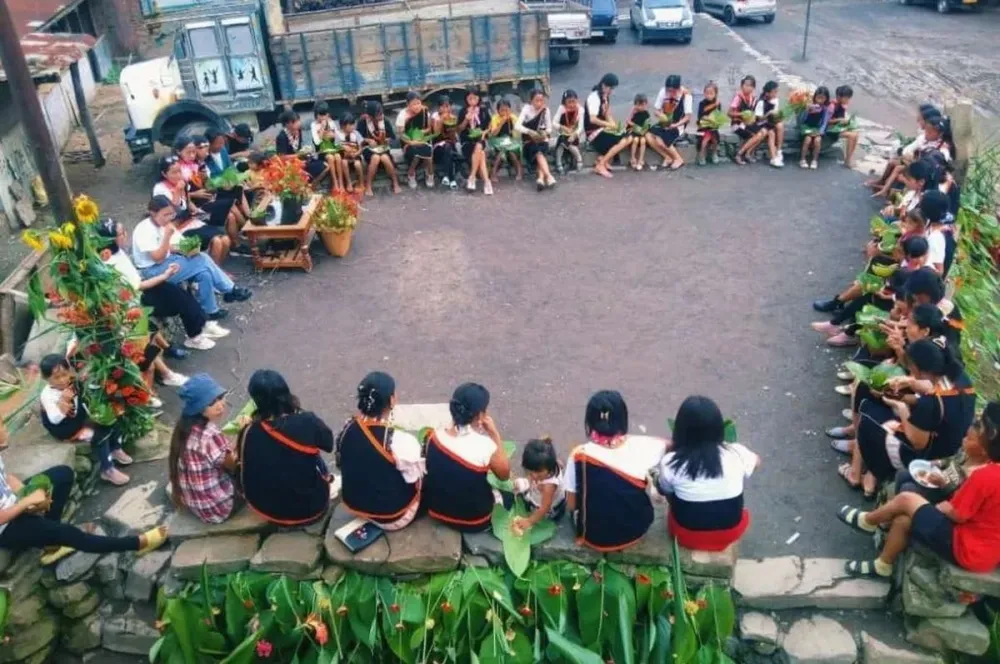
In August, or Türhi as it is called here, the Chakhesang community in Porba village observes Khukhu Nye. Ushered in by the full moon, the festival celebrates girls and women who are yet to be married.
On the day of the festival, unmarried women and girls play games, eat, sing, dance, share stories, and make merry. The venue is decorated with banana leaves, ginger lilies, and other foliage and blooms.
Khukhu Nye traces its origin to a folktale about Thüyipü, a woman who descended from heaven and was forced into marriage by a man. Thüyipü managed to return to heaven on the promise that she would bring her children with her but was ultimately unsuccessful, and the children were left orphaned and abandoned. Within this tale also lies the story of a community that repents for ostracising the two children and learns to care for them.
The festival came to be in remembrance of this story.
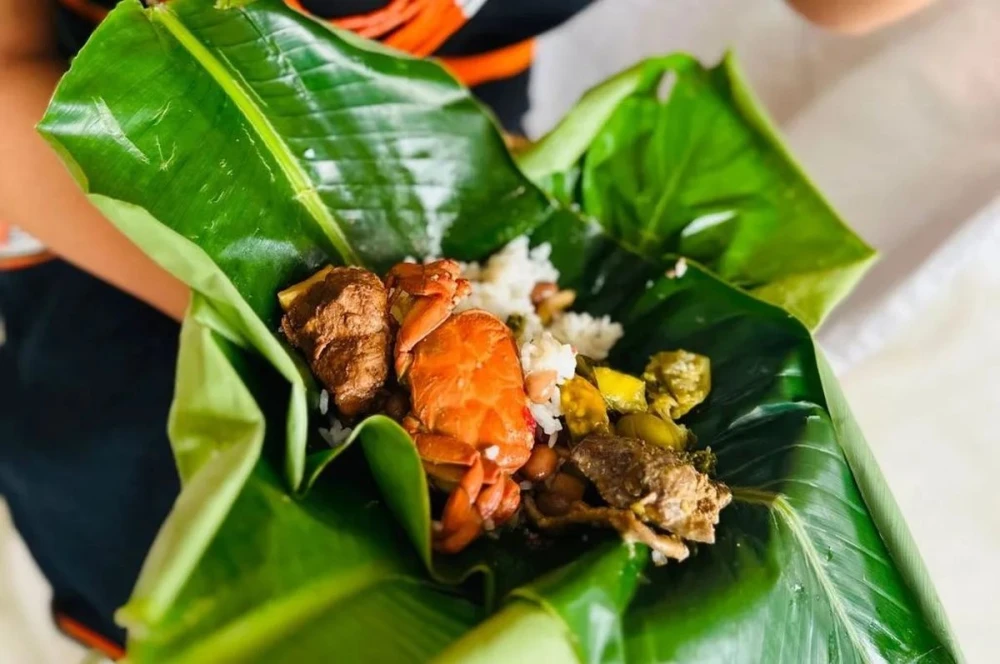
Food is a key part of festivities. Cowhide, beans, bamboo shoots, and crab are cooked for the occasion, and relatives serve the food to girls on woven bamboo plates lined with banana leaves. Girls eat up to 10 plates of food over the course of the day, but in small portions. It is believed that they do not seem to get full because they share the food with Thüyipü.
A lore at the centre of transformation
The festival was once observed over two days, with Thüyipü Khukhu on the first day and Thüno Khukhu on the second day. Thüyipü Khukhu involved intricate rituals tied to the community’s animist ways of life. With the conversion to Christianity, these practices are no longer observed. Today, only the second day, Thüno Khukhu, is celebrated and is called Khukhu Nye.
The image of Thüyipü itself has also changed with religious transformation in the community. Earlier, when people from Porba followed animist beliefs, Thüyipü was understood as a benevolent spirit. She was said to have long hair reaching her waist, and she would enter houses through the roof. Hosting her was believed to bring wealth to the household. Now, she is treated more like a fable rather than a powerful entity that could transform people’s lives. Yet the significance of Khukhu Nye has not diminished.
A moment of respite and joy
Traditionally, Khukhu has also been tied to the place of girls within the household.
Before marriage, daughters and sisters carry responsibilities including caring for younger siblings, doing household work, serving male family members, and helping their parents in the fields.
“In our patriarchal society, women are often not given equal opportunities as their male counterparts,” says Vechüloü Kanuo, former Executive Director of the Chakhesang Women Welfare Society (CWWS). As families already struggling with limited resources tend to prioritise male children, Khukhu provides “a boost or a pathway to improve girls’ self-esteem and gives brothers and fathers an opportunity to show their love and respect to their sisters and daughters,” she adds.
A daughter’s life spent at her parents’ house is seen as temporary. After marriage, girls leave their natal family and become a member of their husband’s family, assume their surname, take on new roles and responsibilities, and build a lineage completely separated from the one they came from. Khukhu offers a day of respite before this transition, a day to eat, play and be cared for.
“We have many festivals, but Khukhu is the only festival I know of that is exclusively for girls and women,” Kanuo says.
After several visits to Porba revealed the significance of the festival, the CWWS resolved to recognise Khukhu as a Chakhesang festival for unmarried women and girls during the Annual General Assembly at the Lozaphuhu Baptist Church in 2018. The resolution encouraged villages to observe the festival as well. “Not everyone can adopt the festival in one go, but we hope that, in formally recognising it, others, especially in Chakhesang areas, would adopt this good practice of celebrating women and girls,” she adds.
Viswema, an Angami village in Kohima district, also celebrates a version of Khukhu called Te-L Khukhu with differences in timing and folklore but similarities in its emphasis on women, food, games, and celebration.
A tradition carried from village to town
As women from Porba have moved to urban areas for education and to work, they have carried Khukhu to towns such as Pfütsero and Kohima. In Pfütsero, the festival has been celebrated as a community gathering for years. Even when there is no community celebration, women from Porba continue the practice within their households, serving food to girl children in their immediate and extended family.
The move from the village to towns has also changed who participates in Khukhu and what it means. In the village, it is largely reserved for unmarried women, while celebrations in towns can include mothers as well and have, in many ways, expanded to encompass a celebration of womanhood. Urban celebrations often include formal programmes, prayers and speeches, and shared food.
In Kohima this year, the Porbami Social Club Kohima (PSCK) Thunoko Krotho (women’s organisation) continued their yearly celebration of Khukhu Nye.
For Zühhüvolü Sakhamo, a 40-year-old woman now settled in Kohima, “In the villages, it is a time for far and near relatives to reconnect. But here, it is a time for people who have moved away from Porba to meet and get to reconnect with each other. They also learn about traditional games, folk songs, stories and other aspects of our culture and traditions.”
For Lütsülü Chiero, a young woman from Kohima who has celebrated Khukhu for as long as she can remember, the festival is “very important and meaningful because in a society that ties the value of a woman to being a daughter, wife or sister, this is a celebration of a girl for being a girl. Khukhu is an alternative message about how girls can be valued.” Being served plates of food every year by her relatives and loved ones, she says, “brings joy and pride in being born a girl.” Over time, these gestures have strengthened her sense of cultural identity and self-worth.
Lütsülü also believes the meaning of the festival must extend beyond the day itself. “Even though there is celebration, if we don’t give a girl child equal love, respect, opportunity, and safety in society, the festival may become mere symbolism.”
This sentiment is even more meaningful given that the celebration, and the day of leisure it affords girls, is made possible through the work and care of women.
From a day of reverence to enduring recognition
Zacüvelü Chiero, a woman who had migrated with her husband and children from Porba village to Kohima, recalls how during every Khukhu, mothers would spend the whole day preparing, cooking and serving food.
At Khukhu, the food, games, and relaxation are therefore inseparable from the labour that makes them possible. One day of celebration does not alter the unequal distribution of work women carry through the rest of the year. It does, however, create a recognised space in which girls and women receive care and attention.
This also brings us back to the story of care that lies at the heart of Khukhu—a community that neglected two hungry children and later sought reconciliation with Thüyipü by offering food.
Today, girls still receive food from relatives. Women gather from near and far. Games are played and songs are sung. The festival has also travelled, changed, and acquired new meanings. But its central gesture remains the same: to feed, to gather, to remember, to offer respite, and, for a day, to make the lives of girls visible.
As Kanuo puts it, Khukhu “may not necessarily be an empowerment, but definitely it is encouragement”—a nudge to see women for who they are and who they can be.
Note: The general concept and folktale of the Khukhu Nye festival in this piece is based on the story shared by Shekhozo Thuluo at the Khukhu Nye event in Kohima in 2026, and the booklet on Khukhu Nye written by Velakho Sakhamo for CWWS.
Kuvethilu Thuluo is a 2026–27 IDR Northeast Media Fellow. She is a 2026 graduate of the Young India Fellowship at Ashoka University and has previously worked as a teacher. Kuvethilu is based in Nagaland.
This article was original published by India Development Review.
https://idronline.org/article/gender/khukhu-nye-how-a-nagaland-village-celebrates-women/