Naga Ancestral Remains Return Home from the Pitt Rivers Museum: Revisiting a Colonial History
Colonel Prakash Bhatt (Retd)
The return of Naga ancestral remains from the Pitt Rivers Museum at the University of Oxford marks an important moment in the history of the Naga people. It is not merely a matter of returning objects held in a museum collection; it is about restoring ancestors to their homeland, acknowledging historical injustices, and recognising the dignity and cultural significance of human remains.
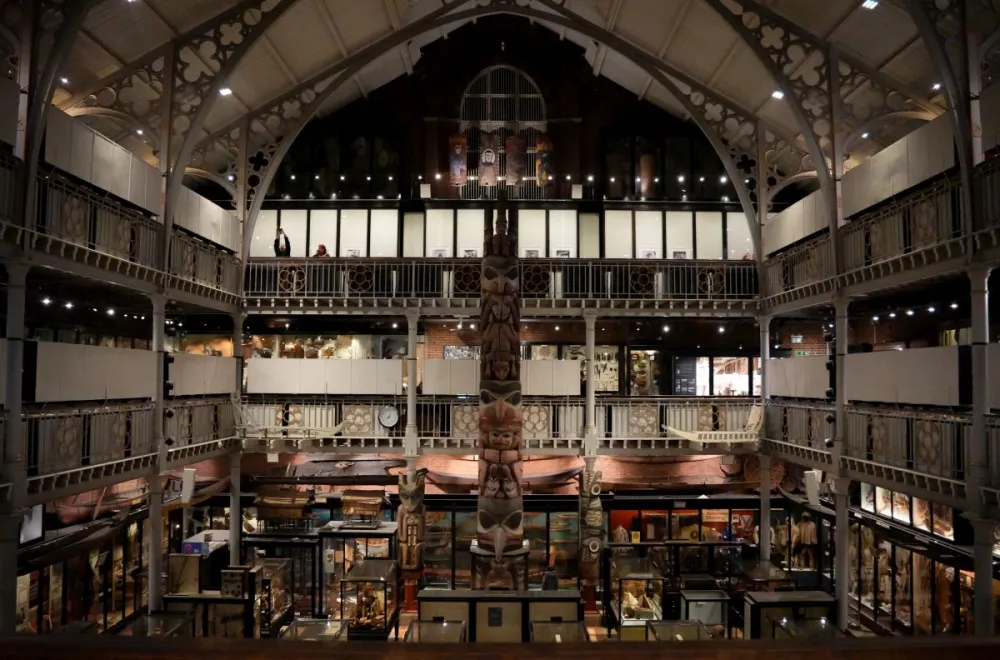
In 2020, the Pitt Rivers Museum closed temporarily due to the COVID-19 pandemic. During this period, a decision was taken to remove displays of shrunken heads and other human remains that had been exhibited since the 1940s, as part of the Museum's decolonisation efforts. This decision, together with the Museum's wider commitment to change, opened the door to conversations that had previously not been possible. Since then, the Museum has worked collaboratively with Naga partners, particularly the Forum for Naga Reconciliation (FNR), and other organisations across the Naga homeland to determine how their ancestors should be returned.
The Pitt Rivers Museum and Its Colonial Collections
The Pitt Rivers Museum houses the archaeological and anthropological collections of the University of Oxford. Founded in 1884, it began with a donation of approximately 22,000 objects by Lieutenant General Augustus Pitt Rivers. Born Augustus Henry Lane-Fox in 1827, he inherited a 27,000-acre estate in Dorset from his great-uncle in 1880, along with the Pitt Rivers family name. Over the years, the Museum's collections expanded to more than 600,000 items, including significant photographic holdings. A substantial part of these collections was donated by colonial officials, travellers, scholars, and missionaries.
Pitt Rivers began his military career at Sandhurst and developed an early interest in the historical development and improvement of weapons. He was an ardent supporter of the emerging anthropological theory of evolution and believed that the progression of human society could be illustrated through the development of weapons, from the spear to the rifle. Collecting artefacts became his passion, and by the end of his life his personal collection had grown to more than 22,000 objects.
However, it was not simply his enthusiasm for collecting that earned him the title of the 'Father of British Archaeology', but also his distinctive approach to the classification of artefacts. The institution that bears his name subsequently became an important repository of material collected from different parts of the world, including India's Northeast.
Hutton, Mills and the Collection of Naga Ancestral Remains
Most of the Naga ancestral remains now held in the Pitt Rivers Museum's collection were taken to Oxford by John Henry Hutton and James Philip Mills, both administrators and anthropologists who served in the Naga Hills during the British colonial period, approximately between 1910 and 1940.John Henry Hutton (27 June 1885–23 May 1968) served as Deputy Commissioner of Naga Hills District from 1917 to 1935, while James Philip Mills (1890–1960) served in the same position from 1935 to 1937.
Hutton was the son of a Church of England clergyman and served as an anthropologist and administrator in the Indian Civil Service (ICS). His years of service in Assam generated a deep interest in the tribal cultures of the region, which became central to his academic work. Joining the ICS in 1909, Hutton spent most of his career in Assam. His responsibilities as a Political Officer and Deputy Commissioner involved extensive tours across the region to inspect facilities and infrastructure and settle legal disputes. In 1920, he was additionally appointed Honorary Director of Ethnography for Assam. His anthropological research was encouraged by Henry Balfour, the first Curator of the Pitt Rivers Museum, who in 1922 visited Hutton in the Naga Hills.
Hutton published several important works on the tribal cultures of the region, including The Angami Nagas and The Sema Nagas. His research earned him a Doctor of Science degree from the University of Oxford in 1921. He resigned from the Indian Civil Service in 1936 for family reasons and possibly also to devote more time to research.
James Philip Mills (1890–1960) was another prominent member of the Indian Civil Service and an ethnographer. He joined the ICS in 1913 and was posted to Assam Province. In 1916, he was assigned to the Naga Hills District, where he served as Subdivisional Officer based at Mokokchung and later became Deputy Commissioner of the Naga Hills District, based at Kohima, during the 1930s.During his time at Oxford, Mills developed an interest in anthropology and was inspired by Henry Balfour, the Curator of the Pitt Rivers Museum. Together with his colleague J.H. Hutton, he made significant ethnographic collections for the institution.
Mills also published three monographs on the Nagas: The Lhota Nagas (1922), The Ao Nagas (1926), and The Rengma Nagas (1937). In 1930, he was appointed Honorary Director of Ethnography for Assam. From 1943 to 1947, he served as Adviser to the Governor of Assam for Tribal Areas and States.
Collecting, Colonial Power and the Pangsha Expedition
It is important to recognise that colonial 'collecting' was not necessarily the neutral, scholarly activity that the term might suggest. As Arkotong Longkumer, Dolly Kikon, and Laura Van Broekhoven argue in their forthcoming chapter, Repatriation: Slowing, Caring and Witnessing: Naga Human Remains and the Work of Time, collecting was frequently intertwined with structures of colonial violence. Human remains and cultural objects were often confiscated during punitive military expeditions rather than freely given.
James Philip Mills provides an account of such activities during the Pangsha Expedition of 1936. He describes undertaking an expedition to Pangsha village, primarily at the request of neighbouring Naga communities who were reportedly being terrorised by Pangsha. In The Pangsha Letters (Mills, 1995), Mills records how he travelled to the village with an armed escort to demand the return of heads that had been taken from another village. He also remarks that the Pitt Rivers Museum would "get some fine specimens" (see The Pitt Rivers Museum: A World Within, O'Hanlon, 2014: 114).
This episode deserves particular attention because it reveals the complex relationship between colonial administration, military power, and the collection of human remains. Although Mills describes the expedition as an effort to protect neighbouring villages, his arrival with an armed escort and his demand for the heads must also be understood within the unequal power relations of the colonial administration.
Mills's reference to the Museum receiving "fine specimens" is particularly revealing. It illustrates how human remains could be viewed as valuable additions to institutional collections, even when their acquisition was embedded in unequal colonial relationships. Such accounts invite us to reconsider the circumstances under which these remains were removed from their communities and transported to institutions thousands of miles away.
The Scale of the Naga Collection
The Museum's wider Naga collection comprises several thousand objects. Within it, 219 items are listed as Naga human-remains-related material: 39 ancestral human remains, primarily skulls, and 178 objects containing, or potentially containing, human hair. These figures underline the scale and complexity of the collection and the importance of engaging in its history. They also demonstrate why repatriation requires careful collaboration, historical research, and meaningful consultation with the communities concerned.
Repatriation: Restoring Ancestral Connections
The ongoing collaboration between the Pitt Rivers Museum, the Forum for Naga Reconciliation, and Naga communities across the homeland represents an important step towards addressing this history. Repatriation challenges the assumption that museums are necessarily the appropriate custodians of all the human remains and cultural materials they hold. It also raises important questions about the historical circumstances in which collections were assembled and the responsibilities of institutions towards the communities from whom these materials originated.
For the Nagas, the return of their ancestors is deeply connected to questions of identity, belonging, memory, and dignity. These are not simply remains preserved for academic study; they are part of living histories and relationships that colonial collecting practices often failed to recognise. Ultimately, bringing the ancestors home is an act of historical recognition and human dignity. It is also a reminder that the work of decolonisation must extend beyond removing human remains from museum displays. It must involve listening to communities, acknowledging historical injustices, and enabling people to reclaim their relationships with their ancestors and their past.
It is difficult to comprehend as to why the colonial powers betrayed the Nagas despite their sacrifices in both the World Wars; in France and in the Battle of Kohima. The remains were collected and taken away by the administrators who were themselves the guardians of the district - for a museum. So why shouldn’t the British Government take responsibility and tender an apology for such grave lapses during the Colonial Rule, and the Government of India should insist on return of all artefacts taken away from Nagaland.
Acknowledgement:- Inputs have been obtained from the Website of Pitt Rivers Museum, Nagaland Gazette and Wikipediain compiling the above article.
‘Ancestors are like stars in the night sky: we can’t always see them, but we know they’re always there.’ - Unknown