

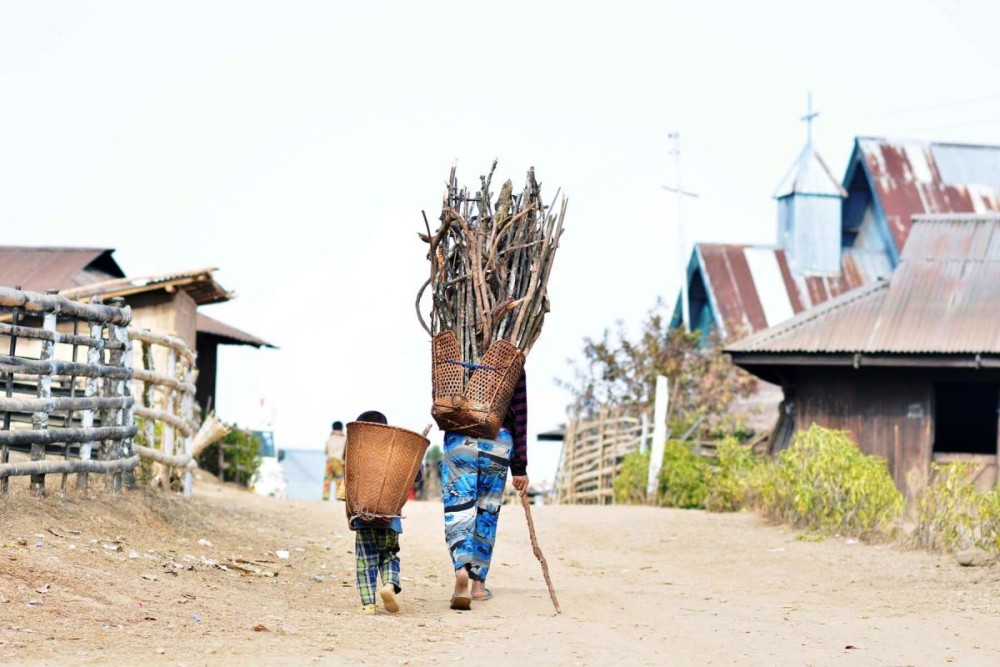
A mother and her child return back home in a village. (Morung file Photo | For representational purpose only)
Vikiho Kiba
Chümoukedima
In an increasingly interdependent world, the fragility of supply chains has emerged as one of the defining anxieties of our age. The specter of a global conflict, whether described as a third world war or otherwise, does not merely conjure images of geopolitical realignment or military confrontation. It also raises a far more immediate and existential concern for peripheral and landlocked regions, namely the question of survival. For the Naga people, whose contemporary life world is intricately tied to external supply systems, the disruption of these lifelines compels a pressing inquiry. Would a return to subsistence agriculture, particularly paddy cultivation, become not merely an option but a necessity?
The modern Naga economy, like many others in the Northeast, has undergone a gradual yet decisive transition from subsistence based practices to a mixed economy increasingly dependent on imported goods. Essential commodities such as rice, pulses, fuel, and medicines flow into the region through a network of highways, trade routes, and market intermediaries. This integration has undoubtedly expanded access to goods and improved living standards. At the same time, it has engendered a structural dependency that often remains unnoticed in periods of stability. However, in moments of crisis, whether triggered by political blockades, natural disasters, or global conflict, this dependency is abruptly exposed in its full severity.
A hypothetical rupture of global and national supply chains would generate cascading consequences. Transportation corridors may be militarized or rendered inoperative. Fuel shortages could immobilize logistical networks. Inflation could make essential goods prohibitively expensive. For a region such as Nagaland, where local production does not fully meet consumption demands, such disruptions would transcend inconvenience and assume the proportions of a humanitarian crisis. The phrase “lifelines snap” thus signifies not merely a breakdown of logistics but a deeper condition of civilizational vulnerability.
Historically, however, Naga communities were not passive recipients of external sustenance. Prior to the consolidation of modern market systems, they practiced forms of agriculture that were both adaptive and ecologically attuned. Jhum cultivation, often described as shifting agriculture, and wet rice terrace farming were not simply economic activities. They were embedded within a broader socio cultural and ecological framework that sustained community life. These practices ensured a degree of food sovereignty, even if they did not generate surplus in the sense defined by modern capitalist economies.
The pertinent question, therefore, is not whether the Naga people can return to the fields, but whether such a transition remains feasible under present conditions. Decades of socio economic transformation have reshaped both landscape and consciousness. Urbanization, expanding educational horizons, and the aspiration for salaried employment have distanced many from agrarian livelihoods. Land once actively cultivated has, in some areas, been left fallow or diverted to other uses. Equally significant is the gradual erosion of traditional knowledge systems, which were once transmitted organically across generations but now face the risk of discontinuity.
Yet crises often function as moments of reckoning. The disruption of external supply chains could catalyze a renewed valuation of local resources and indigenous practices. Paddy cultivation offers a particularly compelling pathway in this regard. Rice remains the staple food across the region, and increased local production would significantly mitigate the impact of supply disruptions. However, the expansion of paddy cultivation is not without its challenges. It requires access to arable land, adequate labor, irrigation infrastructure, quality seeds, appropriate tools, and above all, coordinated community effort.
Herein lies a critical paradox. The very processes that have diminished direct engagement with agriculture, including modernization, migration, and economic diversification, have also equipped the younger generation with new forms of knowledge, technical skill, and organizational capacity. If effectively mobilized, these resources could enable the emergence of a hybrid agricultural model that integrates traditional wisdom with modern innovation. Community farming initiatives, cooperative structures, and localized food systems may thus present viable responses to systemic disruption.
The question of survival, however, extends beyond the material realm into ethical and cultural dimensions. A return to the fields would signify more than a shift in economic activity. It would entail a reorientation of values. It would challenge the prevailing assumption that progress is synonymous with detachment from the land and instead foreground resilience, self sufficiency, and ecological balance as markers of a more grounded and sustainable development paradigm.
This reflection must also be situated within a broader geopolitical framework. Peripheral regions frequently bear a disproportionate share of the burdens generated by global conflicts. Their voices are often marginal within decision making processes, yet their vulnerabilities are acute and immediate. For the Naga people, the imperative is therefore twofold. On the one hand, there is a need to advocate for infrastructural investment and policy measures that ensure the stability of supply systems. On the other, there is an equally urgent need to cultivate internal capacities that reduce excessive dependence on external sources.
Policy interventions can play a decisive role in this process. Strategic investment in rural infrastructure, agricultural training, and incentives for local production would strengthen regional resilience. Educational institutions could integrate agrarian studies and sustainability into their curricula, thereby bridging the gap between traditional knowledge and contemporary academic frameworks. Civil society organizations and church networks, which occupy a significant place in Naga social life, are well positioned to mobilize collective action and foster a renewed commitment to community based initiatives.
At the same time, it would be intellectually inadequate to romanticize a return to subsistence agriculture as a comprehensive solution. Contemporary challenges such as climate change, soil degradation, and demographic pressures complicate any straightforward reversion to earlier modes of life. What is required is not a nostalgic return to an idealized past, but a critical and creative engagement with inherited practices. The task is to construct a resilient future that draws upon the strengths of tradition while remaining responsive to present realities.
The expression “back to the fields” thus acquires a layered and nuanced meaning. It is both literal and metaphorical, signifying the cultivation of land as well as the cultivation of resilience. It gestures not toward regression but toward a deeper grounding in enduring resources and capacities. In this sense, the snapping of lifelines may paradoxically open a pathway toward renewal and self rediscovery.
In conclusion, the possibility of global conflict disrupting supply chains serves as a sobering reminder of the limits inherent in systems of interdependence. For the Naga people, it brings into sharp focus critical questions of food security, economic structure, and cultural orientation. The challenges are formidable, yet they are not insurmountable. Through a strategic recalibration that combines local production, community solidarity, and thoughtful policy support, vulnerability can be transformed into resilience. Whether or not such a crisis materializes, the underlying lesson remains unequivocal. In a world of uncertain lifelines, the capacity for self sustenance stands not merely as an economic advantage, but as a civilizational imperative.

