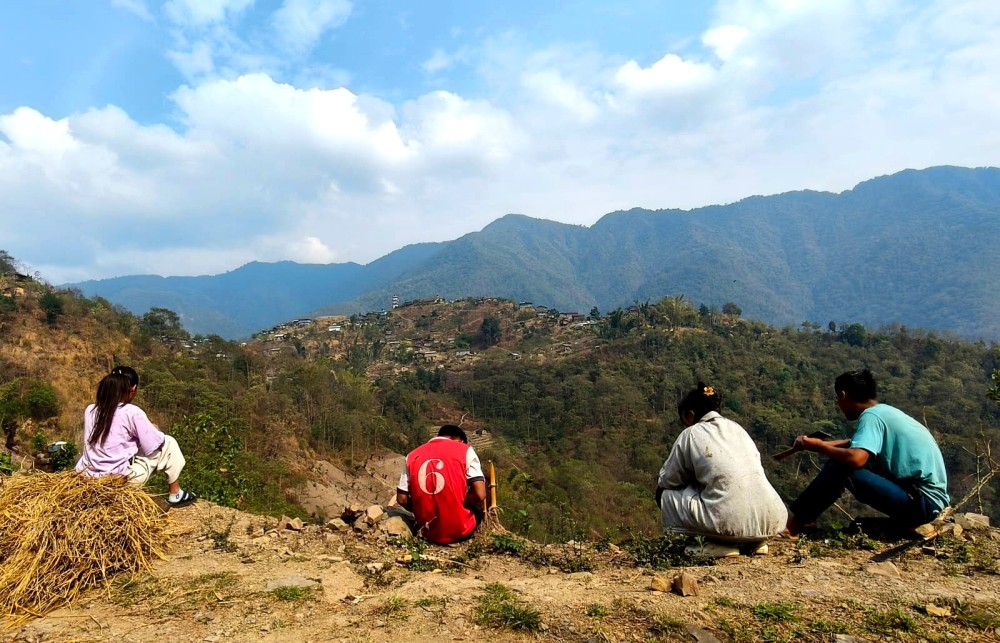
A view of Chendang village, Tuensang district, Nagaland. (Photo Courtesy: Abhayjeet Gupta)
Abhayjeet Gupta
Every December, Chendang village comes alive. Located in Tuensang district of Nagaland, close to the Myanmar border, Chendang is a quiet rural village with around 700 to 800 people. When I came here last November to stay for a year, I found it to be a normal village. But December was different. For about two weeks, people who have left the village return home to celebrate Christmas. As Christmas approached, people started cleaning the whole village together and decorating it with lights. At night, the village looked almost like a city. People stayed up late, singing and dancing around midnight. A village that usually went to sleep around 8 in the evening was suddenly awake, with families enjoying every moment together before leaving again for another year. For those two weeks, the village felt almost like a town. There were people everywhere. Families came together, the village felt full of life, and for a while, it was hard to imagine that most of these people no longer lived there.
Then Christmas ended, and they left. The village became quiet again. I may not have noticed this if I had not been there before and after the celebrations. But having seen the village so full of life and then so quiet, I started wondering where all these people had gone.
After speaking to people in the village, I realised that many of those who returned for Christmas had once lived in Chendang but had left years ago in search of better opportunities and living conditions. Jhum cultivation was the main source of income for most families, and there were rarely any other options. Initially, I thought there was nothing wrong with people leaving. If someone could move out and choose a better future for themselves, why should they not? My thinking started changing when I spoke to a group of young people who had moved out earlier for better career opportunities but later returned to the village. I realised that many of them had not really chosen to leave. They left because they could not earn enough in the village. When their families faced financial emergencies, they had no choice but to move out and take whatever work was available.
Among the group I spoke with, one had worked as a helper in a restaurant, another as cleaning staff in a hotel, while others had taken up different daily wage jobs. What they had in common was long working hours, low pay, no job security and poor working conditions. These circumstances eventually forced some of them to return and help their families in the fields. They had left because they felt they had to, and they returned because they did not have a better option. In both situations, I began to wonder whether they were really making these choices themselves or simply responding to the circumstances around them.
For many families, even farming was not enough to create financial security. Most farmers mainly grow what their families need to eat. This puts pressure on their children to either help with farming, work as daily labourers or migrate for low-paying and uncertain jobs. Education also offers limited opportunities. The village has only one middle school, with classes up to Class 7, because of the shortage of teachers. The community has tried to address this by hiring two private teachers at its own expense, with every family contributing Rs 140 a month.
The more I understood the situation, the more I felt that migration was not simply a choice for many young people. It was often the only option they could see. This became the problem I chose to focus on through my SBI YFI fellowship project, in association with ECS. The youth of the village came together to discuss livelihood opportunities within Chendang. After some market research, we decided to try oyster mushroom cultivation. The demand for mushrooms in the village was high, but no one was cultivating them. The group received training from KVK, and we started with a pilot batch of 22 bags.
The first batch was growing well. But before the youth could harvest and start earning, two of them had to leave the village. One of them called me and told me that his father was not doing well and his mother could not support the family alone, so he had to go. He eventually found work in a hotel, where the pay was low and the working hours were long. He even asked me if I could help him find another alternative, but I could not help him at that moment. He needed the income to support his family, so the difficult working conditions were not something he could simply walk away from. There was nothing we could do about it. We had started the mushroom project to create an opportunity for young people to earn within the village, but before the first harvest, two of them had already left because their families needed them elsewhere.
The first batch was eventually successful. We got a good harvest, but it was still not enough to meet the demand. Encouraged by this, the group planted another batch of 80 bags. This time, we failed. We did not have proper infrastructure to protect the mushroom bags, and the entire batch became contaminated. We lost the whole batch. For us, it was a failed attempt at mushroom cultivation. But for the families involved, it meant losing another opportunity to earn from the village. Soon after, two more families asked their children to move out in search of a stable source of income, even if the work paid very little and came with poor working conditions. This made me realise that when you are working with families who cannot afford to wait, even a small failure can have consequences far beyond the project itself.
This was when something became clear to me. The youth of Chendang were not migrating out of choice. They were migrating because they did not have a choice.
We could start a livelihood project, train young people and find a market for what they produced, but the reality of their lives was much bigger than our project. A medical emergency could force someone to leave before the first harvest. A failed batch could mean another lost opportunity. When a family needs money, they cannot always afford to wait for a new livelihood opportunity to work.
During my visits to other villages in Western Nagaland, I noticed a similar pattern. Many communities depended heavily on jhum cultivation and had limited educational opportunities. In other villages, I also noticed families with the resources to do so sending their children to nearby towns to continue their education, while children from families without those resources were often left with little choice but to work in the fields or as daily wage labourers. For many young people, there were very few options beyond moving to nearby towns and cities to work as unskilled labourers. What I had first noticed in Chendang was not unique to the villages I visited. It reflected a larger reality where young people were leaving their villages not because they wanted to, but because they had very few alternatives.
The attempt of the youth group in Chendang to build a livelihood through oyster mushroom cultivation is therefore about more than earning money. It is an attempt to create a way for young people to earn with dignity in the village they call home. The group is still trying to build something that can give them an option. An option to stay, if they want to. An option to leave, if they want to. Most importantly, an option to decide for themselves. This experience also made me realise that there is a huge difference between choosing to leave because you found a better opportunity and leaving because there is no viable opportunity at home.
I came to Chendang after choosing to leave my own home. At that time, I never thought much about what it meant to have that choice. But working with the youth of Chendang made me realise that the ability to leave can itself be a privilege. I had grown up in a city where education, jobs and opportunities gave me many choices. For many young people in rural Nagaland, those choices are not available in the same way.
I left my home by choice, and I ended up working with young people who were struggling to have the choice to stay in theirs.
For me, migration was a choice. For many young people in rural Nagaland, it is not.
The author is an SBI Youth for India Fellow working with Eleutheros Christian Society (ECS) in Tuensang, Nagaland, where he designed and led a project to create livelihood opportunities for rural youth in Chendang village.