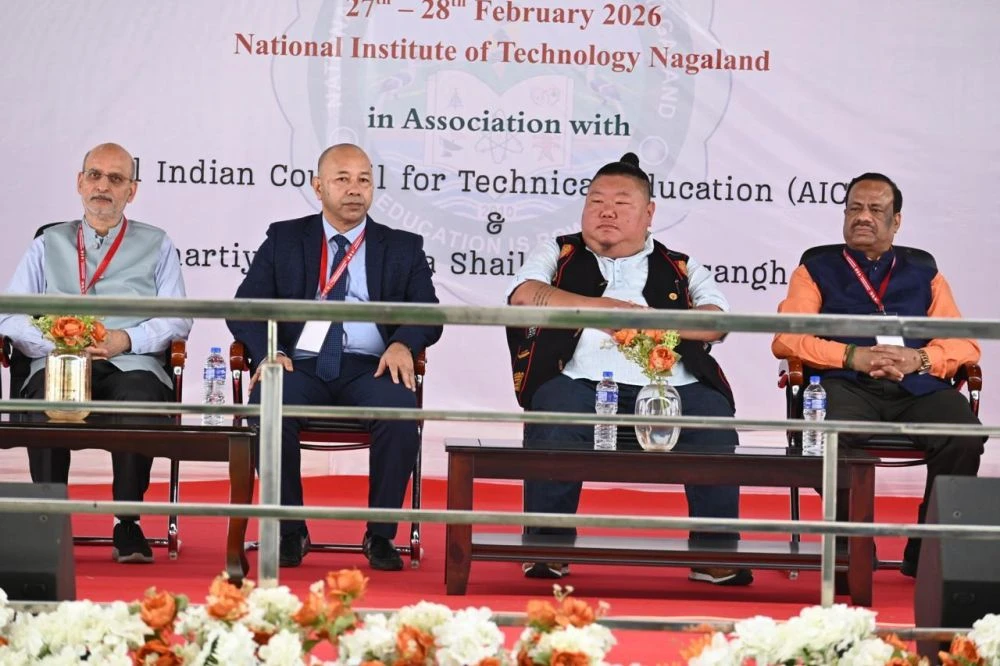
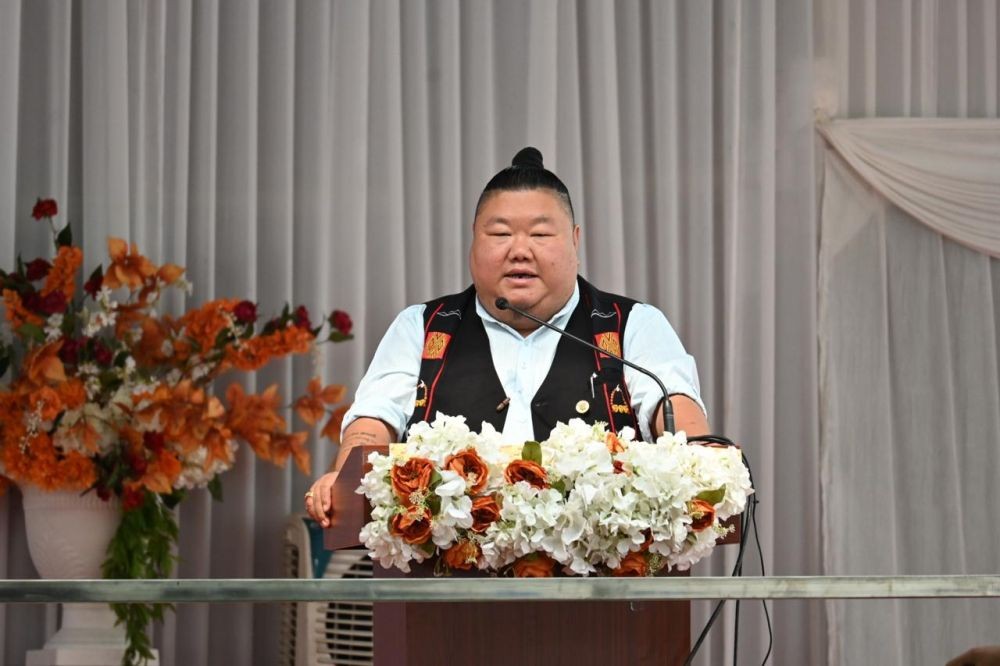
Minister Temjen Imna Along speaking at the national symposium at NIT Nagaland, in Chümoukedima, on February 28. (Photo Courtesy: NIT Nagaland)
‘Political solutions only produce contractors’
Morung Express News
Chümoukedima | February 28
Nagaland Minister for Tourism and Higher Education Temjen Imna Along called for homegrown technological solutions to drive the state and nation forward. Speaking at the two-day national symposium on the ‘Implementation of National Education Policy (NEP) 2020 Challenges and Opportunities in NE Region’ at the National Institute of Technology (NIT), Nagaland, in Chümoukedima, on February 28, the Minister urged engineering students and faculty of Nagaland’s sole NIT to apply technical knowledge to solve the state’s infrastructure challenges.
Addressing the gathering, Along cited the soil instability along the Dimapur-Kohima four-lane, NH 29, as a prime example where scientific engineering intervention is required. He claimed that while the road construction is of high quality, an unstable geology continue to pose issues. He said that it requires scientific solutions, not just construction contracts.
“If we try to solve it (politically), we will only produce contractors. We need your cooperation… so that this road can be maintained properly?” he said. He further stressed the need to create “Knowledge Bank” to avoid a “copy-paste” culture in infrastructure development.
The symposium, which started on February 27, was conducted in association with the NIT Teachers’ Forum, a unit of the Akhil Bhartiya Rashtriya Shaikshik Mahasangh (ABRSM), and the All India Council for Technical Education (AICTE). The NITs of Sikkim, Arunachal Pradesh, Meghalaya, Silchar, Manipur, Agartala and Mizoram were the co-roganisers.
It was the first such event where NITs of the region collaborated to deliberate on the challenges and opportunities of implementing the NEP 2020.
While stating that education must be paired with a spirit of nationalism, Minister Along stressed on "Atmanirbhar Bharat" (Self-reliant India) to realise the Prime Minister’s Viksit Bharat 2047 goals. “If students from South India or from IITs/NITs can influence the policies of India... then our NIT people will be a great strength in nation-building,” he said.
On the sidelines of the symposium, NIT Nagaland Director Dr A Elayaperumal told a section of the media that the institute has undertaken major academic reforms over the past few years. The academic curriculum saw its first major revision in over a decade to align with the NEP. According to him, the institute has made future-ready subjects mandatory for all students, irrespective of their engineering branch.
“We have introduced some of the recent technology courses like Artificial Intelligence and Machine Learning, Python Programming, Data Analytics,” Dr Elayaperumal said. He added that all the students have to study these courses to enable them to compete with the “external world.”
Beyond technical courses, the Director said that the curriculum has integrated elective subjects from the humanities, including Economics to ensure holistic education. He also revealed plans to establish a “Center for Appropriate Technology” to integrate traditional knowledge systems into the curriculum.
Dr Elayaperumal said that NIT Nagaland has come a long way from being unranked to the 100-150 band in the National Institutional Ranking Framework (NIRF) within the last two years, and secured research funding exceeding Rs 15 crore over the past 18 months.
However, getting faculty or teachers to come work in the state’s sole NIT remains a big challenge, as per Dr Elayaperumal.
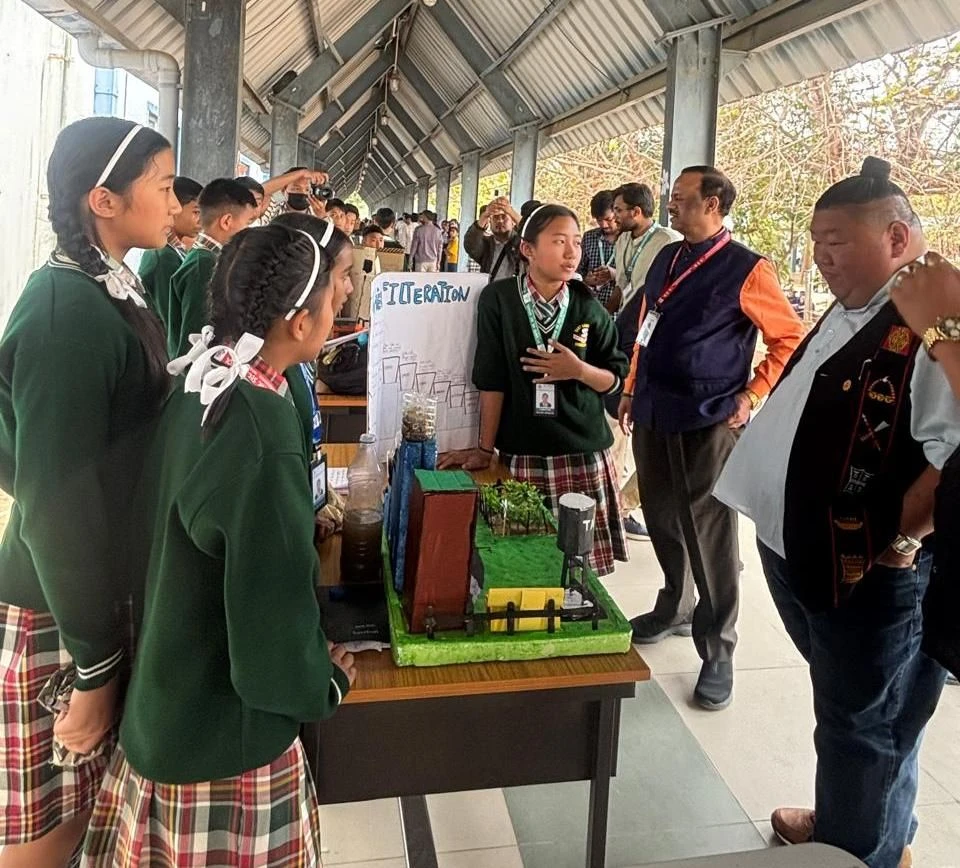
Running parallel to the symposium was the 8th Science Day Exhibition organized by the NIT Nagaland Science Society. Dr Jyoti Prasad Borah, Associate Professor of Physics, said that 572 students from 17 schools participated in various events including a science exhibition, debate, quiz, and poster-making competitions. The exhibition celebrated National Science Day, commemorating CV Raman’s discovery of the Raman Effect.
“The objective of the society is to create awareness and scientific temperament,” Dr Borah said. He added the society, established in 2018, conducts outreach programmes in remote areas, to promote scientific thinking outside the laboratory.