• Bar Exam likely in Kohima
• SC seeks RTE compliance details
Moa Jamir
Dimapur | May 21
Questions surrounding Indigenous Inhabitant Certificates (IICs), implementation of the Right to Education (RTE) Act and holding of All India Bar Examination (AIBE) in Nagaland were some of the key legal issues concerning the State in the recent past.
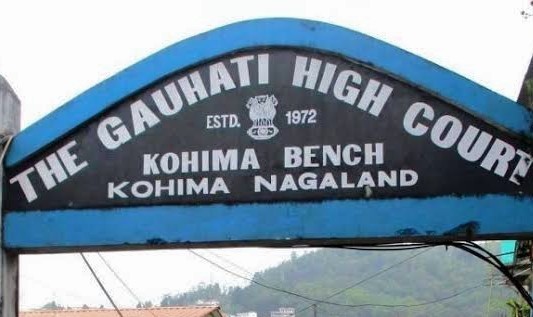
At the Gauhati High Court Kohima Bench (GHCKB), two Public Interest Litigations (PILs) concerning the State Government’s 2024 notification on Indigenous Inhabitant status are presently being heard together.
On May 20, the Additional Advocate General (AAG) Nagaland informed the Division Bench of Justice N Unni Krishnan Nair and Justice Yarenjungla Longkumer that instructions on the issue have been received from the State Government and these would be brought on record on or before June 10.
The Court has sought those instructions in March. Accordingly, the Bench stated that no further adjournment would be granted.
If the affidavits are not filed by the next hearing, concerned respondent authorities handling the matter might be directed to appear personally before the Court to assist in disposal of the PILs, the Bench added, listing the matter again on June 17.
The PILs were filed by the Nagaland Tribes Council (NTC) and the Angami Public Organisation (APO).
The NTC’s PIL, filled in May 2025, noted that indigenous inhabitant status in Nagaland had traditionally been governed by the April 28, 1977 notification, which prescribed three criteria linked to the pre-statehood period.
It further contended that although a RIIN Commission was constituted in 2019 and made recommendations concerning indigenous inhabitant status, the norms introduced through the September 20, 2024 order did not fully adhere to those recommendations.
The norms had been “diluted,” raising concerns that non-indigenous persons could obtain Indigenous Inhabitant status, it added.
Meanwhile, in another PIL filed earlier this year, the APO specifically questioned the applicability of September 20, 2024 notification to the 15 recognised Naga tribes, contending that it did not expressly require applicants or their forefathers to have been residents of Nagaland prior to December 1, 1963.
During an earlier hearing, the Court had noted that the September 20, 2024 Cabinet Memorandum does not specify any cut-off date requiring Naga Tribe applicants or their ancestors to have been inhabitants of Nagaland before December 1, 1963.
Prima facie, the Court observed that the State may have intentionally omitted this condition for the 15 recognised Naga tribes, but sought clarification from the Government of Nagaland via an affidavit.
It must be noted here that another writ petition concerning the indigenous issue as well as enumeration exercise for Garo, Kuki, Kachari and Mikir (Karbi) communities is also pending in GHCKB.
The Kuki Inpi Nagaland along with the Nagaland Garo Tribal Council, Kachari Tribal Council Nagaland and Karbi Union Nagaland had challenged the September 20, 2024 order and October 1, 2024 notification directing enumeration of persons and descendants from those communities settled in Nagaland prior to December 1, 1963 for determining eligibility for IICs and Permanent Resident Certificates (PRCs).
The petitioners contended that they were already recognised Scheduled Tribes under the Constitution (Nagaland) Scheduled Tribes Order, 1970 and could not be subjected to a separate verification process.
The High Court had earlier restrained the State from proceeding with the enumeration exercise. Later, during hearings in March 2026, the State Government through the AG informed the Court that it did not presently intend to proceed with fresh enumeration while the matter remained pending.
Consequently, the GHCKB listed the matter has been listed for further hearing on May 25, directing the State has to file its additional affidavit on or before May 20.
Bar Exam and RTE compliance
In another PIL heard on Wednesday, the Division Bench was informed that steps are being taken to conduct the AIBE 2026 in the State, with a centre in Kohima in compliance with the Court’s May 6 direction.
The Court, thus, noted that it would monitor the matter and directed the registry to list it again on June 10.
In a separate development, the Supreme Court has sought details from Nagaland and several other States and Union Territories regarding implementation of Section 12(1)(c) of the Right of Children to Free and Compulsory Education (RTE) Act, 2009.
The Court’s order on May 7 indicated that Nagaland belonged category of States/UTs claiming compliance without furnishing proof.
Accordingly, the apex Court granted four weeks’ time to Nagaland and 7 other states to file affidavits regarding the “true and faithful implementation” of relevant section of the RTE Act.
Failure to comply may compel the court to summon the Principal Secretaries of the Education Departments of the concerned States and UTs, it added, listing the matter next on July 22.
Section 12(1)(c) of the RTE Act mandates reservation of 25% seats for children belonging to economically weaker sections and disadvantaged groups in private unaided schools at the entry level.