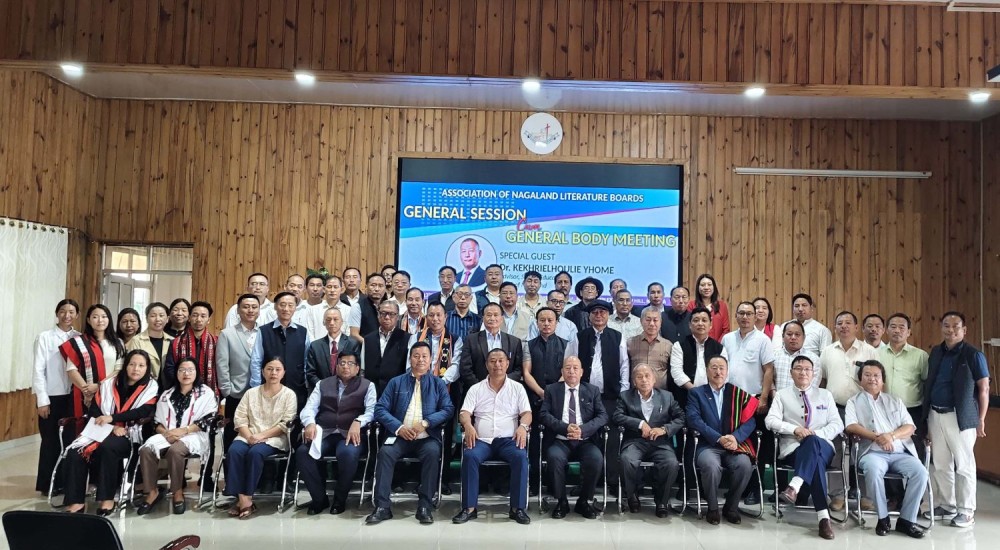
Dr Kekhrielhoulie Yhome and others at General Session-cum-General Body Meeting of ANLB in Kohima on July 17.
Our Correspondent
Kohima | July 17
Nagaland School Education Advisor Dr Kekhrielhoulie Yhome today called for stronger institutional support, academic recognition and collaborative efforts to preserve and develop Naga languages.
“Language is the cornerstone of identity and cultural continuity,” he said while addressing the General Session-cum-General Body Meeting of the Association of Nagaland Literature Boards (ANLB) at Platinum Hall, NBCC Complex, Bayavu Hill, Kohima.
Dr Yhome said that indigenous languages can only thrive through sustained efforts by their speakers, scholars and community organisations.
Emphasizing the role of the National Education Policy (NEP) 2020, he said the three-language formula provides an opportunity to strengthen mother tongue education from the foundational stage.
The School Education department, he said, has identified schools based on their linguistic composition and posts primary teachers in their respective language areas so that children are introduced to learning in their mother tongue from an early age.
Dr. Yhome, however, pointed out that the department is constrained in appointing language teachers because many tribal languages still lack recognised academic qualifications.
He said the introduction of undergraduate and postgraduate courses in indigenous languages through recognised institutions would enable the government to recruit qualified language teachers.
‘Indigenous languages for safeguarding culture’
Dr Yhome stressed that language development requires proper institutional mechanisms, standardised orthographies and scholarly research. He urged literature boards to organise seminars and academic discussions to address issues relating to translation, vocabulary development and standardisation.
Referring to debates surrounding Bible translations in some Naga languages, he said language translation should be guided by scientific principles and undertaken with the involvement of linguists and language experts.
He added that the department has initiated collaboration with the Department of Linguistics at Nagaland University to strengthen language-related research and development.
Highlighting the advantages of multilingualism, Dr. Yhome said Naga children naturally acquire several languages, making them better equipped for communication and learning. He said multilingual exposure should be viewed as an asset while ensuring that mother tongues continue to be preserved as markers of identity.
He also informed that the State Curriculum Framework under preparation envisages greater promotion of tribal languages alongside English.
While English remains essential for higher education and global opportunities, he said indigenous languages are equally important for safeguarding culture, heritage and identity.
He encouraged language organisations to expand literary activities, including the publication of books, dictionaries and translations, noting that the shortage of reference materials has posed challenges in preparing school textbooks.
Education policy seeks to preserve rich linguistic diversity
Deenabandhu Panda, Additional Director, Directorate of School Education, said that the department has introduced the languages of all recognised Naga tribes in schools over the past 35 years, with tribal languages now being taught from Class IX beginning this academic year.
He said the initiative reflects the objectives of the National Education Policy, which seeks to preserve India’s rich linguistic diversity.
Stressing that even dialects within tribes deserve equal attention, Panda urged communities to work collectively to preserve both major tribal languages and smaller speech varieties.
Welcoming the gathering, Ura Academy Vice-President Daso Paphino traced the evolution of Tenyidie, stating that the language began its formal development after American missionary Rev. Sidney W. Rivenburg introduced the Tenyidie alphabet following his arrival in Kohima in 1887.
Paphino reaffirmed Ura Academy’s commitment to working with literature boards, educational institutions and language stakeholders to strengthen Tenyidie and other Naga languages for future generations.
Earlier, welcome address was delivered by B Tingshem Konyak, President, ANLB while Rev Dr Alem Sangtam Chairman, Sangtam Literature Board invoked God’s blessings.
The session was led by S Akho Leyri, Vice President, ANLB while vote of thanks was proposed by Chegeseng Kath, General Secretary ANLB.