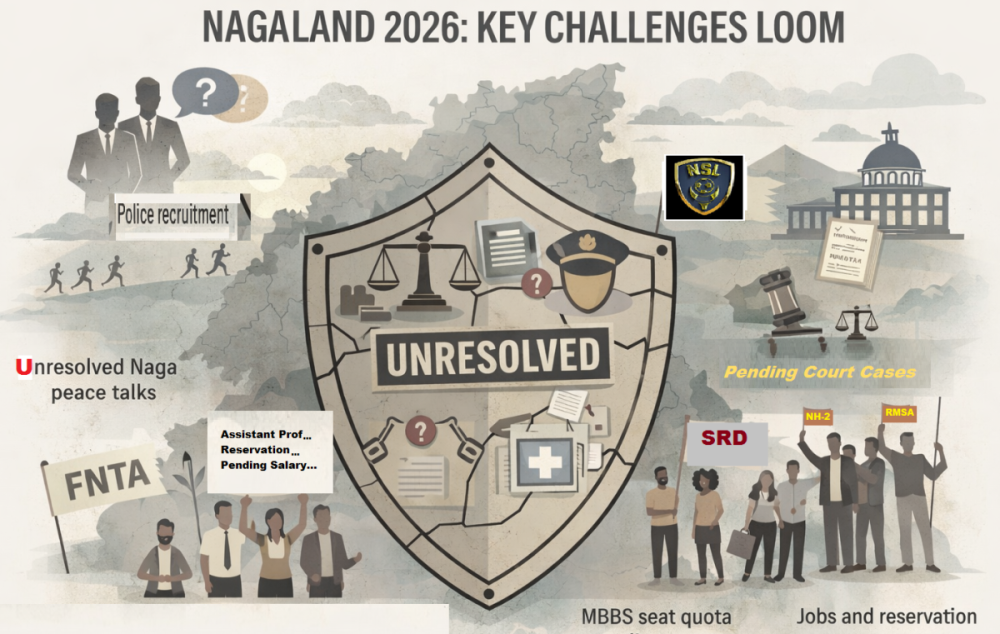
Here are key developments likely to shape public sphere in 2026
Moa Jamir
Dimapur | January 9
From the perennial Naga political issue to contestations both inside and outside courtrooms, a range of unresolved governance and political challenges are expected to dominate Nagaland’s public sphere in 2026, as developments from the past year spill over into the new one.
As the State enters the second week of 2026, several long-standing unresolved issues continue to cast a shadow over governance and the public sphere.
As the State enters the second week of 2026, several long-standing unresolved issues continue to cast a shadow over governance and the public life as the year unfolds.
Initial cautious optimism
However, one early notable positive development is the commencement of the recruitment process for 1,176 Constable (GD) posts in the Nagaland Police across Nagaland from January 7.
The recruitment process follows a prolonged legal battle that was finally adjudicated in 2025. Any future development on the matter will be dependent how transparent the process is perceived to be by the citizens. Nevertheless, uncertainty continues over the recruitment of around 40 Sub-Inspectors and UBSIs.
The talks on the proposed Frontier Nagaland Territory Authority (FNTA) also appeared to have reached a breakthrough, with Nagaland Chief Minister Neiphiu Rio reportedly announcing that the State Cabinet and members of the Eastern Nagaland Legislators’ Union (ENLU) had cleared the way for the FNTA following a closed-door meeting on January 6.
Nevertheless, the FNTA demand, spearheaded by the Eastern Nagaland People’s Organisation, is likely to resurface prominently, as several issues still need to be streamlined and addressed.
Politically, the formal merger of the Naga People’s Front (NPF) with the ruling Nationalist Democratic Progressive Party (NDPP) in 2025, strengthening the government led by Chief Minister Neiphiu Rio, is expected to play out through 2026.
Attention will now shift to the first Assembly session of the year, expected in February or March, when the merged entity is likely to sit together for the first time, potentially reshaping legislative dynamics.
Fault lines persist
The year 2025 also saw splits within Naga political groups, the emergence of new formations, and visible fissures within civil society, underscoring the fluid political environment while the broader Naga political talks also remain unresolved.
Despite periodic engagements between Naga political groups and the Centre, an “inclusive and honourable solution” continues to elude the process, with recent developments offering little indication of a breakthrough in 2026.
Courts are again set to remain a central arena of governance in 2026. Several unresolved cases continue to linger, ranging from Assistant Professor and excise recruitment disputes to the enumeration exercise and Lokayukta amendment cases.
In addition, the Gauhati High Court Kohima Bench will continue to monitor two suo motu public interest litigations taken up in 2019 and 2022, relating to National Highways-29 and 2.
The case of the MBBS pool quota for Nagaland is also slated for final hearing in February before the Supreme Court of India.
Another issue that saw significant legal closure in 2025 was the Special Recruitment Drive involving COVID-era appointed medical officers. While the State Government announced their regularisation in December following a favourable court ruling, opposition from the Naga Students’ Federation and other groups, along with an ultimatum, indicates that the issue is yet to reach full resolution.
This public engagement on governance and employment issues, through protests, memoranda, representations and appeals, is expected to continue.
Meanwhile, the Nagaland Reservation Review Commission is expected to submit its recommendations on the State’s reservation policy in the early part of 2026. The outcome of the report and subsequent policy decisions could significantly influence public discourse.
On the sporting front, while officials struck an upbeat note following the success of the inaugural Nagaland Super League (NSL) and indicated that Season 2 was being targeted for the December 2025–January 2026 window, a part of that timeline has already elapsed, with little visible buzz so far.
As the year begins, Nagaland faces overlapping pressures from unresolved legal cases, employment-related unrest, regional political demands and long-running peace negotiations.
How these issues unfold in courtrooms, on the streets, within the legislature, and across society at large, is expected to shape the State’s public discourse through much of 2026.