Graphic created based on data from the NCB Annual Report 2025 with AI assistance.
State-wise data leaves unanswered questions over Nagaland’s synthetic drug data
Moa Jamir
Dimapur | July 1
Nagaland has been identified among India’s frontline states in an evolving narcotics landscape, with the Narcotics Control Bureau (NCB) highlighting that the country’s North-East frontier is witnessing increasing trafficking pressure from the Golden Triangle amid a major shift in regional drug production, trafficking routes and political developments.
In its Annual Report 2025, the NCB designated Nagaland, Manipur and Mizoram, as states “bearing the sharpest frontline exposure” to narcotics trafficking originating from Myanmar.
Alongside the Western corridor along the Indo-Pak border, the Eastern gateway along the Indo-Myanmar border, including Arunachal Pradesh, has been designated a “High Risk Frontier Zone” and marked as an “immediate priority” due to its role as a key entry point for methamphetamine and heroin.
The porous borders and the erstwhile Free Movement Regime (FMR) have transformed these states from “peripheral transit zones” into “active staging grounds” for distribution into the Indian hinterland, it noted.
The report further stated that Myanmar has emerged as the world's leading source of illicit opium following Afghanistan's 2022 poppy cultivation ban, with illicit cultivation rising by about 56 per cent from 30,200 hectares in 2021 to 47,100 hectares in 2023. Shan State accounts for 88 per cent of the country's cultivation.
This expansion was attributed to Myanmar’s prolonged political instability and economic collapse.
The NCB further noted that the trafficking corridor from Myanmar passes directly through India’s NE states, posing not only a narcotics challenge but broader security concerns, including financing of armed activities and smuggling.
The increasing drug availability, the affordability of synthetic drugs and limited treatment infrastructure, it maintained, are creating conditions for drugs intended for transit to spill over into local consumption markets.
The report also identified synthetic drugs as the fastest-growing challenge noting a 140 per cent increase in Amphetamine-Type Stimulant (ATS) seizures in India between 2020 and 2025, describing it as the clearest indicator of the rapidly escalating threat from the eastern corridor.
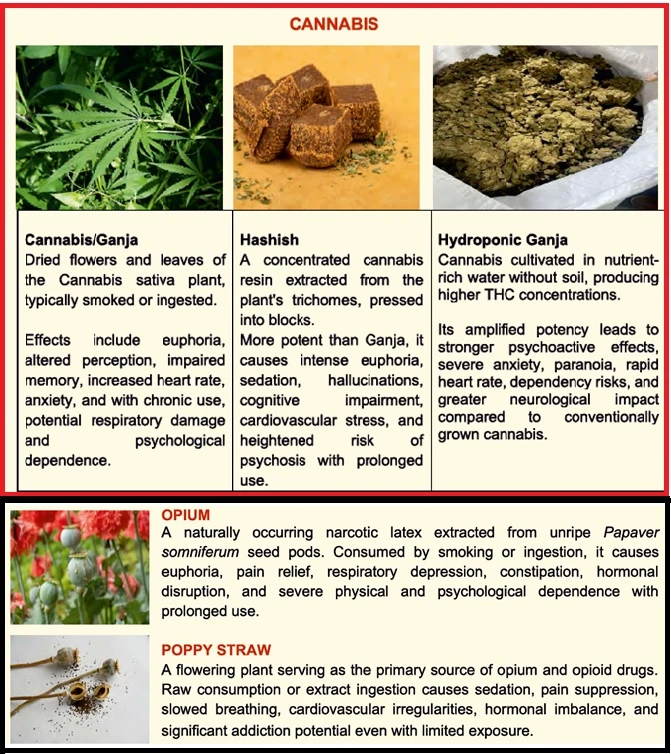
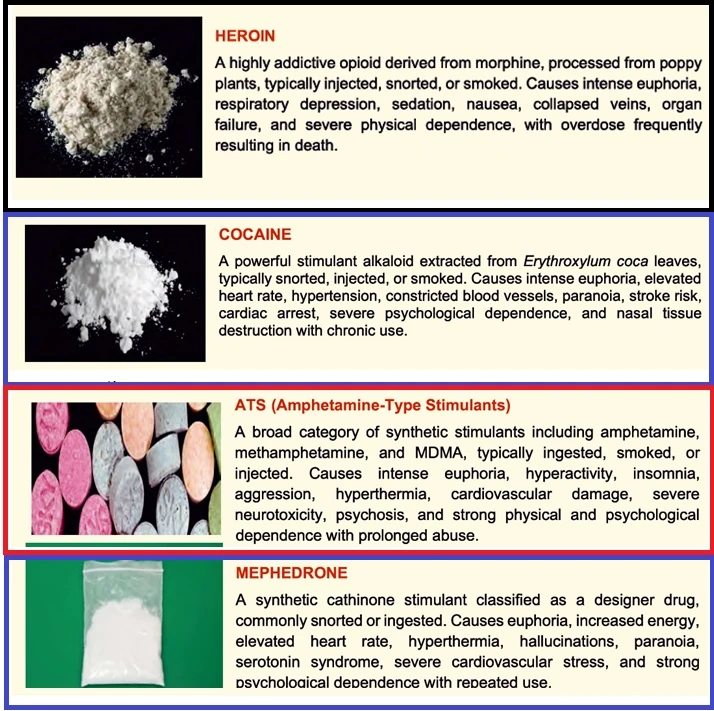
Injectable and tablets lead Nagaland’s seizure profile
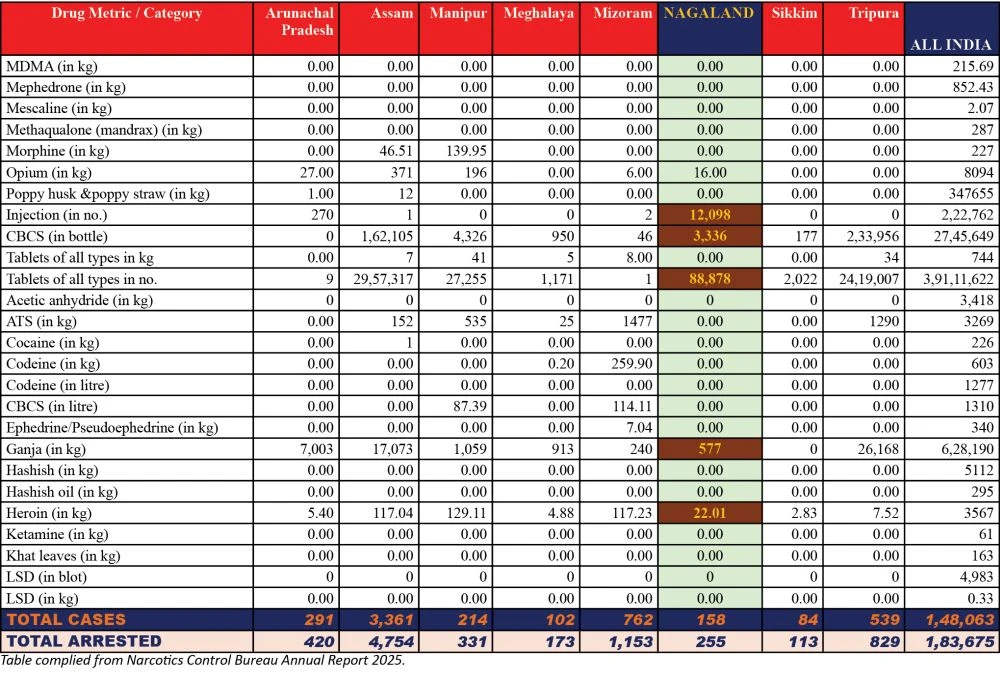
Despite frontline exposure tag, the state-wise annexure of seizure by DLEAS reflected a mixed picture for Nagaland.
One notable feature is the volume of pharmaceutical and other preparations with Nagaland accounting for 5.4 per cent of the 2,22,762 injectable preparations seized nationwide in 2025.
Further, a total of 3,336 CBCS (Codeine-Based Cough Syrups) bottles and 88,878 tablets (all types, number) were recovered.
Among conventional narcotics, the reported noted seizures of 577 kg of ganja, 22.01 kg of heroin and 16 kg of opium.
No seizures are recorded under the ATS (representing board categories of synthetic stimulants), hashish, hashish oil, cocaine, codeine, ketamine, morphine, mephedrone, mescaline or methaqualone categories as well as poppy husk or poppy straw.
Drug Law Enforcement Agencies (DLEAs) registered 158 NDPS cases in Nagaland during 2025, resulting in 255 arrests.
Regional comparison
Among the NE states, the State recorded fewer cases than Assam (3,361), Mizoram (762) and Tripura (539), Arunachal Pradesh (291), and Manipur (214), but more than Meghalaya (102) and Sikkim (84).
While Nagaland recorded no ATS seizures, neighbouring Mizoram reported 1,477 kg, Manipur 535 kg, Assam 152 kg, Tripura 129 kg and Meghalaya 25 kg.
Similarly, Nagaland’s 22.01 kg heroin seizure was considerably lower than Manipur (129.11 kg), Mizoram (117.23 kg) and Assam (117.04 kg).
On the other hand, Nagaland reported one of the region’s highest figures for injectable preparations (12,098), far exceeding negligible numbers (0-1) in other NE States.
Recovery of 88,878 tablets is third in NE after Assam (29.57 lakh) and Tripura (24.19 lakh).
Questions over classification
One aspect of the report warranting further clarification is the presentation of synthetic drug data.
Despite the ‘frontline exposure’ status to the expanding methamphetamine trade from the Golden Triangle, Nagaland recorded no ATS (in kgs) seizures from the State.
Moreover, while tablet and injectable seizures were substantial, no tablets by weight were recorded, and the report does not explain their composition or classification.
This makes direct comparison with other official datasets less straightforward.
For instance, the Annual Administrative Report 2025–26 (AAR) of the Home Department informed that synthetic drug seizures by Nagaland Police increased from approximately 80,496 units in 2024 to 104,470 units in 2025, reflecting a rise of around 30% while other agencies also report periodic seizures.
It is unclear whether such seizures are reflected in the state-wise annexure.
Incidentally, the NCB’s Annual Report 2024 recorded 0.69 kg of ATS seizures from Nagaland.
Nationally, the NCB reported highest-ever enforcement output during 2025 with 12,409 quintals of narcotic drugs seized across the country. Nationally, DLEAs registered 148,063 cases and made 183,675 arrests.
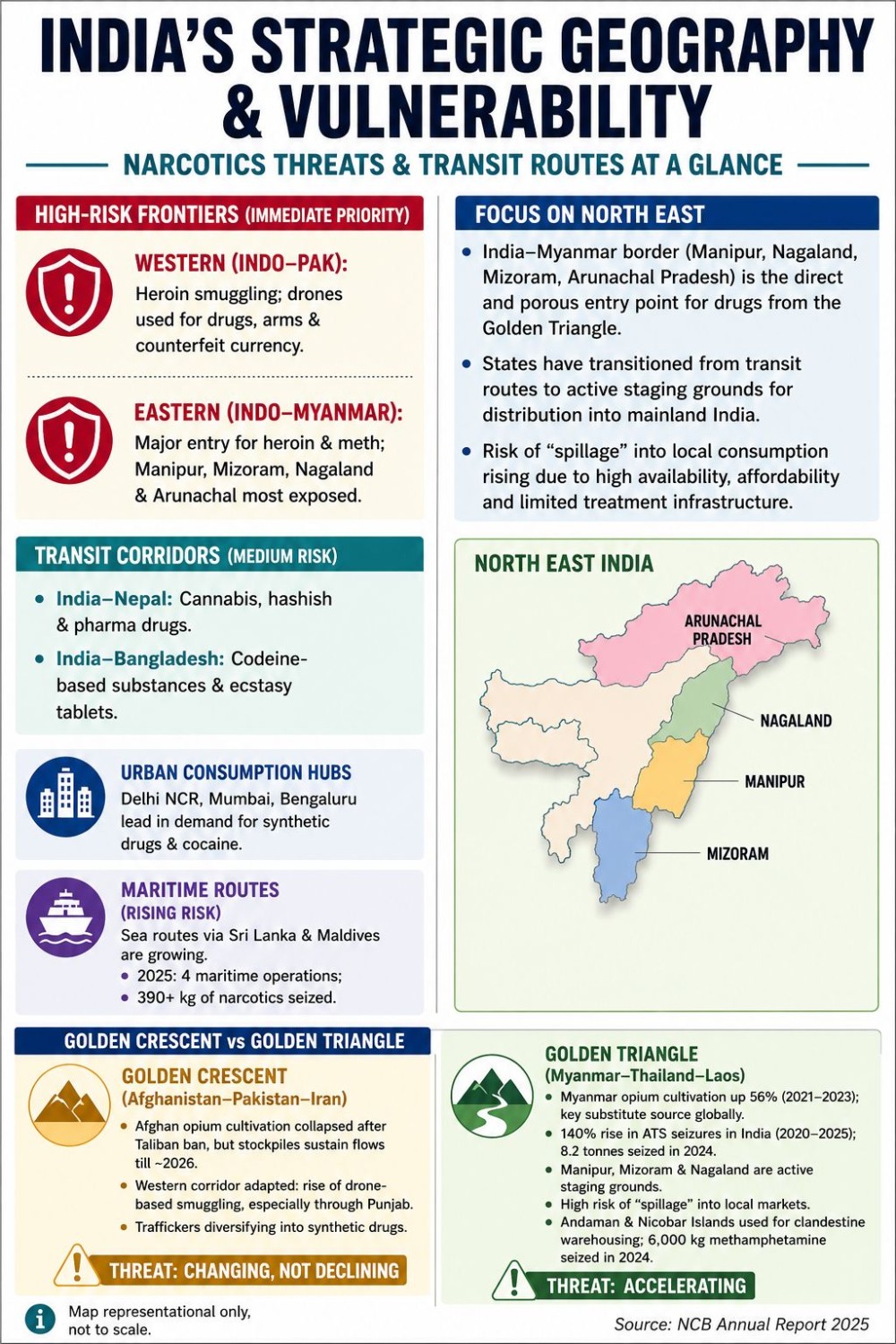
INDIA'S VULNERABILITY AREAS: AT A GLANCE
High-Risk Frontier Zones (Immediate Priority)
• India-Pakistan border (3,323 km): A persistent heroin trafficking corridor due to its proximity to Afghanistan. The report also flags increasing use of drones for smuggling narcotics, arms and counterfeit currency across Punjab.
• India-Myanmar border (1,643 km): Identified as a major gateway for methamphetamine and heroin from the Golden Triangle. Myanmar's illicit opium cultivation has expanded significantly, while methamphetamine (Yaba) flows through the India-Myanmar corridor continue to intensify.
• Porous terrain and the erstwhile Free Movement Regime (FMR) make Manipur, Mizoram, Nagaland and Arunachal Pradesh particularly vulnerable.
Medium-Risk Transit Corridors (Immediate Priority)
• India-Nepal: Open-border dynamics facilitate trafficking of cannabis, hashish and pharmaceutical drugs into northern and eastern India.
• India-Bangladesh: A significant route for codeine-based cough syrups (Phensedyl) and ecstasy tablets, with eastern states serving as key transit and distribution nodes.
• Illicit cultivation patterns are evolving, with poppy and cannabis cultivation gradually shifting towards northeastern border areas and certain coastal regions, signalling a decentralisation of domestic supply sources.
Urban Distribution Hubs
• Delhi NCR, Mumbai and Bengaluru remain the principal consumption centres, particularly for synthetic drugs and cocaine, reflecting rising urban demand.
Maritime Risk Areas
• Trafficking networks are increasingly exploiting sea routes via Sri Lanka and the Maldives, with India's coastline from Gujarat to West Bengal serving as an important entry and exit corridor. In 2025, four maritime operations seized more than 390 kg of narcotics.
MAJOR DRUG TRAFFICKING ROUTES INTO INDIA
GOLDEN CRESCENT (Afghanistan–Pakistan–Iran)
• The world's primary opiate trafficking corridor, sustained by an estimated 13,200 tonnes of pre-ban Afghan opium stockpiles.
• Land route: Heroin and other narcotics enter India through the Punjab and Rajasthan border with Pakistan.
• Maritime route: Trafficking also occurs along the Gujarat and Maharashtra coastlines, using fishing vessels and small coastal craft that often evade conventional maritime surveillance.
• The NCB notes that traditional heroin routes are increasingly being used to traffic Amphetamine-Type Stimulants (ATS) as well.
GOLDEN TRIANGLE (Myanmar–Thailand–Laos)
• Now the world's leading methamphetamine hub and a major opium-producing region, centred on Myanmar's Shan State.
• Primary land route: Heroin and methamphetamine enter India through the Manipur corridor, traversed by National Highway-102.
• Secondary land route: Drugs also enter through Champhai (Mizoram) and move via Silchar to Guwahati, before being distributed across mainland India.
• The NCB identifies Manipur, Mizoram and Nagaland as states facing the "sharpest frontline exposure", citing porous borders and the erstwhile Free Movement Regime (FMR).
• Emerging maritime route: The Bay of Bengal and the Andaman Sea are becoming important trafficking corridors. The report cites the 6,000 kg methamphetamine seizure in the Andaman Sea in 2024, warning that traffickers are increasingly exploiting uninhabited islands and deep-sea routes.