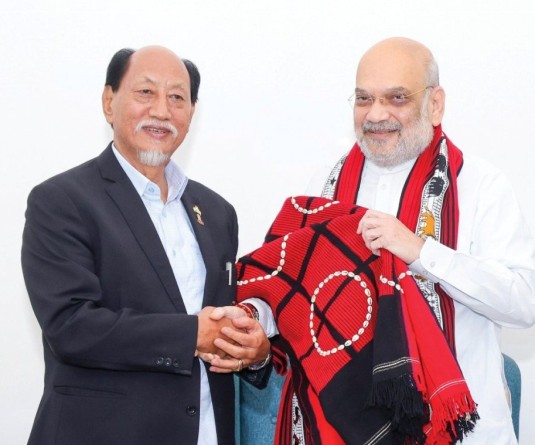
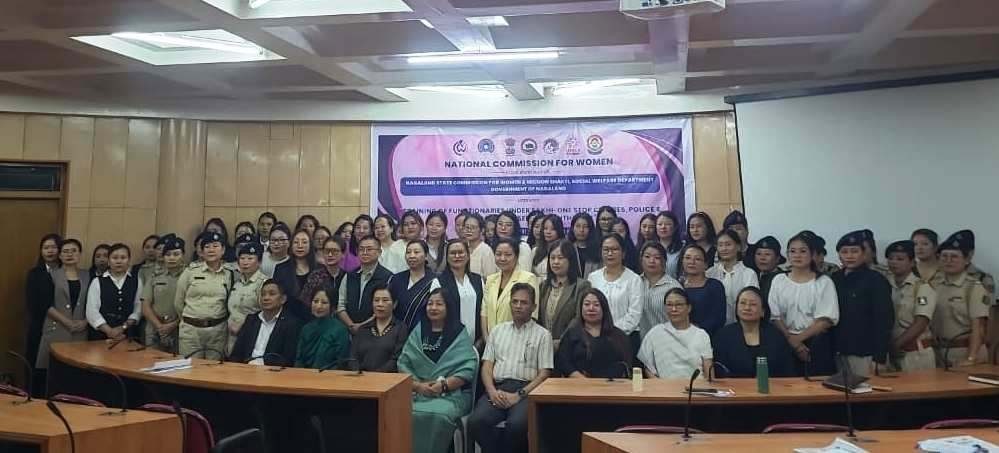
Rupin Sharma and other dignitaries with participants of training for functionaries under Sakhi-One Stop Centres, Police, Legal Services Authority in Kohima on August 5. (Morung Photo)
Training for functionaries under Sakhi-One Stop Centres, Police, Legal Services Authority
Our Correspondent
Kohima | August 5
The National Commission for Women (NCW) in collaboration with Nagaland State Commission for Women (NSCW) and Mission Shakti under Social Welfare Department, Nagaland on August 5 organised a training programme for functionaries under Sakhi-One Stop Centres, Police and District Legal Services Authority at PHQ Conference Hall, Kohima.
The programme witnessed discussion on medico-legal procedures for handling gender-based violence, mental health & self care, convergence protocols and SOPs for catering to women & children affected by gender-based violence.
Talking on the work of police and the laws, Rupin Sharma, Director General of Police (DGP) Nagaland, stressed on the need to coordinate with each other, sort out things together and make life safer for all the women and children of Nagaland.
He said that all departments which are dealing with crimes against women, gender based violence, human trafficking and gender abuse need to consult each other and work together to prevent gender-based violence. “If we coordinate better, we will achieve better results,” Sharma said.
Sharma also stressed on the need to evolve to a newer system to deal with crime cases and start trusting the modern system of governance.
Talking on preventive aspect, he said that a lot of crimes against women and children can actually be prevented. “There are tell-tale time signs in the society or in the family which I think we need to pick up,” he said.
“If women or children start coming openly about abuse or violence in the family or sexual abuse of children or women, the risk is that the family structure may get hurt. But the advantage is that soon the males will learn a lesson that this cannot be done,” Sharma said.
‘Ensure no woman or child feels abandoned by the state or the law’
NSCW Chairperson W Nginyeih Konyak said that the Commission envisions a society where every woman can live a life entirely free from fear, coercion, and violence.
“Every day, women face vulnerabilities that test their resolve, safety, and dignity. When a woman in distress seeks help, she does not see boundaries between government departments. She simply looks for safety, justice, and a hand to hold,” She said.
But historically, she said a major hurdle in handling gender-based violence has been institutional isolation.
“A survivor would approach the police, only to be told to seek a legal remedy elsewhere. She would go to a hospital for medical aid, where her injuries might be treated without addressing her immediate safety. She would visit a legal aid clinic, while still lacking physical shelter or psychological counselling. This fragmented approach inflicts secondary trauma on an already vulnerable individual. We cannot expect a victim of trauma to navigate a complex, bureaucratic maze just to feel safe, Nginyeih said.
She said that Government of India launched Mission Shakti, an integrating sub-scheme like the One-Stop Centres (OSC) and the Women Helpline. The ultimate goal is a seamless ecosystem of care.
Stating that in Nagaland, the social fabric is beautifully interwoven with strong community ties, rich customary traditions, and tribal values, she however said “While these structures offer immense social security, but they sometimes, inadvertently or intentionally, cause domestic distress to be pushed behind closed doors. The fear of social stigma, the lack of economic independence, or simply the ignorance of legal rights often forces women to suffer in agonizing silence.”
She called upon all the stakeholders to ensure that no woman or child in Nagaland who is a victim of domestic violence feels abandoned by the state or the law.
Olemjungla Aier, Additional Secretary, Social Welfare and Mission Director, Mission Shakti said that the strategic convergence of Sakhi-OSC, Police Deptt and the NLSA can establish a seamless institutional mechanism that ensures comprehensive protection and holistic empowerment of women affected by violence.
She said that Mission Shakti Centres is a dedicated Mission for safety, security and empowerment of women supported by the Ministry of Women & Child Development, Gol.
The Women Helpline-181 and Child Helpline - 1098 (Women & Child Development Control Room) in Kohima is integrated with the District centres.
Sakhi-One Stop Centres are set up in 17 districts including Shakti Sadan - a long term relief and rehabilitation shelter home for women in distress.
The District Hubs for Empowerment of Women (DHEW) are responsible for creating awareness under Beti Bachao Beti Padhao scheme.
“Let us renew our commitment to give our best of services through coordinated action. Effective coordination and regular communication among the departments is key to achieving our goal,” Aier said.
‘Give due justice & integrated services without delay’
Tosheli Zhimomi, Director, Social Welfare, Nagaland, reiterated that as per the guidelines issued by the Ministry of Women & Child Development, Gol, One Stop Centers are mandated to work in close coordination and convergence with other initiatives like District Legal Service Authority (DLSA) and Anti Human Trafficking Units (AHTUs), Women Help Desks (WHDs) under Police.
She said that today's training program aim at strengthening knowledge and skills, adding “More importantly, it is a good platform to strengthen our convergence mechanism between Police, legal service authority and Social Welfare Department.
“Let us continue to collectively work together to ensure that victims who approaches us are given due justice and integrated services without any delay,” she added.
Dr S Manyau Phom, Project Director, NSACS, Health & Family Welfare, Nagaland talked on the topic “Medico- Legal Procedures for handling Gender-Based Violence” while Themmungla Raman Longkumer, Clinical Psychologist, The Cloud Room spoke on “Mental Health & Self Care: Burnout Prevention, Stress Management & Emotional Resilience.”
Dr. Tiamenla Phom, NPS, Addl. Superintendent of Police, Zunheboto and Gracy Ayee, State Mission Coordinator, Mission Shakti, Department of Social Welfare talked on “Convergence Protocols” and “SOPs for Catering to Women & Children affected by Gender-Based Violence” respectively.
NSCW member Akokla Longchar chaired the introductory session while Meteno V, Gender Specialist, SHEW, Mission Shakti, and Department of Social Welfare moderated the technical session.