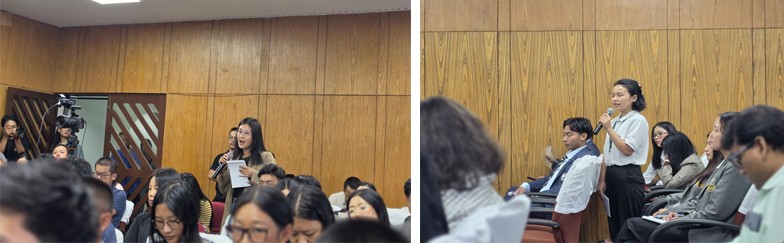
Attendees take part in the discussion during the XXIII Morung Lecture at Hotel Japfü, Kohima, on August 19. An initiative of The Morung Express, the XXIII Morung Lecture and was organised in partnership with the Research and Development Cell, Fazl Ali College, Mokokchung. (Morung Photo)
‘We need people with vision at all levels’
Morung Express News
Kohima | August 19
While corruption, nepotism and favouritism have manifested in various forms in Nagaland over the years, Lithrongla G Chishi (Retired IAS) nevertheless expressed optimism about the new breed of officers, whose sincerity would determine the future of society.
In response to a query raised during the XXIII Morung Lecture, held at Hotel Japfü, Kohima, on August 19 under the theme “Truth and Integrity in Naga Public Life”, on the extent of good seen in public service, she stated that their sincerity and commitment would make a difference, even though the impact may not be very visible now.
She also maintained that better governance emerging now is an outcome of training and capacity-building extended to government employees.
‘Silence weakens deterrence’
On the other hand, drawing from personal experience, she cited that as a government servant heading a department, one of their greatest fears was coming under the Comptroller and Auditor General (CAG). In Nagaland, she, however, noted that the CAG is not taken seriously, with no social platform taking it up and putting it at such a point where departments realise they have to fear coming under the CAG.
She urged young people, in particular, saying that “it is time to open up” and that one change in one department would make a difference in the public life of Nagaland. She further underscored that one does not have to depend on somebody for their integrity, but that it is a quality of oneself.
In the meantime, she underlined that the lack of integrity in the State’s data has also caused a lack of development. She called upon the younger generation to rise up and raise issues and, as research scholars, contribute to developing data with integrity.
Responding to queries related to CAG reports, Kahoto J Yepthomi, IAAS, provided insights into auditing and asserted the need for people to raise their voices.
Citing several instances and observations from years of professional experience, he reiterated the need to start questioning the system while also pointing out that there are many pressure groups in the State.
“Deterrence is not there because all of us are not speaking out,” he said, further commenting that corruption, nepotism and favouritism have been normalised and accepted as a way of life.
“All of us should raise our voice and that's how things change even if it takes time,” he emphasised, while stating that it is far worse if we keep quiet.
He also observed that Nagas are very good at DPR (Detailed Project Report), but maintained that execution is pathetic. Stating that many people do not practise corruption but that their silence affects the system, he urged the gathering to ask questions and raise their voice, while underscoring that “we need people with vision at all levels.”
‘Any healthy society should be able to self correct’
In his closing remarks, Aküm Longchari, Publisher of The Morung Express, pondered on how society can really self-correct, stating that any healthy society should be able to self-correct.
Stating that, as a society, “we seem to value stability more than the truth”, he asked, “for us to self correct, how do we bring the truth back?”
In the 21st century, he noted that “truth seems to be defined by the powerful”, while highlighting the distinction between truth that reveals and truth that hides.
If society is to self-correct, he called for everyone to take responsibility for contributing to shedding light.
In the era of social media, he further asked, “is it possible for us to look at the facts first, before creating a theory”, pointing to social media where reports and information are not necessarily based on facts and the need to reverse this.
He also called upon the gathering to ground themselves in reason and asserted the need to pursue truth wholeheartedly and not selectively.
“For us to self correct, it also means to take a step back, look at the value system, why it is degenerating especially at a time when truth is diminishing. We have to all engage in truth telling,” he articulated.
The Morung Lecture is an initiative of The Morung Express. The XXIII series was organised in partnership with the Research and Development Cell, Fazl Ali College, Mokokchung.