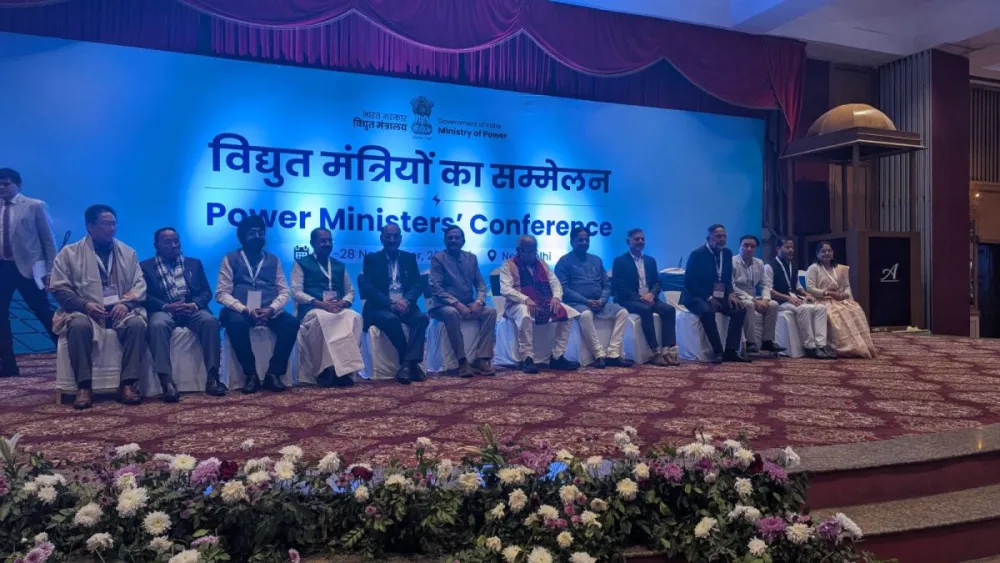
KG Kenye along with other officials during the Power Ministers' Conference of States and Union Territories in New Delhi on November 28.
State unable to meet basic power needs through own generation
Our Correspondent
Kohima | November 28
Nagaland is the only state that continues to be unable to generate sufficient electricity to meet its basic power requirements, Power and Parliamentary Affairs Minister K G Kenye said on Saturday.
Addressing Union Power Minister Manohar Lal during the Power Ministers' Conference of States and Union Territories in New Delhi, Kenye said the state faced a persistent gap between power demand and supply, placing significant strain on households, public services and, particularly, its emerging industrial and entrepreneurial ecosystem.
He said Nagaland's existing installed power generation capacity stood at 39.4 MW, while its total installed capacity, including allocation from the Central Sector, was 241.4 MW.
The state's present peak power demand is 203 MW and is projected to reach 482 MW by 2034-35, he said.
According to the Central Electricity Authority's (CEA) Resource Adequacy Plan 2035, a generation capacity of at least 715 MW from various non-renewable and renewable sources would be required to meet the projected demand of 482 MW.
Kenye said the state had drawn up several initiatives to add capacity by developing its own generation projects and encouraging private sector participation.
A total of 668 MW has been tied up through existing projects, projects in the pipeline, power purchase agreements (PPAs) and No Objection Certificates (NOCs) issued to private developers.
An additional 40 MW hydroelectric project is also under planning. However, various obstacles have already delayed projects for decades, and despite the PPAs and NOCs, none of the envisaged projects has taken off.
Given the circumstances, the state was unlikely to meet even its basic power requirements over the next decade, Kenye said.
He stressed the need for a major impetus to solar power generation through the Battery Energy Storage System (BESS) initiative, describing it as the most reliable and cost-effective alternative to achieve the target of at least 715 MW generation capacity by 2034-35.
Generation
Kenye said the state was pursuing three major hydroelectric generation projects.
Of these, the 42 MW Lower Tizu Hydroelectric Project and 24 MW Zungki Hydroelectric Project, with estimated costs of Rs 514.12 crore and Rs 368.53 crore respectively, had been approved by the Department of Economic Affairs (DEA) and were currently undergoing due diligence studies by the Asian Development Bank (ADB).
The third project, the 24 MW Tizu Valley Hydroelectric Project, estimated to cost Rs 366.22 crore, had been proposed for implementation under the External Aided Project (EAP) route.
He also said the development of 25 MW/100 MWh BESS facilities at the 220/132/33 kV Zhadima substation and at Niuland, at an estimated cost of Rs 127 crore each, had been proposed.
Kenye said BESS had immense potential if the Ministry of Power (MoP) allocated Nagaland a quota of at least 500 MW of solar power from the 30,000 MW Central Reserve, along with all admissible support, including Viability Gap Funding (VGF).
Transmission
The CEA, in collaboration with the Nagaland government, had prepared the Transmission Plan 2034-35, comprising an additional transmission capacity of about 770 MVA, transmission line connectivity of 963 circuit km and restringing or reconductoring of 277 circuit km.
The plan, estimated to cost around Rs 1,900 crore, is intended to meet the projected power demand of 482 MW by 2034-35.
To address critical transmission infrastructure requirements in different parts of the state, a portion of the plan had been proposed for EAP funding under the project titled "Development of 132 kV Western Intra-state Transmission System Build-up and Strengthening, Nagaland", with an estimated cost of Rs 898.89 crore.
A separate proposal amounting to Rs 604 crore for urgent strengthening and modernisation of the transmission and sub-transmission systems had been submitted to the North Eastern Regional Power Committee (NERPC), Shillong, for recommendation of funding under the Power System Development Fund (PSDF) of the Ministry of Power, Government of India.
Distribution
Kenye said the Distribution Perspective Plan 2034-35 had been prepared, envisaging an additional distribution transformer capacity of about 685.55 MVA.
The plan also includes associated 33 kV, 11 kV and low-tension line connectivity of 5,576.21 circuit km, with an estimated cost of Rs 1,355.17 crore, to cater to a cumulative connected load of 1,163.55 MVA by 2034-35.
The total number of consumers, including existing consumers, is projected to reach 5,72,485.
Under the ongoing Revamped Distribution Sector Scheme (RDSS), the state is implementing smart metering for 3,17,210 consumers at a project cost of Rs 328.17 crore.
For the remaining 2,55,275 consumers, Nagaland would require additional budgetary assistance of Rs 139.94 crore from the Centre, he said.