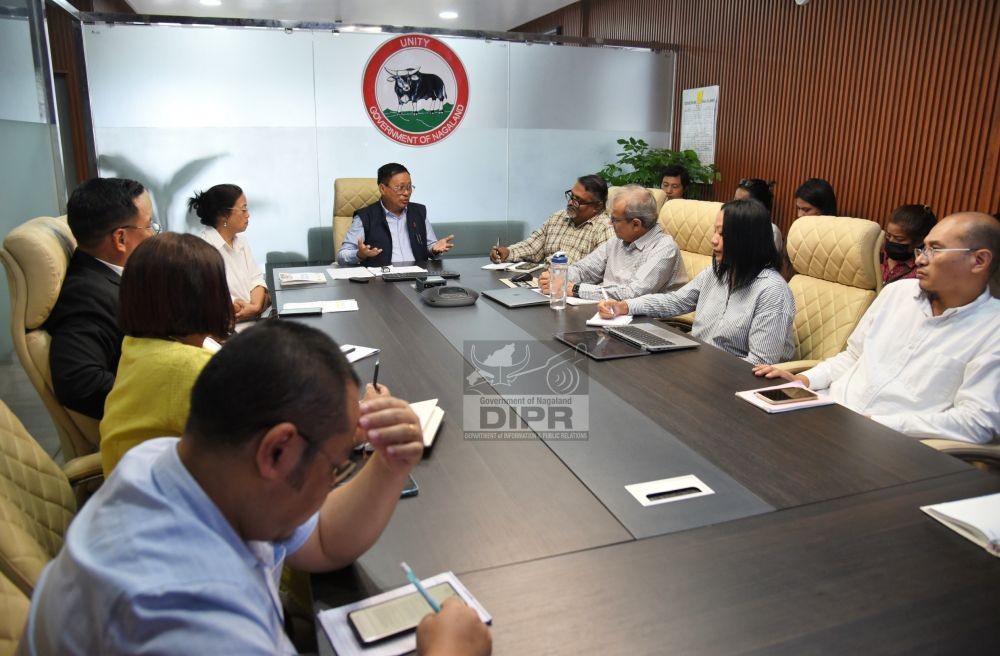
Principal Secretary and Development Commissioner, Y Kikheto Sema, IAS chair the coordination meeting with Jaimon Uthup, Policy Specialist from UNDP, along with STG cell and Planning department officials at the Nagaland Civil Secretariat, Kohima on August 15. (DIPR Photo)
Kohima, August 14 (MExN): Nagaland is taking concerted steps to improve its performance in the Sustainable Development Goals (SDGs), with a focus on addressing data reporting gaps, capacity constraints, and the State’s unique socio-economic and geographical context, officials said on Friday.
Principal Secretary and Development Commissioner, Y Kikheto Sema, IAS, held a coordination meeting with Jaimon Uthup, Policy Specialist from the United Nations Development Programme (UNDP), along with STG cell and Planning department officials at the Nagaland Civil Secretariat, Kohima. The meeting was part of the ongoing formulation of the Viksit Nagaland 2047 vision framework and aimed at identifying reasons behind the State’s low ranking in the SDG assessment, stated a DIPR report.
Data reporting gaps major reason for low score
Sema pointed out that inadequate awareness among departments about SDG data submission was a primary reason for Nagaland’s poor performance in the 2024 SDG assessment. Several departments either failed to submit accurate data or did not upload required information on designated dashboards, leading to indicators being recorded as “zero” or “unreported”.
“One of the major reasons for the State’s low performance was inadequate awareness among departments about the importance of SDG related data submission. Several departments had either failed to submit accurate data or had not uploaded the required information on the designated dashboards and portals,” Sema said.
He also highlighted practical challenges at the grassroots level, including lack of smartphones and devices among Anganwadi workers in some areas for uploading data. Training and capacity building initiatives are now being undertaken to address these issues, he added.
Context-sensitive approach needed
Sema stressed that SDG indicators must be viewed in light of Nagaland’s distinct agricultural practices, where traditional and shifting cultivation with limited fertiliser use naturally results in lower measured yields compared to intensive commercial farming.
“Some indicators are not fully relevant to the State, particularly those relating to agricultural productivity measured in kilograms per hectare. Agriculture in Nagaland is largely based on traditional and shifting cultivation practices, with limited use of chemical fertilisers, which naturally results in lower measured yields,” he said.
On gender equality, Sema noted that earlier data had failed to capture the actual participation of women, who are now actively represented in Village Development Boards, Education Committees, and Water and Sanitation Committees, besides forming a substantial share of banking and financial service beneficiaries.
Disparities among districts
While acknowledging genuine development gaps in health, education, road connectivity, and financial services, Sema referred to the NITI Aayog July 2025 district-level performance report, which placed Mokokchung (4th), Kohima (6th), and Dimapur (10th) among the top 10 performing districts in the Northeast. However, he noted that some districts continue to rank low, highlighting significant intra-State disparities.
“Some districts of the State continue to remain at the lower end of the ranking, highlighting the significant disparity in development outcomes between the front-running and lagging districts,” he said.
UNDP assures technical support
Policy Specialist Jaimon Uthup assured that the concerns raised by the State would be conveyed to the UNDP Country Head and discussed at the appropriate level. He appreciated Nagaland’s continued engagement with the SDG framework and acknowledged the practical difficulties and contextual factors explained during the meeting.
“UNDP would continue to extend technical assistance and support to the Government of Nagaland in strengthening SDG implementation and monitoring,” Uthup said, adding that he was optimistic about improvement in the State’s SDG Index score in the next assessment.
Lead Consultant Sunder Subramanyam presented the draft document on the vision and roadmap for Viksit Nagaland, outlining key areas and proposed framework. He acknowledged the need to incorporate the latest and most reliable statistical data to ensure the document reflects an accurate assessment of the State’s development status.
Sema proposed a meeting involving the Statistical, Planning and Finance departments to review Gross State Domestic Product (GSDP) figures, stressing the need for a consistent baseline for measuring economic growth. He also urged the UNDP to convey the need for a more context-sensitive approach, stating that a “one-size-fits-all” approach may not reflect the realities of States like Nagaland.
The UNDP team expressed the view that Nagaland is moving in the right direction and that ongoing consultations with departments and stakeholders would help strengthen the Viksit Nagaland 2047 roadmap, ensuring it remains grounded in the State’s actual development needs.