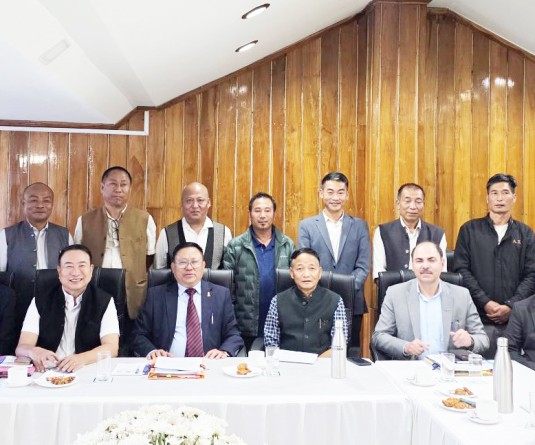
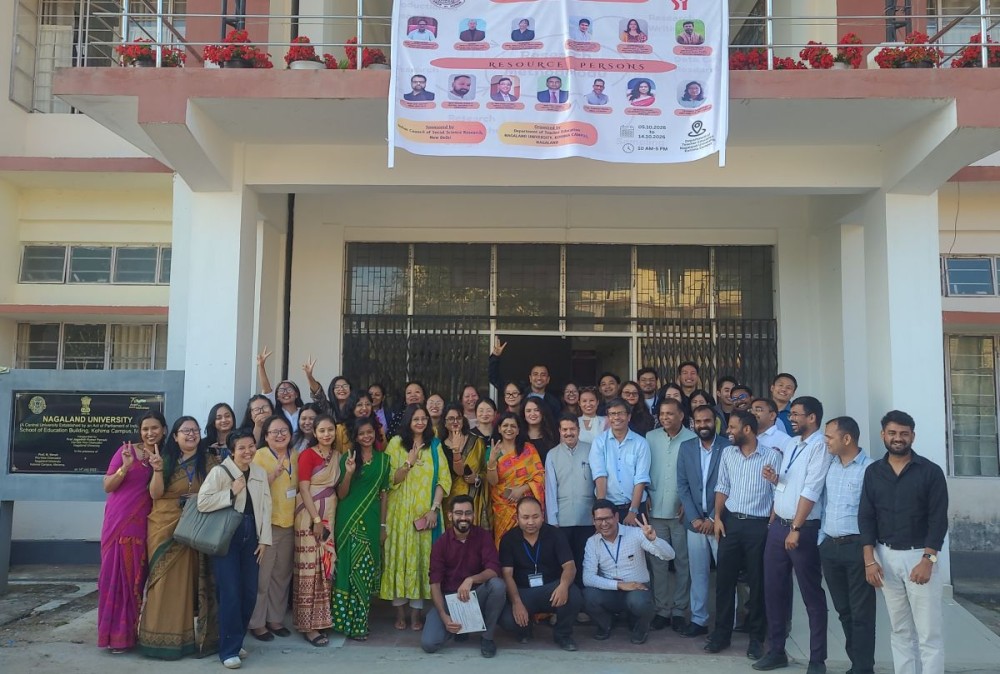
Dignitaries and participants of 10 Day Research Methodology Course on October 14. (Morung Photo)
Our Correspondent
Kohima | October 14
A ten day Research Methodology Course (RMC) on “Enhancing Research Capacities through Digital Tools: From Theory to Practice” organised by Department of Teacher Education, Nagaland University, Kohima Campus, Meriema and sponsored by Indian Council of Social Science Research (ICSSR) concluded on October 14.
Addressing the valedictory function, Dr Nigamananda Das, Senior Professor, Department of English, Nagaland University, described the RMC as educative, relevant and fruitful exercise and urged upon the participants from across the country to become expert in their respective fields and contribute for social growth and development.
He also encouraged them to keep writing research papers and gain recognition for their expertise.
Later, he released a book on “Work Life Balance among women: Challenges opportunities transformation” written by Prof. Anju Verma and Dr. Seema Rani Thappa.
Presenting consolidated report of the ten day course, Angukali S Swu, PhD Scholar, Department of Teacher Education said that the RMC held from October 5 to 14, aimed to strengthen research competencies through expert lectures, practical demonstrations, and hands-on activities covering digital research tools, literature reviews, data analysis, academic publishing, plagiarism detection, and research ethics.
Professor GN Tiwari’s discussed on the theoretical foundations of digital research tools. He emphasized that conceptual understanding and critical thinking must take precedence over blind dependence on technology.
Professor Pranab Prabhakar talked on research quality indicators, including the H-index, Impact Factor, and SCImago Journal Rank (SJR), highlighting that research quality cannot be determined by publication metrics alone.
Dr Anu GS took session on the ethical aspects of digital technologies, addressing data privacy, responsible technology use, and research ethics.
Professor PK Patnaik discussed technology integration in the context of the National Education Policy 2020, highlighting digital learning platforms, Open Educational Resources, virtual laboratories, and the role of technology in strengthening higher education.
Dr Sushil Kumar Singh demonstrated the applications of Microsoft Word, Excel, and PowerPoint in academic writing, data management, and research presentations.
Dr Monita Wahengbam, explored AI-supported data analysis, Agentic AI, and research platforms such as Consensus and SciSpace.
Dr Thongam Thomas Singh introduced participants to Google Drive, Docs, Sheets, Forms, Slides, and Analytics. The demonstrations covered document management, collaborative research, questionnaire development, data collection, and digital data organisation.
Dr Roopam Bachhil introduced Exploratory Factor Analysis (EFA), Confirmatory Factor Analysis (CFA), and Structural Equation Modelling (SEM), with reference to SPSS and AMOS. Participants gained insights into data cleaning, sampling adequacy, factor analysis, and examining relationships among research constructs.
Dr Subhashish Banerjee, delivered a lecture entitled “Researching the More-than-Human World: Digital Humanities and Arboreal Consciousness.”
Professor Manoj Saxena discussed plagiarism, authorship concerns, publication ethics, and the responsible use of AI in academic writing.
Professor Amit Gautam of NIEPA conducted sessions on AI applications in different fields and their relevance to research.
Dr K Thiyagu Suriya Q from Central University of Karnataka introduced digital tools such as VOSviewer, R, Dimensions, and Bibliometrix.
Dr Prabhakar Sharma discussed journal selection, publication procedures, journal metrics, and the identification of predatory and cloned journals.
Dr Prasenjit Pal, focused on developing research instruments such as questionnaires, checklists, rating scales, and schedules. The session also introduced JASP statistical software.
Professor Vimal Kishor from Central University of Jharkhand discussed the role of Open Educational Resources in promoting accessible, affordable, and inclusive education.
Dr Subhash Mishra of Babasaheb Bhimrao Ambedkar University, Lucknow, focused on qualitative data analysis and the systematic interpretation of textual and descriptive information.
Dr Chanlang Ki Bareh, Prof. Ashutosh Tripathi, Dr Seema Rani Thappa and Prof Lungsang Zeliang also spoke on the programme.
Chairing the valedictory function, Dr Prasenjit Pal said that “In the modern academic and professional landscape, research and digital tools have become inextricably linked, fundamentally transforming how knowledge is discovered, analysed, and shared.”
He said that digital research platforms-ranging from scholarly search engines like Google Scholar and Semantic Scholar to specialised databases allow scholars to rapidly access vast libraries of peer-reviewed literature from anywhere in the world.
Shivam Mohra from Central University of Haryana was declared as the Best Research paper while Visalieto Lhousa from Nagaland University bagged second place. Anisha Chhetri from Sikkim Central University was adjusted as the Best Poster Presentation while Zevisanuo Khate from Nagaland University stood second place. Anisha Chhetri, from Sikkim Central University, Mintu Kumar from Tezpur University, Raj Kr Chhetri from NU Kohima Campus and C Yelih Konyak from Nagaland University, Lumami shared their experiences.
Meanwhile, Prof Anju Verma proposed the vote of thanks. Mentioanably, Prof N Venuh, Pro-Vice Chancellor NU Kohima Campus and Prof Jano S Leigise, Dean, School of Humanities & Education, NU-Kohima Campus were the patron and co-patron respectively of the RMC.
Following the academic session, participants, accompanied by the course coordinators, visited Khonoma Village for cultural and environmental exposure.