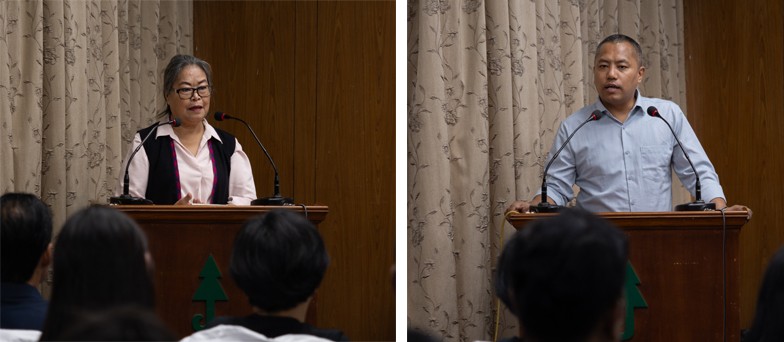
(LEFT) Lithrongla G Chishi and (RIGHT) Kahoto J Yepthomi address the XXIII Morung Lecture at Hotel Japfü, Kohima, on August 19. (Morung Photo)
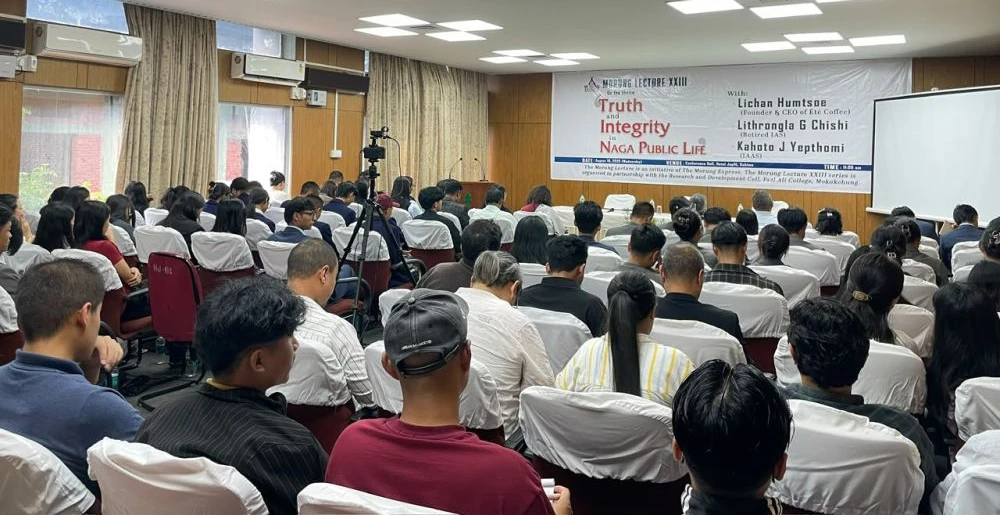
XXIII Morung Lecture calls for truth, integrity and accountability in Naga public life
Morung Express News
Kohima | August 19
Speakers at the XXIII Morung Lecture have called for deeper introspection into Naga society, warning that corruption, nepotism, favouritism and misuse of public resources have become so normalised that many people no longer question them.
Speaking on the theme “Truth and Integrity in Naga Public Life” at Hotel Japfü, Kohima, retired IAS officer Lithrongla G Chishi and Kahoto J Yepthomi of the Indian Audit and Accounts Service (IAAS) urged Nagas to look beyond what they preach and examine what they actually practise in their homes, workplaces and public institutions.
Accepting uncomfortable reality
Chishi said truth begins with accepting reality, even when it is uncomfortable.
She also spoke about the importance of being honest with oneself, recalling instances of age tampering in official records.
While such practices may have declined, she said they serve as a reminder of how easily people can compromise truth when circumstances appear to justify it.
For Chishi, integrity is ultimately about what a person does when nobody is watching. She questioned the growing emphasis on academic achievement, careers and competition at the expense of character and responsibility. Schools may provide knowledge, she said, but families have a greater role in teaching children honesty, compassion and moral values.
“It's time we change our mindset,” she said, urging parents to recognise that children learn more from what adults do than from what they say.
Nepotism, VIP culture and responsibility
She was particularly critical of nepotism and VIP culture, saying young people without influential connections often struggle to access jobs, education and other opportunities.
Drawing from her experience, Chishi recalled seeing deserving entrepreneurs lose out while those with connections received preferential treatment.
She also cautioned against blaming politicians alone for corruption.
Public servants, she said, have a responsibility because government decisions ultimately pass through officials who process and sign them.
“If all of us in public life can make a difference and say no to wrong things, say no to dishonest things, say no to corruption, say no to nepotism, we will be able to change,” she said.
Chishi also raised concerns about unnecessary government expenditure, saying public servants must be willing to question practices that place an unnecessary burden on the state.
She said integrity should extend beyond government and politics to everyday human relationships. The decline of compassion, she observed, is equally troubling, with people becoming increasingly focused on their own ambitions and goals. “We need to rebuild our society now, based on moral values and ethics,” she said.
‘The problem is what we preach and what we practice’
Yepthomi, meanwhile, described the situation in Nagaland as ‘deeply worrying’ having worked in the state for more than a decade adding that he had seen corruption become increasingly normalised.
“We have accepted this as a part of the system. No one is even questioning it,” he said. He also questioned the gap between Nagaland’s Christian identity and its public conduct.
He recalled how traditional Naga society placed considerable value on honesty, hard work and family reputation. Yet, he said, a society that now identifies itself overwhelmingly as Christian has struggled to uphold those same values.
“The problem today is between what we preach and what we practise,” he said. He also questioned the silence of churches and church leaders on corruption, arguing that corruption should be treated as a moral issue rather than merely an administrative or political one.
According to Yepthomi, public life must also include church leaders, NGOs and civil society leaders, student leaders and others who influence society.
He warned that tribal and personal loyalties were often placed above the common good, with people defending wrongdoing simply because the person involved belonged to their tribe, clan or circle.
State finances and public responsibility
Yepthomi also drew attention to Nagaland’s financial difficulties, saying the State’s dependence on central funding made responsible use of public money even more important.
He revealed that changes in central funding, including the withdrawal of the Revenue Deficit Grant, had added pressure to the State’s finances.
With a large share of Nagaland’s resources coming from outside the state, he said public officials and citizens should be particularly conscious that the money being spent ultimately comes from taxpayers.
“We have to be more accountable. We have to be more transparent,” he said.
He also pointed to voters’ role in the system, particularly during elections. If candidates are chosen because of their ability to spend money or provide personal benefits, he said, citizens cannot expect them to govern entirely in the public interest.
“Who are our leaders? It is we who are electing them,” he said.
Speaking up against wrongdoing
Yepthomi was also critical of weak accountability and what he described as the normalisation of ineffective disciplinary action.
He said suspension was often treated as the standard response to wrongdoing, but questioned whether it served as a meaningful punishment when suspended employees continued receiving subsistence allowances.
He further raised concerns about projects that exist on paper but are not properly implemented; saying public silence allows those responsible to continue without fear of serious consequences.
He called for greater use of mechanisms such as the Right to Information (RTI) to promote transparency, while also cautioning against its misuse for personal gain.
At the same time, he encouraged citizens to ask difficult questions. “We should start speaking up,” he said.
Hope in the younger generation
Conversely, Yepthomi said there were reasons for hope. He observed that younger officers entering government service appeared more willing to work honestly and responsibly.
He also noted that departments were increasingly responding when audit reports pointed out irregularities, suggesting that greater public scrutiny was beginning to have an impact.
For both speakers, however, lasting change will require more than government action.
Chishi urged the present generation to think about what it is leaving behind for its children and grandchildren. Yepthomi similarly argued that change cannot simply be demanded from political leaders; citizens must examine their own role in sustaining the system.
“Change is not going to start from anywhere else. Change is going to start from you and me,” he said.
The speakers ultimately called for a return to values that place honesty, accountability, compassion and the common good above personal interests.
As Yepthomi put it, truth is more than stating facts; it is about living with honour and keeping one’s word. Integrity means doing what is right even when nobody is watching.
For a society seeking a better future, he said, truth can build trust, trust can strengthen accountability, and accountability can lead to greater unity, peace and development in Nagaland.
The Morung Lecture is an initiative of The Morung Express and the XXIII series was organised in partnership with the Research and Development Cell, Fazl Ali College, Mokokchung.