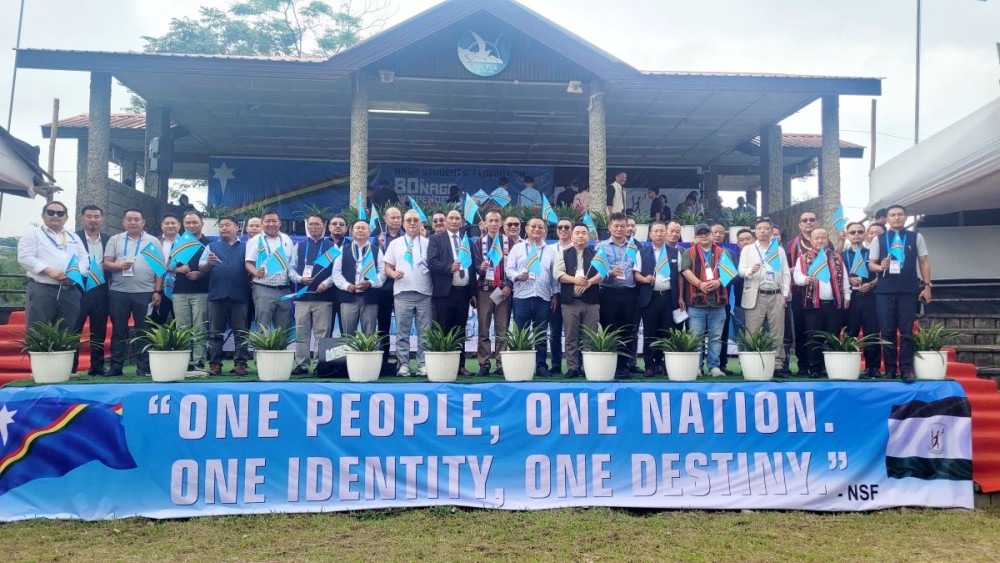
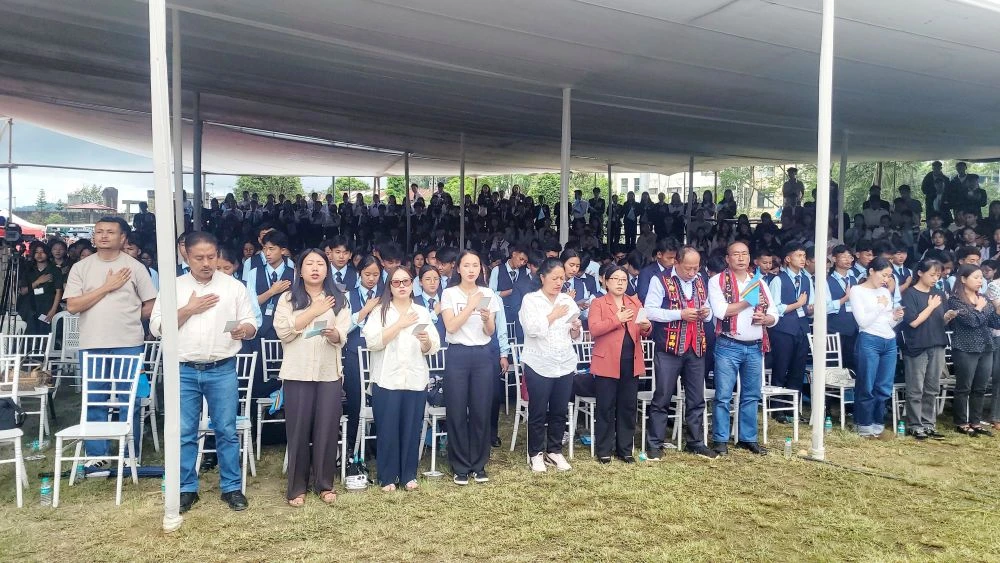
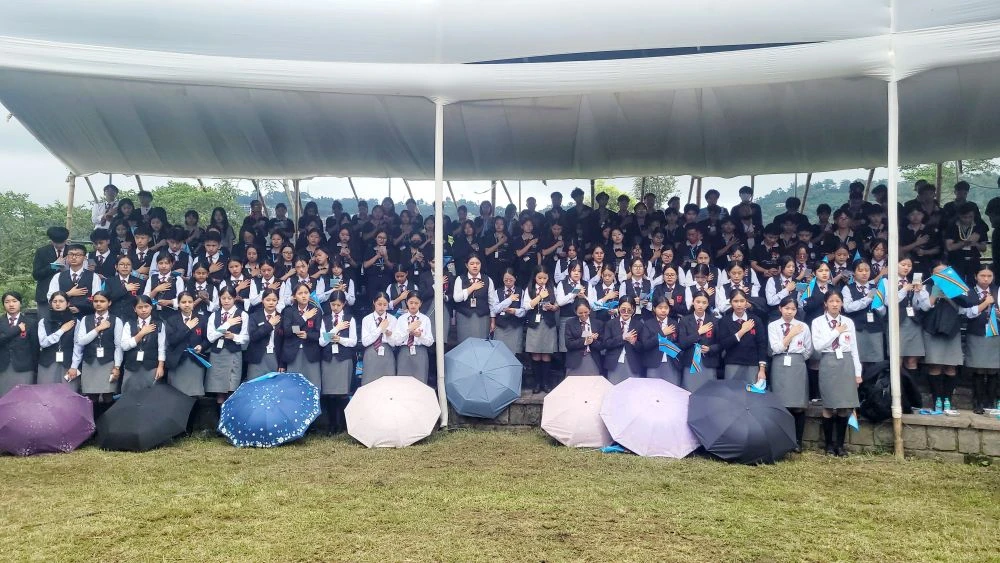
Officials and participants during the 80th Naga Independence Day commemoration programme oganised by NSF at Naga Solidarity Park, Kohima on August 14. (Morung Photo)
Morung Express News
Kohima | August 14
Legal luminary, Tongpok Pongen has called on the Naga people, particularly the younger generation, to rebuild trust, strengthen unity and reflect on the values that guided their forefathers when the Naga independence movement began.
Speaking at an 80th Naga Independence Day commemoration programme oganised by the Naga Students’ Federation (NSF) at Naga Solidarity Park, Kohima Pongen said the declaration of August 14 as Naga Independence Day was the result of years of preparation and collective effort by Naga leaders.
Pongen said the greatest achievement of the pioneers was their ability to bring the people together around a shared vision of independence.
“They were free and independent people, proud of their heritage and proud that they did not depend on outside charity to exist,” he said, describing the people of that period as hardworking and self-reliant.
He noted that an overwhelming majority of Nagas supported the independence movement, but cautioned that history should not be remembered only through its achievements.
“There are also dark sides to everything,” he said, adding that the Naga people must learn from their hardships and mistakes as much as from their accomplishments.
Pongen said the early Naga movement drew inspiration from the biblical Exodus, particularly the idea of “Let my people go”. He said the original aspiration was to live peacefully as a nation among other nations, maintain good relations with neighbours and help one another.
However, he lamented that the movement gradually became marked by internal conflict and bloodshed. “What happened? Brothers turned on brothers,” he said, recalling the violence that emerged within Naga society.
He drew a parallel with the biblical story of Cain and Abel, saying the shedding of innocent blood had consequences and that the Naga people continued to experience the divisions that followed.
According to Pongen, the splintering that began during those years has continued in different forms, including within civil society, where new groups continue to emerge claiming to represent different sections of the Naga people.
He cited the biblical teaching that a house divided against itself cannot stand, arguing that Nagas must honestly acknowledge the extent of their divisions rather than trying to justify them.
“How do we rebuild that trust which was there when our forefathers started this movement?” he asked. Pongen said rebuilding a broken society would not happen overnight and would require the participation of every section of society and, importantly, the younger generation.
He urged students to begin building bridges at their own level, saying tomorrow’s leaders have a responsibility to create stronger relationships across communities.
“It is not built by some elders coming together. It is built by all members of society, whichever group you may belong to,” he said.
He also called for greater interaction among Nagas, saying people should not live like isolated islands and come together only during public occasions.
Pongen contrasted the self-reliance of earlier generations with what he described as the growing dependence of modern society.
He questioned whether Nagas today were truly free, asking whether dependence and personal obligations had compromised their sense of independence.
“Are we free today?” he asked, urging people to consider whether they were hardworking, self-reliant and capable of taking pride in themselves.
Pongen also challenged what he described as a common perception of Naga history that portrays the forefathers simply as headhunters.
He acknowledged that warfare existed and that heads were taken during conflicts, but said traditional Naga society was not characterised by indiscriminate attacks on neighbouring villages.
Instead, he pointed to the diplomatic relationships and networks of trust that existed among villages and tribes. He urged the younger generation to reflect independently rather than simply accepting opinions handed down by others.
Calling for the Naga people to return to their faith and make God central to their lives, Pongen said this should go beyond symbolic prayers during meetings and instead involve a genuine commitment to prayer and Christian values.
He also called on Naga leaders to turn to God and urged the people to learn from the mistakes of the past rather than repeating them.
Referring to the biblical teaching that truth sets people free, Pongen said the Naga people should seek guidance through faith and remain committed to learning from their history.
He expressed the belief that a return to God, greater unity and a willingness to learn from past mistakes could help the Nagas move closer not only to a final political solution but also towards a more peaceful and united society.