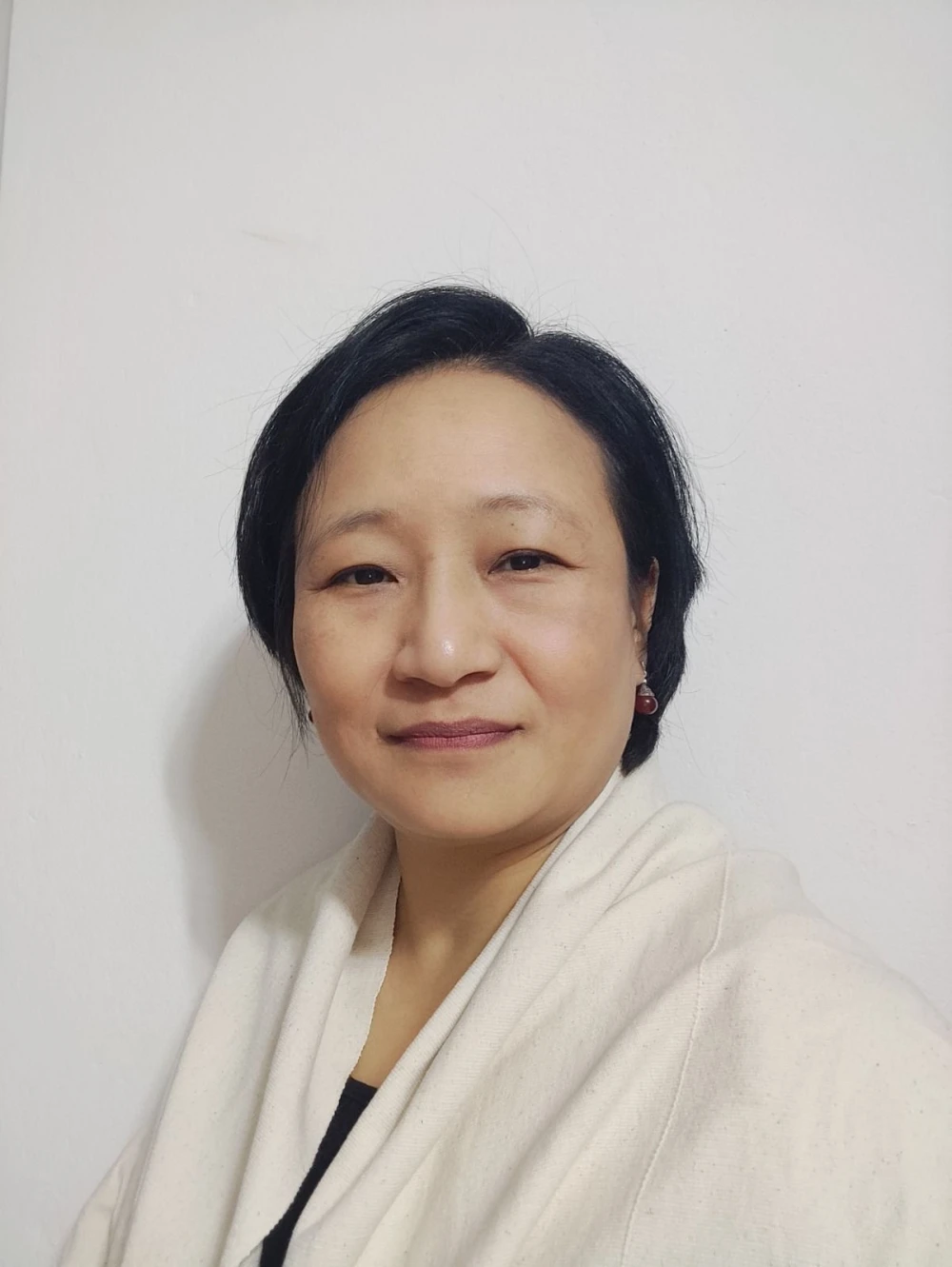
Avinuo Kire (Image by Kekhriezalie Keretsu)

Aims to document ancestral wisdom of elders
Vishü Rita Krocha
Kohima | March 16
Given the stark reality of a dying generation of ‘professional storytellers’, who are leaving and taking with them the bulk of information vital for cultural survival, Nagas are on the verge of losing an entire generation’s knowledge and wisdom that might further lead to the loss of “the link to our ancestral heritage.”
This deep realisation prompted Dr Avinuo Kire and Dr Meneno Vamuzo Rhakho to set up ‘The Naga Heritage Centre’ with the intent of preserving, revitalizing, safeguarding, promoting and increasing awareness of Naga heritage through various means.
“There is a serious urgency to collect from the elders, as they are our only channel to gain from and maintain our sense of identity as a people,” they highlight even while acknowledging that, “these elders are our walking libraries, whose vast knowledge needs to be tapped into and collected before they walk away with their entire libraries.”
Towards achieving this challenging and monumental task, the Naga Heritage Centre is documenting oral narratives not only as means of preserving them for the present generation of Nagas but for future generations as well, for whom, in their words, “are the only link to the past.”
As a highly oral society, whose main pool of knowledge and information lies with the elders, they remark that, “in the old days, knowledge was orally passed down from generation to generation through the art of storytelling, and traditional teachings were generally passed down through the Morungs which were traditional institutions and served as knowledge imparting centres.”
However, even as the Morungs ceased to exist, and subsequently with the shift towards globalization in recent years, it has also impacted the Nagas through change in lifestyles and thought patterns in the globalised melting pot.
This, as they observe, has given rise to the urgent need to document the oral narratives while still possible, even as they maintain that “the Nagas are now in a transitional period, faced with the pull towards modernity on one hand, and the continuation of traditional and customary practices on the other.”
As Nagas did not originally possess the art of script, they strongly feel that, “a wide range of subjects remain to be documented and preserved.” Stating that “indigenous peoples around the world, who have realized the significance of their ancestral wisdom and knowledge, have been on a relentless pursuit to learn and gather as much as possible from their knowledge holders while they still can,” they also point out that, “the Nagas are in fact, quite late in this aspect, but must now make a start nonetheless.”
At the heart of the Naga Heritage Centre’s activities is the belief that, “a crucial wealth of information can be brought about not only for the benefit of Nagas at present, who are foremost in mind, but also for future generations who will never know, if we do not take the initiative now.”
People Stories
In its effort to document oral narratives by systematically tracing, recording, collecting and documenting the Naga oral narratives including stories, history, legends, folktales and traditional teachings which contain keys to knowledge of the past, history, ecosystem, and the rich intangible cultural heritage, “People Stories: Volume One” is the first volume of stories gathered from various sources.
The book was first published under the imprint of PenThrill in the year 2016, and was formally released by former Chief Minister of Nagaland, Dr Shürhozelie Liezietsu and former Minister, Deo Nukhu.
Ten years later, a revised edition of “People Stories: Volume One” by Avinuo Kire and Meneno Vamuzo Rhakho with a fresh cover featuring a photograph by Longri Kichu is being published by PenThrill Publication House marking its 117th publication.
In her introduction to the book, Meneno Vamuzo Rhakho noted that, “Nagas have resiliently lived through a series of harsh, and sometimes enriching experiences in their encounters with non-Nagas, including the British administration in the 1800s, the American Baptist mission in the early 1830s, the Japanese onslaught in 1944, and later, the Indian incursion from the mid-1950s.”
Stating that one of the most destructive incidents in Naga history was the Indian Army’s repeated incineration of most Naga villages in the mid 1950s, she remarked that, “not only were many Naga lives lost, but this act also destroyed our people’s histories, our records, and whole traces of evidence of Naga life in earlier times.”
This is one of the reasons why, she asserted that documenting stories collected from elders has become most crucial. She also exuded hope that the stories would transport the reader to these times and through their lenses, the realities of Naga individuals and families would come alive. “May we all learn to appreciate the struggles and challenges our ancestors proudly contended with”, she added.
Underlining that “it is imperative to note that these human stories offer the reader a glimpse into another world, way of life, and belief system which is forgotten today,” Avinuo Kire asserted that, “their stories allow us to experience that lost world in a real and intimate way.”
She also stated that her section of stories “is a modest attempt to preserve oral stories from the last generation of Nagas who knew what life was like, before outside influences arrived and changed everything forever.”
With the second reprint, she further expressed that, “I am grieved that seven of these amazing story tellers have passed since, including my own beloved grandfather.”
However, she added that, “a deep sense of gratefulness also burgeons within the sadness” while expressing that it was her honour and privilege to write and share their remarkable stories.”