Date Source: National Family Health Survey (NFHS-6), 2023-24: India and State/UT Fact Sheets; Graphic prepared using AI-assisted design tools with editorial review by The Morung Express.
Moa Jamir
Dimapur | June 7
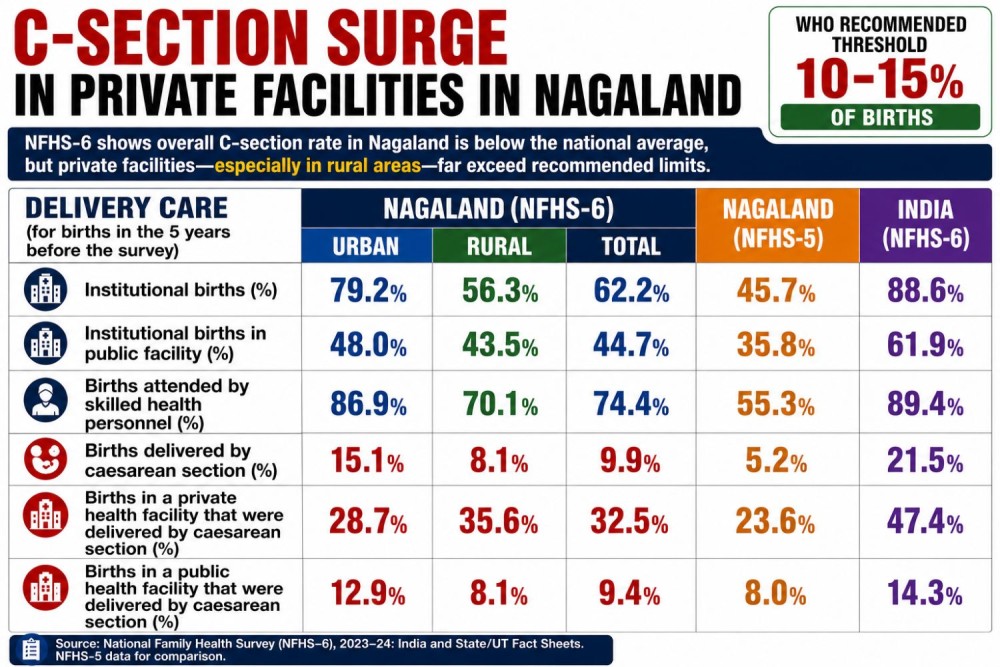
Caesarean section (C-section) deliveries in Nagaland have nearly doubled over the past five years, according to the latest National Family Health Survey 6 (2023-24), with deliveries in private health facilities significantly exceeding the benchmark recommended by the World Health Organisation (WHO).
The NFHS-6 reported that 9.9% of births in Nagaland during the five years preceding the survey were delivered through caesarean section, up from 5.2% recorded in NFHS-5.
Despite the increase, the state's overall C-section rate remains well below the national average of 21.5%.
The WHO, whose benchmark is widely referenced by India's Ministry of Health and Family Welfare, recommends that caesarean deliveries account for about 10–15% of births at the population level.
However, rates substantially above or below this range do not necessarily translate into better maternal or neonatal outcomes.
However, a closer look at institutional deliveries reveals stark differences between public and private healthcare facilities.
According to NFHS-6, 32.5% of births in private health facilities in Nagaland were delivered by caesarean section.
In contrast, the corresponding figure for public health facilities stood at 9.4%, remaining within the recommended threshold.
Overall, the state's C-section rate stood at 15.1% in urban areas compared to 8.1% in rural areas. C-section deliveries in public health facilities also stood at 12.9% in urban areas and 9.4% in rural areas.
Incidentally, the pattern was reversed among births occurring in private health facilities. In rural areas, 35.6% of births in private facilities were delivered by caesarean section, substantially higher than the corresponding urban figure of 28.7%.
Nationally, C-section rates in private facilities were higher in urban areas (57.4%) than in rural areas (52.2%).
The findings are particularly notable given Nagaland's relatively low utilisation of institutional maternal healthcare services. NFHS-6 recorded institutional births at 62.2% in the state, significantly below the national average of 88.6%.
Likewise, 74.4% of births in Nagaland were attended by skilled health personnel, compared to 89.4% nationally.
The state's lower overall C-section rate, therefore, appears to coincide with lower levels of institutional delivery and skilled birth attendance. At the same time, the proportion of C-section deliveries in private health facilities remains substantially above the WHO-recommended threshold, particularly in rural areas.
About NFHS-6
The NFHS-6 was conducted during 2023–24 by the Union Ministry of Health and Family Welfare (MoHFW), with the International Institute for Population Sciences (IIPS), Mumbai, serving as the nodal agency.
The sixth round of India's flagship nationwide health survey covered nearly 6.79 lakh households across 715 districts and collected information from 679,238 households, 716,397 women and 100,977 men. It was conducted in all States and Union Territories, except Manipur.
In Nagaland, fieldwork was conducted between August 26, 2023 and March 5, 2024, covering 11,104 households, 9,693 women and 1,635 men.
The provisional results of NFHS-6 ‘India and State/UT Fact Sheets’ were released on May 29. The detailed report is still awaited.