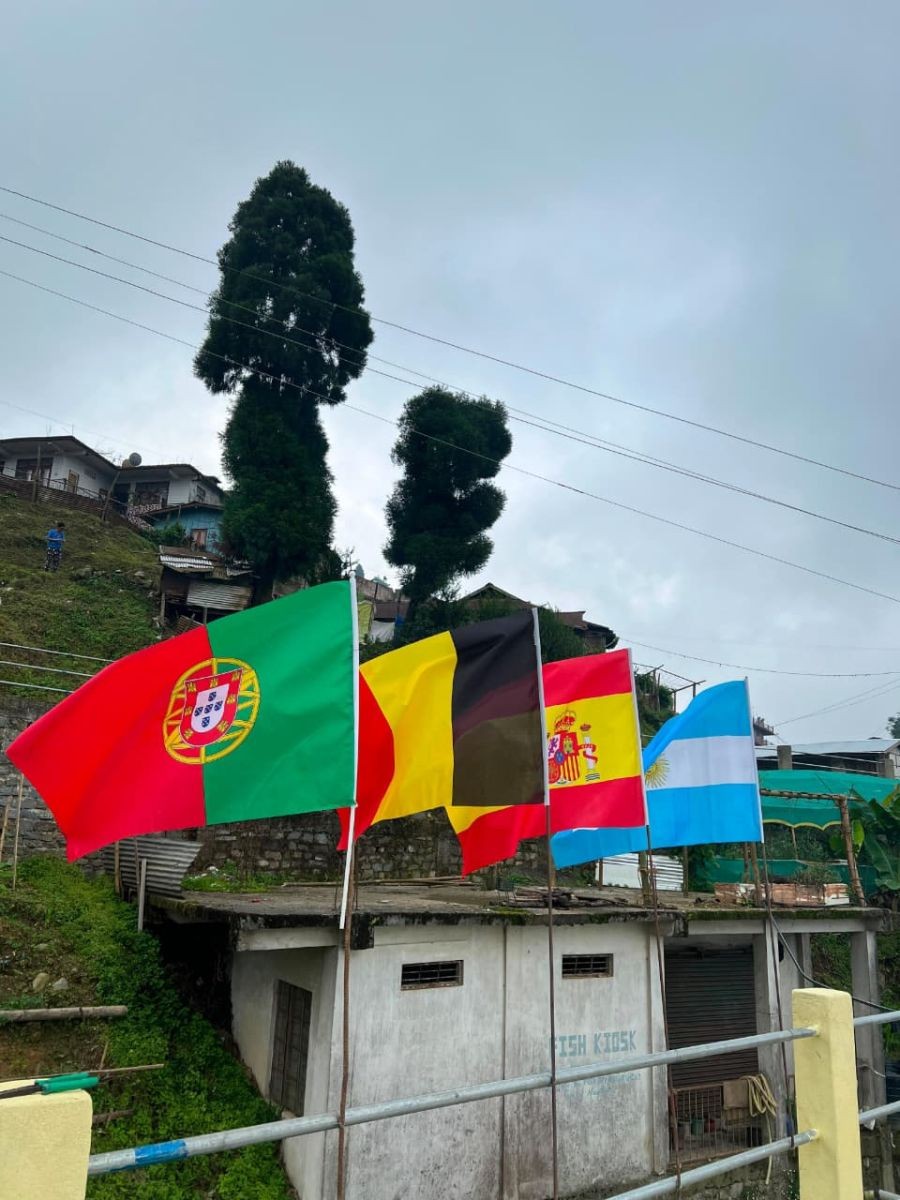
Ahead of the World Cup, flags of different countries seen waving at DC Hill Colony in Zunheboto. (Morung Photo)
Tokavi K Zhimo
Zunheboto | June 10
As another FIFA World Cup approaches, excitement is once again sweeping across Nagaland. But for those who grew up before smartphones and streaming, the tournament brings back memories that go far beyond the game.
In rural Nagaland, the World Cup was never just a sport, it was a community event. With television sets a luxury and electricity unreliable, watching a match meant gathering in a single home. Rooms were packed to the brim, shoes lined up outside. Generators and inverters were rare, yet patience and determination were not.
The season also brought cicadas. Children caught them in plastic containers, lured by porch lights. The insects were fried and shared with adults watching late into the night, sometimes for a small payment, creating an unlikely World Cup tradition.
But power cuts were the greatest foe. During blackouts, fans huddled over cups of black tea, debating missed chances and bad calls. A popular joke ran - the electricity workers always cut the power when their own team was losing.
For many Nagaland football lovers, those memories resonate as loudly as any final whistle.
T Chishi recalls watching his first World Cup in 1994 on a black-and-white television. More than three decades later, one moment remains unforgettable. “I still remember crying when Roberto Baggio missed the decisive penalty against Brazil in the final,” he recalled. “Watching the World Cup back then felt magical because very few people owned television sets.”
According to Chishi, expressions of football fandom were far more subdued in those days. “People did not put up country flags or wear team jerseys like they do now. Today, fans gather together with food and snacks regardless of whether matches are played at midnight or dawn. The passion has become much more visible,” he said.
L Holuto Ayemi, who also watched his first World Cup in 1994, remembers a time when live broadcasts were difficult to access and television ownership was limited. “There wasn't as much enthusiasm as there is today because viewership was limited,” he said.
However, he witnessed how football culture evolved over time. During the 2018 FIFA World Cup, Ayemi transformed his home into a celebration of football by displaying flags and decorating his surroundings in Argentina's colours. He invited students, painted faces in national colours and experimented with football-inspired hairstyles.
“What started with a few children soon spread throughout the village. More people began displaying flags and gathering to watch matches together. Even those who were not regular football followers became familiar with players like Messi, Neymar and Ronaldo,” he said.
For AIFF D Licensed Coach Vika V Zhimomi, football memories stretch back to the 1998 FIFA World Cup final between France and Brazil. At just ten years old, he walked nearly a kilometre with his father in the middle of the night to watch the match at a neighbour's house because his family did not own a television. “Watching Zidane felt like watching something extraordinary. His vision, control and movement inspired me to become a midfielder in local tournaments later in life,” he recalled.
Vinoka I Sumi remembers another aspect of football fandom that younger generations may find difficult to imagine. “If you missed a match, there was no social media, YouTube or instant highlights. You had to wait for newspapers or television sports bulletins to know what had happened,” he said.
He believes modern technology has made football more accessible but has also changed the way people experience the tournament. “In the past, neighbours and families crowded around a single television set. Every goal felt like a shared celebration. Today people can watch alone on their phones, but some of that communal experience has faded.”