Moa Jamir
Dimapur | August 13
Nagaland’s two Members of Parliament recorded high attendance during the Monsoon Session of Parliament, but their recorded floor interventions remained relatively limited, particularly against the backdrop of a session marked by frequent disruptions and low productivity.
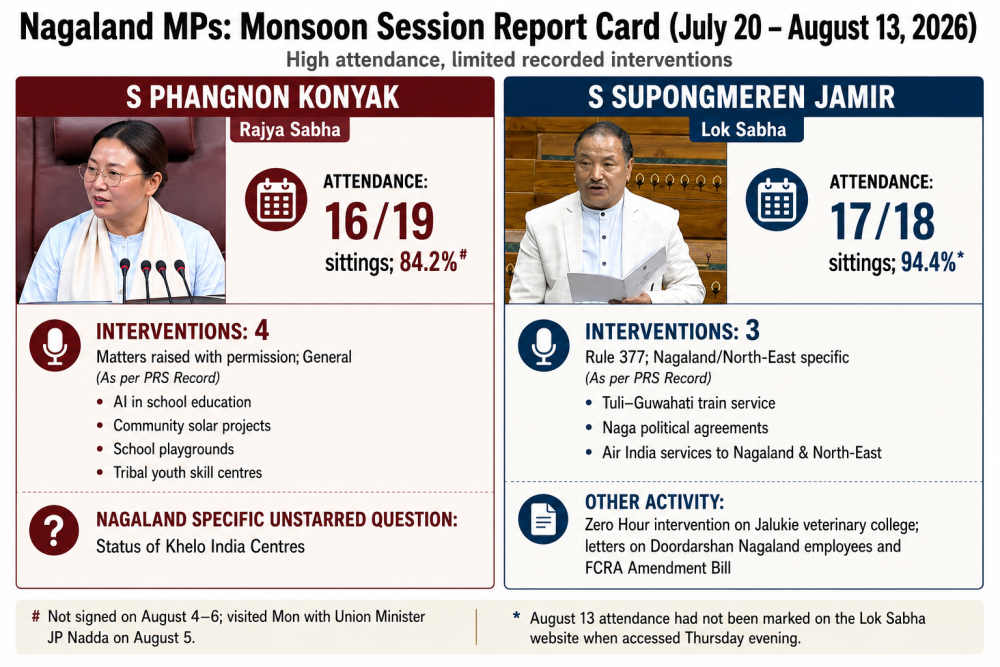
The Monsoon Session, which began on July 20 and concluded on August 13, saw Rajya Sabha MP S Phangnon Konyak record attendance at 84.2%, while Lok Sabha MP S Supongmeren Jamir was recorded 94.4%.
Konyak’s record
Konyak, the BJP’s Rajya Sabha MP from Nagaland, was recorded as having signed in on 16 of the 19 sitting days. The Rajya Sabha attendance record showed no sign-in for August 4, 5 and 6.
The period, however, coincided with Konyak’s presence in Nagaland. On August 5, she accompanied Union Minister for Health and Family Welfare and Chemicals and Fertilisers Jagat Prakash Nadda’s visit to landslide-affected areas of Mon town. The team inspected affected locations at Defence Colony and adjoining areas in Techa ward.
In terms of parliamentary interventions, Konyak participated in four matters raised with permission during the session, according to PRS Legislative Research.
The issues were not specific to Nagaland and included the need to establish residential skill development and employment centres for tribal youth in Tripura; protect playgrounds in government schools through a ‘One School-One Playground’ campaign; promote community solar energy projects on government vacant land and launch a ‘One District-One Solar Town’ initiative; and formulate guidelines for the responsible use of Artificial Intelligence in school education.
On the last day of the session, August 13, however, Konyak raised a Nagaland-specific question on Khelo India Centres. She asked whether the Government proposed to establish such centres in every district of Nagaland and about the steps being taken to ensure regular coaching, sports science support and nutrition for rural athletes.
As per attendance records, Jamir signed in on 22 out of 31 sittings in the Lok Sabha, indicating an attendance of around 71 per cent.
During the Budget session held from January 28 to April 18, Konyak recorded over 87 per cent attendance.
Jamir’s record
Meanwhile, Congress Lok Sabha MP Jamir topped the attendance record, with attendance on 17 of the 18 sitting days, or 94.4%. The attendance for August 13, however, had not been marked on the Lok Sabha website when accessed on Thursday evening.
According to PRS Legislative Research, Jamir participated in three matters under Rule 377, all concerning Nagaland or the wider North-East.
On July 21, he raised the need to start passenger train services between Tuli in Nagaland and Guwahati in Assam.
On August 6, he raised the need to implement the agreements reached by the Government with the NSCN (IM) in 2015 and the Naga National Political Groups in 2017.
On August 10, he raised the need to restore Air India flight services to Assam, Manipur and Nagaland.
Beyond the interventions recorded by PRS Legislative Research, Jamir also raised issues through Zero Hour and other parliamentary engagements, according to releases issued by his office and party.
During Zero Hour, he urged the Centre to strengthen infrastructure and academic facilities at the College of Veterinary Sciences & Animal Husbandry, Jalukie, seeking support for key projects to modernise the institution and improve animal healthcare services in remote areas of Nagaland.
He also wrote to Union Minister for Information and Broadcasting Ashwini Vaishnaw seeking regularisation of contractual engineering and programme employees at Doordarshan Nagaland.
On the FCRA Amendment Bill, 2026, Jamir addressed an official letter directly to Union Home Minister Amit Shah.
Jamir recorded around 71 per cent attendance during the Budget Session.
Assessment in the context of a disrupted session
Taken together, the session presents a mixed picture of Nagaland’s parliamentary representation: high attendance, but relatively limited recorded floor participation.
However, the assessment also needs to take into account the functioning of Parliament itself with the Monsoon Session marked by repeated disruptions and protests, with the Government and Opposition trading blame over the deadlock.
According to figures cited by PTI, Lok Sabha recorded only 19% productivity, while Rajya Sabha recorded 39% during the session.
While 12 Bills were passed by each House, discussions in both were limited to only one, the Public Examination (Prevention of Unfair Means) Amendment Bill, 2026, or the anti paper leak legislation, it added.