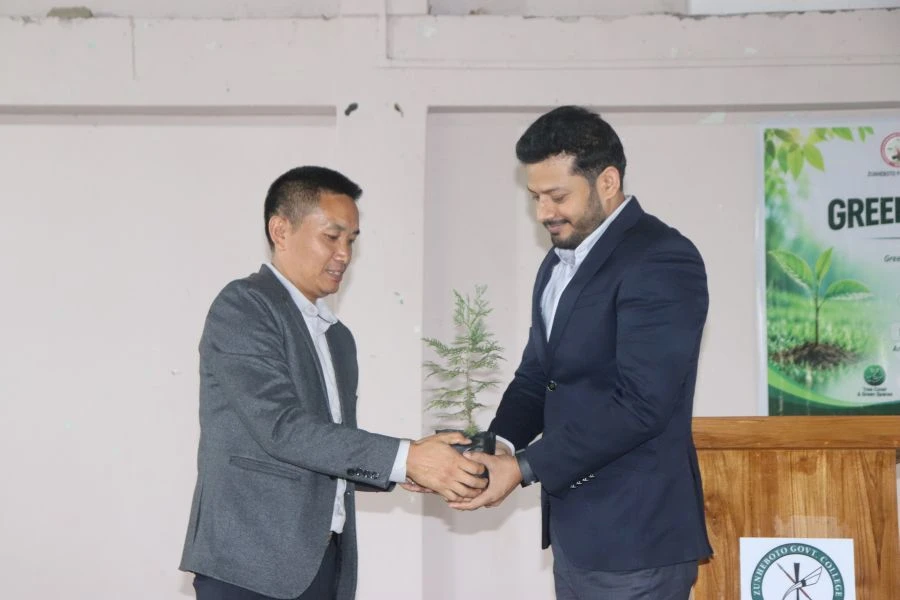
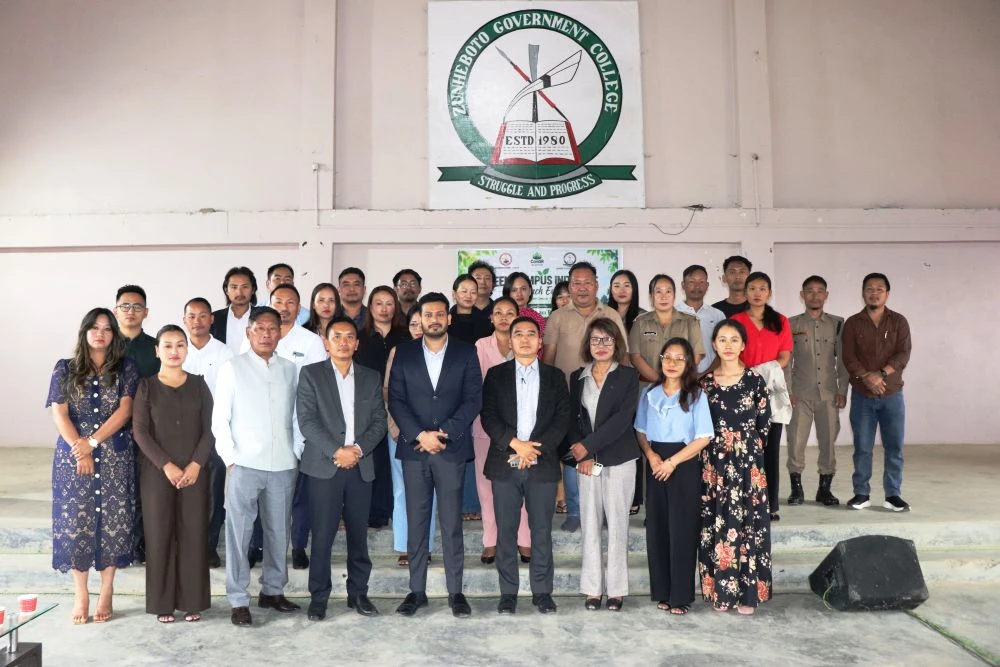
DC Zunheboto Dharam Raj, ZGC Principal Dr R Bendangtemjen, DFO Obed Bohovi Swu and others take part in a commemorative plantation of native trees as part of the Green Campus Initiative at Zunheboto Government College on August 12. (Morung Photo)

Tokavi K Zhimo
Zunheboto | August 12
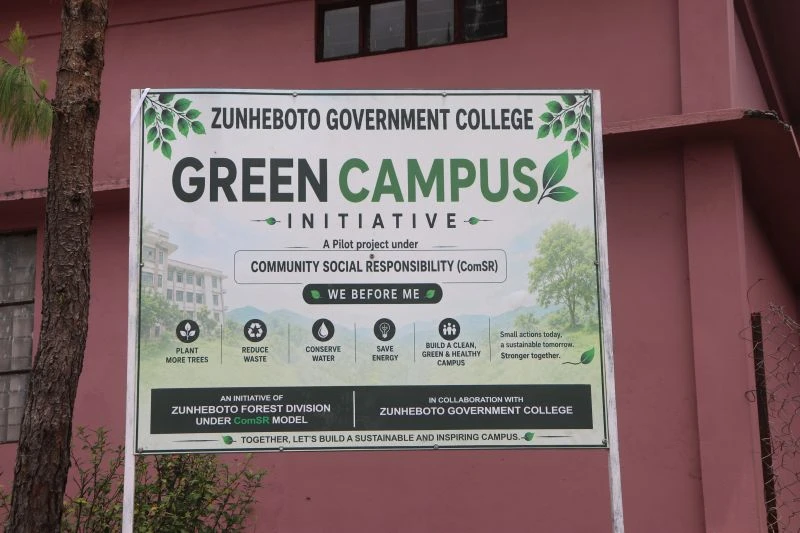
The Green Campus Initiative, a pilot project under the Community Social Responsibility (ComSR) model, was launched at Zunheboto Government College (ZGC) on August 12, with a focus on environmental sustainability, community participation and conservation.
The initiative, jointly organised by the Zunheboto Forest Division (ZFD) and Zunheboto Government College, was launched in the presence of Deputy Commissioner, Zunheboto, Dharam Raj, IAS, who attended as the special guest.
Speaking during the programme, Divisional Forest Officer (DFO) ZFD, Obed Bohovi Swu, said the initiative was rooted in the philosophy of communities coming together to help themselves. He said government schemes and assistance alone cannot address every challenge and that communities must take responsibility for finding solutions to local issues.
Explaining the concept of Community Social Responsibility, Swu said the philosophy may have been given a new name, but the idea of communities helping themselves is not new. He said his interaction with communities during field visits had reinforced his belief that people possess an inherent capacity to address their own challenges.
He stressed that government schemes should complement community efforts rather than be seen as the sole solution, and said the principle of “we before me” should become a lived value among individuals and communities.
On the Green Campus Initiative, the DFO said college was selected as it is the only college in the district and therefore deserved community support to strengthen its development. He expressed appreciation to the college principal and faculty for supporting the initiative and said the project would involve a number of activities aimed at improving the campus and promoting environmental responsibility among students.
Launching the initiative, DC Raj described it as an innovative, community-led initiative and appreciated the Forest Department and the DFO for conceptualising it.
The initiative should be approached holistically and should not be limited merely to increasing forest cover, he said, stressing that conservation and development must go hand in hand.
Referring to the traditional relationship between tribal communities and forests, Raj noted that communities have historically understood the importance of protecting natural resources. He also encouraged participants, particularly the younger generation and Gen Z, to actively participate in the initiative and incorporate sustainable practices into their daily lives.
He emphasised the importance of reducing energy consumption and promoting a minimalistic lifestyle, stating that responsible consumption of resources can contribute to a more equitable distribution of resources and benefit vulnerable sections of society.
The programme began with an invocation by Assistant Professor Everkali W Achumi, followed by a welcome address by ZGC Principal Dr R Bendangtemjen. The vote of thanks was delivered by IQAC Coordinator Tiasunep Ozukum.
A commemorative plantation of native tree species was subsequently carried out on the college campus. As part of the initial activities, tree saplings were received for plantation on the campus.
Sustainability through community participation
Speaking to the media, DC Zunheboto credited the ZFC and the DFO for conceptualising the initiative, saying community participation would be key to its success. Initiatives led by the community have greater potential for sustainability than those imposed upon it, he observed.
The initiative seeks to encourage a lifestyle rooted in minimal consumption and responsible use of resources, drawing from Nagaland's traditional practice of living simply, he held.
The initiative would include an annual audit of energy consumption and usage within the college campus to ensure that the institution remains committed to the minimalistic approach being promoted, he informed.
According to Raj, adopting such a lifestyle could contribute to a more equitable distribution of resources and, in the long run, benefit the poorest sections of society.
The Green Campus Initiative is only one among several initiatives being planned, with more community-oriented programmes expected to be launched in the coming days, he added.
Towards a holistic green campus model
DFO Zunheboto Obed Bohovi Swu said the college was selected for the initiative because it deserves greater community support and recognition, adding that individuals, communities, departments and civil society organisations can all contribute towards taking the institution forward.
He said the initiative is not intended to be a one-time programme but will involve a series of activities in partnership with faculty members, students, the community, administration and different government departments.
As an initial step, a green audit will be conducted to assess the present environmental condition of the campus and identify areas requiring attention. The audit will be supplemented by energy, water and environmental audits, with the findings to be analysed and used to prioritise future activities.
While tree plantation and campus greening will remain important components, Swu said the initiative would adopt a holistic approach rather than focusing on a single aspect of the campus.
He further stressed that the initiative should continue beyond the tenure of individual officers and functionaries. The objective, he said, is to establish a sustainable system and community ownership so that the initiative can continue even when officials move on.
Swu expressed hope that the model developed at ZGC would eventually mature and be replicated in other areas, making Zunheboto a place where the concept of Community Social Responsibility can be successfully demonstrated.
ZGC to pursue sustainability as ongoing process
Dr R Bendangtemjen, Principal of ZGC, stated that the initiative is expected to bring about positive transformation for both the institution and the broader community. He expressed particular encouragement regarding the integration of ComSR into the programme, noting that the college benefits from young, receptive minds who can quickly grasp new concepts, as well as qualified faculty members well equipped to advance the initiative.
“I am sure this initiative which we have launched today is going to bring some transformation in the college as well as in our society,” he said.
The principal stressed that ComSR is a broad concept and that the Green Campus Initiative is only one component of it. He expressed hope that the initiative would continue to grow and eventually inspire others to adopt similar practices.
He further said that ComSR would be treated as a continuous process, with the college taking gradual steps rather than considering the launch as a one-time activity.
He added that the college would next undertake a green audit with the support of the Forest Department to assess the campus and identify areas for improvement. “We hope and pray that the college campus will change,” he said, expressing optimism that the initiative would lead to a greener and more sustainable campus in the days ahead.