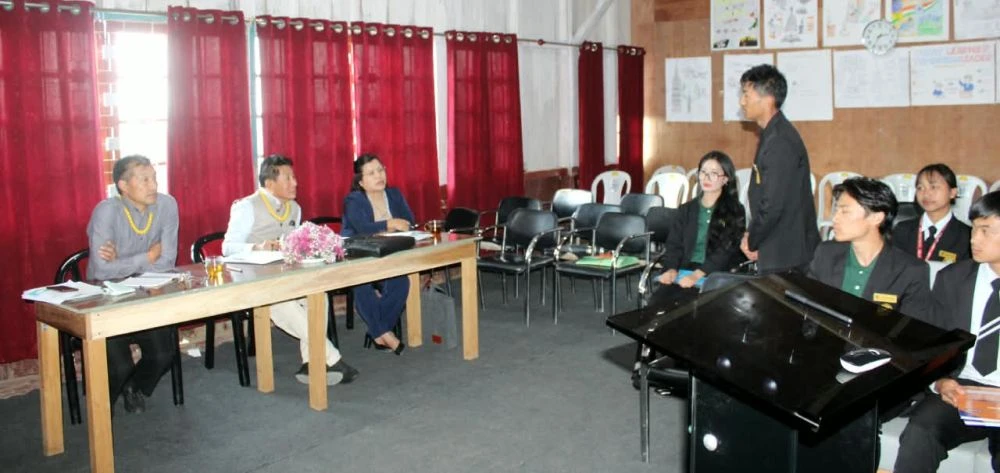
Members of the Academic and Administrative Audit (AAA) team hold consultations with student union executives and officials during their five-year audit at Pfutsero Government College on October 17.
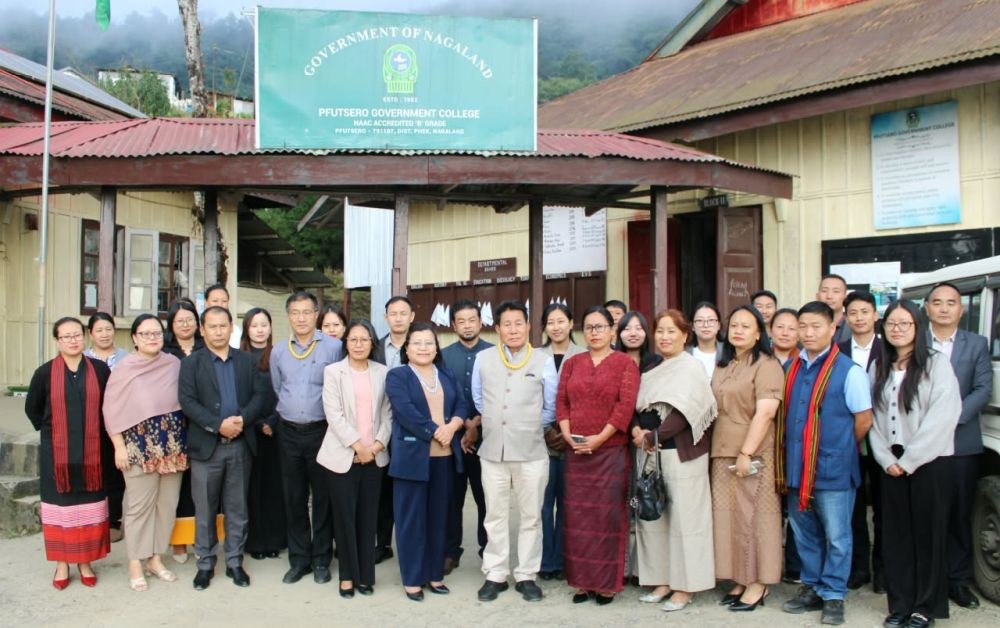
Pfutsero, October 18 (MExN): Pfutsero Government College underwent an Academic and Administrative Audit (AAA) conducted by a team constituted by the Higher Education Department, Government of Nagaland, on October 17, with the audit team recommending measures to improve research output, institutional funding, infrastructure and quality assurance.
The audit covered the college’s functioning over five academic years, from 2021 to 2026.
The team was convened by Dr Watijungshi, retired Additional Director of Higher Education, with Dr Temjenwapang, Principal of Kohima Science College (A), and Dr Ketoukhrie-u, Associate Professor and Internal Quality Assurance Committee (IQAC) Coordinator of Kohima College, as members.
During the audit, Principal Dr Anungla Pongener presented the college’s administrative functioning and developmental activities, while IQAC Coordinator Dr Thungdemo N Yanthan presented reports on internal quality across seven parameters assessed by the National Assessment and Accreditation Council (NAAC). Heads of Departments also highlighted their respective departmental activities.
The team held consultations with the college students’ union executives and non-teaching staff and physically verified the institution’s infrastructure before providing feedback on areas for improvement.
Commending the college for securing recognition under Section 2(f) of the University Grants Commission (UGC) Act, Dr Watijungshi stressed the need to obtain recognition under Section 12(b), which would make the institution eligible for major funding for various projects.
He also urged the IQAC to ensure that memoranda of understanding (MoUs) with other institutions were functional rather than signed merely as a formality.
Highlighting the importance of environmental sustainability, Dr Watijungshi recommended a Green Audit, noting that it covered different categories and that dedicated tree plantation was one component the college could undertake.
Dr Temjenwapang emphasised the importance of measurable outcomes under the forthcoming NAAC assessment framework and called on the IQAC to develop robust data collection and reporting mechanisms.
He identified faculty research output as an important outcome under the proposed framework and challenged faculty members to pursue multidisciplinary and interdisciplinary collaborative research.
Dr Ketoukhrie-u encouraged the college to go beyond career guidance and develop mechanisms to facilitate job placements for students. She also suggested consolidating complaint mechanisms to address gender discrimination, ragging and other forms of discrimination, instead of maintaining multiple committees that were not functioning effectively.
Pointing to the importance of traditional knowledge systems under the new assessment framework, she recommended establishing a Traditional Knowledge Committee alongside the college’s existing Cultural Committee.
Other recommendations from the audit team included introducing a gender budget, strengthening student feedback on classroom activities, exploring funding opportunities through corporate social responsibility initiatives, civil society organisations and alumni, developing the library at the new campus, enhancing skill development and improving Wi-Fi coverage across the college.