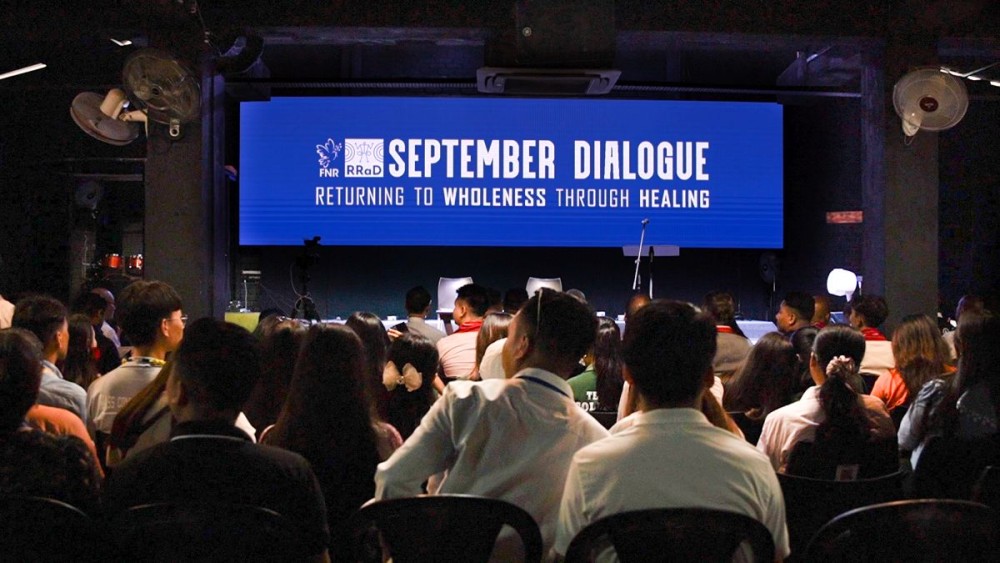
On September 5, tribal elders, student leaders, grassroots activists and academics gathered at the Lighthouse Church in Dimapur for the third September Dialogue 2026, held on the theme, “From Recovery to Reclaiming: What Repatriation of Our Ancestral Human Remains Means for Our People.” (Morung Photo)
Wati Aier
Forum for Naga Reconciliation
Introduction: Distinguished members the Naga tribal representatives, special invitees, respected people of common humanity, and esteemed colleagues in the Recover, Restore, and Decolonize team of the Forum for Naga Reconciliation. I am deeply honored to deliver this keynote address on “Returning to Wholeness through Healing,” subtitled, “The Naga Journey in the Light of Repatriation.” We are gathered at a moment when geopolitics and history are unfolding with urgency. The question before us is whether the Naga people, like many indigenous communities across the world, will allow this critical moment to slip away, or whether we will seize this clarion call and step across the threshold of transformation.
The Naga people carry within their collective memory the wounds of colonial intrusion, political violence, and cultural disruption. These wounds bear the scars of communal and intergenerational trauma, which have inevitably shaped identity, social life, and the pursuit of reconciliation among the Naga people. Since 2020, the repatriation of Naga ancestral remains from the Pitt Rivers Museum at the University of Oxford has emerged as a profound moment of evaluation. This subject matter is not only about returning bones to the land of the Nagas, but also about returning dignity, memory, and wholeness to a fractured people.
Let me pose the following questions: What does repatriation mean for 21st century Nagas? What does it actually say about our past? How has it affected the Nagas especially the youth?
Trauma as Collective and Intergenerational
As Dolly Kikon reminds us, “The Naga people’s case requires understanding the immense violence and trauma we continue to experience because of colonization.” Trauma in tribal contexts is collective and intergenerational because it is borne by entire communities. Colonial military campaigns, forced incorporation into India, and decades of armed conflict created wounds that were shared across villages and generations. Kikon’s ethnographic work demonstrates how militarization and extractive industries disrupted kinship and land, producing scars that cannot be reduced to individual psychology.
Maria Yellow Horse Brave Heart, a member of the Oglala Lakota Sioux Tribe, has conducted studies of Native Americans that echo deeply with the Naga experience. Trauma is transmitted across generations through memory, behavior, and social structures. Children inherit not only stories of violence but also patterns of mistrust, fear, and fractured identity.
Sowmiya and Vinothkumar’s research on Denotified Tribes in India (tribes that the British colonial government falsely labelled as “hereditary criminals”) illustrates how displacement and criminalization perpetuate intergenerational trauma. Similarly, Naga youth inherit unresolved wounds of conflict and militarization. Carl Jung’s notion of the collective unconscious helps us see how trauma embeds itself in the shared psyche of a people, shaping generations long after the original wounds.
Repatriation as a Moment of Healing
The repatriation of Naga ancestral remains is not a procedural or an organizational act, but a revered moment of healing. It is an intentional reversal of colonial violence and a communal reclaiming of dignity. As Dolly Kikon wrote, “When the resilience of the Nagas challenged colonial power, we became exotic objects to be studied and materially colonized… it became clear how we have been exotified and not considered something human that could feel.” Repatriation confronts this dehumanization directly.
Healing requires rites and observances that permeates collective memory. The burial of repatriated remains in Kohima, at a site chosen by the Naga tribe hohos and the Forum for Naga Reconciliation, will serve as a communal sacred moment of closure. Such a sacred moment transforms trauma into memory, and memory into grit and perseverance by reframing wounds as shared narratives of survival and dignity. Repatriation thus becomes a catalyst for reconciliation, reminding us that the dignity and destiny of Nagas are indivisible and cannot be fragmented.
Healing also requires cultural renewal, such as reviving songs, stories, and practices that affirm identity. As described in Kikon’s book entitled Food Journey: Stories from the Heart, food, land, and kinship are central to Naga identity. Repatriation can inspire renewal by reconnecting people to ancestral land and traditions, transforming despair into hope. Brave Heart’s concept of historical trauma demonstrates that rituals of remembrance—powwows, memorials, and collective ceremonies—help communities reclaim dignity. For the Nagas, repatriation is precisely the moment of remembrance and renewal.
Wholeness and Belonging
Healing for the Nagas is not only psychological but theological. A theology of reconciliation insists that wholeness comes through truth, forgiveness, and belonging. Thus, repatriation can be understood as covenantal—between God and the people. Therefore, the returning of ancestral remains to their land should inspire the people to wholeness through healing. Arkotong Longkumer describes this as a “momentous time,” transforming the Naga community from subjects in “glass cages” to witnesses confronting colonial violence. In theological terms, repatriation is a sacrament of belonging—a visible sign of invisible grace.
Here, Aristotle’s insight into eudaimonia, human flourishing and well-being through virtue and community, becomes instructive. Repatriation is an act of justice that restores the conditions for collective flourishing. In his critique of domination, Noam Chomsky reminds us that systems of power thrive by “erasing memory and silencing voices.” Repatriation resists this erasure, reclaiming the right of the Nagas to narrate their own history.
Returning to Wholeness through Healing
At the heart of this keynote address lies the central theme: Returning to Wholeness through Healing. This return has two inseparable dimensions. To return to wholeness through healing without truly receiving our ancestors risks continuing the colonial narrative, reducing repatriation to a symbolic gesture without relational depth. Conversely, to act simply as a receiver without extending Naga hospitality would dishonor the ancestral remains.
We must also avoid the danger of “othering” the ancestral human remains. Return is not exclusively symbolic; it is lived out through sacred rites that bring people together, reinforce our collective values, and provide individuals and communities with meaning and well-being.
What the Nagas envision is uniquely contextual—a trajectory rooted in Naga traditions, not borrowed beliefs. The relationship between the “receiver” and the “received” must therefore move beyond a purely logistical or bureaucratic understanding of repatriation toward one that is spiritual, relational, and deeply rooted in our understanding of who we are. To return our ancestors is not simply to move them from one place to another. It is to take a step toward wholeness.
Colonial powers reduced Naga ancestors to objects. Reclaiming these remains breaks the cycle of historical objectification, allowing the Naga spirit to move from being a victim of structural violence to an agent of self-determination. Welcoming ancestral remains to their native land allows the Nagas to physically perform an embrace. By laying their ancestors to rest with dignity, they heal the brokenness of the land and liberate the communal spirit from the trauma of colonial rupture.
Healing requires a redemptive memory of colonial trauma. Memory is never neutral. It can be used as a shield to protect a community from future harm, or weaponized as a sword to inflict revenge and perpetuate hatred. The Nagas must choose redemptive memory—remembering historical wounds in a way that heals the present rather than poisoning the future. This concept unfolds in three understandings:
Refusing to let wounds define the future. Colonialism fractured Naga society, physically extracting ancestors’ remains to foreign lands and classifying culture as “primitive.” Keeping trauma alive as bitterness risks fueling internal divisions or blind hatred because it shifts collective memory away from shared aspiration toward factional fragmentation. Acknowledging the pain truthfully, and using it as a catalyst to unite different Naga tribes, reclaims shared dignity.
For example, when unresolved trauma from past inter-tribe or inter-factional violence is nurtured as bitterness, it acts as a tool for “othering” fellow Nagas as different in order to reassure oneself of one’s own identity and belonging. Rather than viewing each other as parts of a unified identity, individual groups begin to view neighboring tribes or opposing political factions with perpetual suspicion, locking communities into historical cycles of blame.
Shifting from victims to storytellers. When the Forum for Naga Reconciliation began the process of returning ancestral remains from the Pitt Rivers Museum, the Nagas practiced redemptive memory. The ancestors left as stolen colonial exhibits; they return as revered elders laid to rest with honor by a self-determining people. The facts of history remain, but the end of the story is transformed.
Relying on the traditional Naga paradigm, where trauma is treated as an illness affecting the entire community, not just the individual—helps share the emotional burden and encourages mutual forgiveness.
Experiencing spiritual release. Bringing the remains home allows the Nagas to say: “We will never forget what happened, but we will not allow that injustice to make us permanently resentful.” Memory is redeemed because it is transformed from a source of trauma into a symbol of resilience and peace.
Moving past emotional and reactive unity toward structured legal, political, and inter-tribal communication allows the younger generation to shape a future anchored in mutual respect rather than inherited grudges.
The repatriation of Naga ancestral remains must be understood not as parochial culturalism, but as a public theological responsibility. It asserts that human dignity does not cease at death, that colonial domination reducing ancestors to artifacts must be repudiated, and that wholeness through healing requires restoring right relationships between land, living, and the dead. To bring ancestors home is thus an exercise in public faith—an act that honors the body, demands ethical accountability from Western institutions, and models reconciliation grounded in memory and dignity.
If repatriation is to be more than symbolic, it must cultivate a creative socio-political imagination of wholeness, what the Hebrew tradition names shalom. Shalom is not simply the absence of conflict, but the presence of justice, reconciliation, and flourishing. For the Nagas, who have been tormented long enough by militarization and inter-factional rivalry, shalom must mean healing that touches every generation. The present generation has inherited wounds of fear, hatred, and division. To allow these wounds to become their permanent inheritance would be to curse the Naga future. No people in their right frame of mind would wish this upon their children.
I want to imagine. I imagine that as the Naga ancestral remains return home, the people will be mentally prepared to recognize that healing is at hand. This is not naïve optimism, but the discipline of the spirit and the mind of the receiver. For this vision to actualize, the Nagaland Baptist Church Council (NBCC), the Nagaland Christian Revival Church (NCRC), the Catholic Church, and all Christian bodies must lead prayer vigils, presenting the theological truth that wholeness is inseparable from forgiveness and belonging.
I imagine that all Naga tribe hohos will join hands to bid the past to rest and begin anew in the land of the Nagas. I imagine that Naga political groups, long divided, will reconcile with the past as a covenant with the ancestral remains, moving forward together in hope.
I imagine that young and old, those living in the land of Nagas and those in the diaspora, will walk with a heightened sense of belonging, no longer fractured by suspicion, but together in dignity. I imagine that the final resting occasion of the Naga ancestral remains will pave a highway for Naga flourishing, a pledge-bound moment where memory becomes perseverance and trauma is transfigured into peace.
This imagination is not utopian but a necessary act of socio-political imagination. Repatriation is a repayment of dignity owed to our ancestors, but it also creates a “covenantal debt” of responsibility toward future generations. Thus, wholeness for the Nagas must be envisioned as a reconciled society where ancestral remains are not objects, but subjects to be embraced, where memory is redeemed rather than weaponized, and where reconciliation is a living being in institutions, communities, and in everyday practices. It is a wholeness that transforms violence into vigilance for peace, inter-factional rivalry into cooperation, and inherited trauma into perseverance. It is a wholeness that resounds throughout the hills and valleys of the land of the Nagas, proclaiming that the brokenness of the land has been healed, and that the communal spirit has been liberated from colonial rupture. These I imagine!
Conclusion
The Naga people’s journey of trauma is collective, historical, and intergenerational. Yet in the light of repatriation, there is an opportunity to return to wholeness through healing. By reclaiming ancestral remains, the Nagas reclaim dignity, memory, and belonging. This act is not only about the past, but about the future. This act passes on hope by transforming trauma into wholeness. As Desmond Tutu reminds us, “There is no future without forgiveness.” If the Nagas desire a future where wholeness reigns, we must forgive those who have wronged us—offering proactive forgiveness from below as strength and testimony to the world. Let us not forget our beloved leader Niketu Iralu’s final words: “Nagas must learn to love one another [and] forgive one another.”