

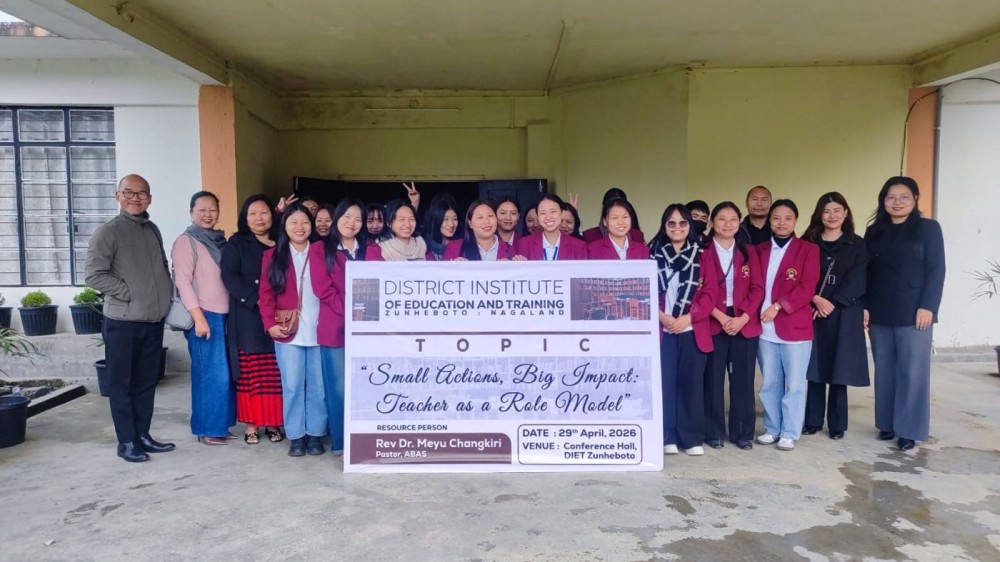
The author and his wife with the students of DIET Zunheboto
Meyu Changkiri
There are journeys we plan - and then there are journeys that quietly shape us while we are simply passing through them.
On our way to attend the convocation of Clark Theological College, my wife, Achala, and I made a brief stop at Eastern Theological College - a place where, many years ago, our own theological journey first began. What we expected to be a short visit soon became something deeper: a return not just to a place, but to a season that had quietly shaped our calling and direction in life.
Walking through familiar spaces stirred more than memory. It reminded us that lives are not shaped only by big decisions or dramatic moments, but by small, consistent influences - conversations that guide us, mentors who invest in us, and environments that help us grow. Meeting former teachers, reconnecting with friends, and seeing familiar faces made us realise that much of what formed us happened day by day, often without us even noticing it at the time.
One of our teachers warmly welcomed us for a meal, and we were accommodated at Brewster House, a place meant for guests of the college. The kindness shown to us was simple, yet deeply meaningful. It reminded us that influence is often expressed not through grand gestures, but through thoughtful acts of care that leave a lasting impression.
The name “Brewster” carried a personal meaning for me. Many years ago, during a visit to the United States, I experienced similar kindness through the hospitality of the pastor and his family at Brewster Baptist Church. Even now, that memory remains clear. Though separated by time and place, these experiences shared something in common - genuine care expressed through ordinary acts of hospitality.
Such moments point to an important insight: the influence of those who teach, guide, and nurture us is not always immediate or obvious. Often, it unfolds over time. What is given in one moment may continue to bear fruit long after.
With these thoughts still fresh in my mind, we continued our journey to the 51st Convocation of Clark Theological College. It was a moment of celebration, but also one that invited reflection.
Standing before 121 graduating students, in my capacity as Chairman of the Board of Governors, I found myself looking beyond the certificates they were about to receive. These were not just students completing a programme, but individuals who had been shaped over years - through learning, discipline, and guidance - and were now preparing to step into new responsibilities.
At that moment, I was reminded that education is not only about completing a course or earning a qualification. It is about preparation - preparation to influence lives, serve communities, and take responsibility for the future.
Convocation, therefore, is not just an ending. It is also a beginning - a transition from learning to living, from receiving to giving.
From there, our journey continued - together with my wife, whose companionship in both life and ministry I deeply value - first to Zunheboto, and then onward to Kiphire for a church programme. What began as a routine schedule gradually took on deeper meaning, as each encounter added something to reflect upon.
Before we reached Zunheboto, I had been invited to speak to a group of young people undergoing teacher training under a government programme organised through the District Institute of Education and Training.
When I stood before them, I did not just see trainees preparing for a profession. I saw individuals standing at the threshold of influence - people who would one day guide young minds and shape the next generation.
In many ways, they stood at a similar point as the graduates I had just met - different paths, yet a shared responsibility: the responsibility to influence lives.
That moment stayed with me. It reinforced a conviction that has grown stronger over the years: teaching is never a small responsibility, even if it is sometimes quietly overlooked.
The Power of Remembered Moments
If we reflect honestly, most of us cannot remember every lesson we were taught in school. Many details have faded with time. Yet there are certain teachers we remember clearly.
We remember how they spoke to us, how they treated us, and how they made us feel. Perhaps it was a word of encouragement when we were discouraged, a patient explanation when we struggled, or simply the feeling that someone noticed us.
These moments may have seemed small at the time, but they stayed with us.
This points to an important insight: while knowledge may fade, the experience of being valued and understood often remains. The way a teacher treats a student can shape confidence, motivation, and self-worth in lasting ways.
Small Actions, Lasting Impact
We often assume that meaningful impact must be something big or dramatic. But in the life of a teacher, influence is usually built quietly through daily consistency.
A smile at the beginning of a class may seem small, but to a student who feels unseen, it can mean acceptance. Calling a student by name creates a sense of belonging. Listening carefully shows respect. Being fair builds trust. Encouraging effort helps develop resilience.
These actions may not be noticed publicly, but over time, they accumulate - and they shape lives.
Lasting impact is rarely the result of one big moment. More often, it comes from many small actions carried out faithfully over time.
The Teacher as a Role Model
A teacher does more than share knowledge; a teacher models life.
Students observe more than we realise - how a teacher speaks, reacts, handles challenges, and treats others. Even when they appear distracted, they are often learning through observation.
Being a role model is not something extra; it is part of the role itself. The question is not whether teachers influence students, but what kind of influence they carry.
A meaningful role model is not someone perfect, but someone consistent and genuine - someone who shows honesty, fairness, and patience, even in difficult situations. Over time, students recognise and respect this kind of authenticity.
Facing Real Challenges
Teaching is not always easy, especially in many parts of North East India. Classrooms may lack resources. Students may struggle with motivation. Some carry personal challenges from home - financial difficulties, family issues, or emotional stress.
These realities cannot be addressed by lessons alone. They require patience, understanding, and a strong sense of purpose.
In such situations, a teacher becomes more than an instructor. A teacher becomes a guide, a listener, and a steady presence.
When patience is chosen over frustration, it teaches self-control. When encouragement replaces criticism, it builds hope. When understanding replaces judgment, it builds trust - and where there is trust, learning can grow.
Teachers as Leaders in Our Communities
In many parts of North East India, teachers are highly respected, and rightly so. Their influence goes beyond classrooms into homes, churches, and communities.
A teacher’s life becomes a message. Integrity, responsibility, and character speak more powerfully than words.
To be a teacher is not only to educate; it is also to lead. The values lived out in classrooms often shape the wider community.
A Shared Responsibility
While teachers carry great responsibility, they do not carry it alone.
Students also have a role - to be respectful, attentive, and willing to learn. Parents play an important part as well. When respect for teachers is reinforced at home, it strengthens the entire learning environment.
Education works best when teachers, students, and parents work together with mutual respect and shared purpose.
A Personal Journey
As I spoke to those trainee teachers, I found myself reflecting on my own journey.
Before entering full-time ministry, I spent a year teaching at the Mission School in Changki. At that time, I did not fully understand how important that experience would be. But looking back, I can see how it shaped my thinking, my character, and eventually my path into ministry.
Teaching did not only influence my students - it influenced me.
This is often how it works. When we invest in others, we are also being shaped in the process.
The Legacy You May Not See
One of the challenges of teaching is that results are not always immediate. There are times when it may feel like little progress is being made.
But the absence of visible results does not mean there is no impact.
A word of encouragement today may build confidence years later. A moment of care may stay with someone for a lifetime. A life may take a different direction because of something that once seemed small.
Much of what is done faithfully may only be seen later - but that does not make it any less valuable.
A Final Word
As we continued our journey from Zunheboto to Kiphire, one thought stayed with me. The work of a teacher may seem routine and, at times, unappreciated - but it is never insignificant.
Every day, teachers shape lives often quietly, without recognition, and without immediate results. Yet their influence reaches far beyond the classroom, touching individuals, families, and communities.
In many ways, the strength of a society can be seen in how it values its teachers. When teachers are supported and respected, the impact is seen in the lives of the next generation.
And for all of us - students, parents, and communities - the responsibility is shared. When we value those who shape lives, we strengthen our future.
In the end, it is often not the big moments that shape a life, but the small, steady actions repeated over time. These are the quiet forces that build character, influence direction, and create lasting change.
And in ways we may not always see, those simple, faithful actions continue to shape lives - one day at a time.

