Officials and others during the Stakeholders meet on “Mitigating El Niño Impacts on Kharif 2026 Agriculture” held on August 7.
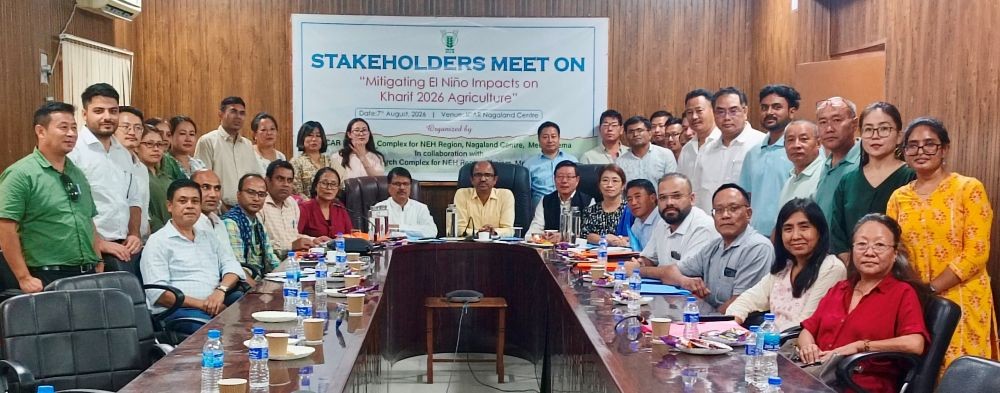
Medziphema, August 7 (MExN): Amid mounting concerns over erratic weather patterns threatening the ongoing Kharif season, the ICAR Research Complex for NEH Region, Nagaland Centre convened a stakeholder meeting on Friday to formulate a science-driven strategy to counter the adverse effects of El Niño on the state’s agriculture.
The programme on ‘Mitigating El Niño Impacts on Kharif 2026 Agriculture,’ held at the Centre’s Medziphema campus, brought together top agricultural scientists, state officials, and extension experts to devise proactive, science-led strategy aimed at safeguarding the Nagaland’s agricultural sector against climate abnormalities during the ongoing Kharif season.
In his opening remarks, Dr Kadirvel Govindasamy, Director of ICAR RC for NEH Region, Umiam, Meghalaya, underscored the critical need for climate resilience, adaptive planning, and institutional readiness to protect farmers from adverse weather patterns.
The technical session, chaired by Dr Girish Patil, Director of ICAR NRC Mithun, Medziphema, featured detailed scientific presentations that featured comprehensive, data-driven scientific presentations.
During the session, Dr Debahish Chakraborty, Senior Scientist, presented a detailed analytical overview of changing meteorological parameters, rainfall deficits, and temperature threats to crop yields in Nagaland.
Dr VK Verma, Principal Scientist, Horticulture, ICAR RC for NEH Region, Umiam, highlighted strategic contingency plans to protect northeastern horticulture from extreme weather disruptions. The plan emphasised adopting robust water management techniques to sustain yields and development of climate resilient varieties. These proactive measures aim to secure farmers' livelihoods against unpredictable seasonal shifts and prolonged droughts, Dr Verma stated.
Dr Krishnappa Rangappa, Senior Scientist, ICAR RC for NEH Region, Umiam deliberated on El Niño preparedness in hill ecosystems, focusing on stress-tolerant crop varieties and contingency crop planning, while Dr Harendra Verma, Scientist at the ICAR Nagaland Centre, detailed sustainable land and water management solutions and announced the release of seven newly developed high-yielding, climate-resilient rice varieties tailored for the state.
The technical deliberations were followed by an extensive interactive session with state officers from agriculture and allied departments, who discussed logistical challenges, immediate field implementation of tech-driven resource management, and the distribution of climate-resilient inputs.
In his closing remarks, Khonthungo Lotha, Joint Secretary, Government of Nagaland, praised the joint efforts of scientists and the state machinery, calling for seamless and rapid communication between research bodies and field departments to effectively deploy the mitigation strategies across Nagaland’s hills. Concluding the event, Dr Girish Patil offered expert remarks, stressing the importance of protecting crops, livestock, and the broader tribal farming ecosystems from climate stress.
The meeting was attended by District Agriculture Officers (DAOs), Joint Directors and officers from Agriculture, Horticulture, Fisheries & Aquatic Resources, faculties from SAS, Nagaland University, scientists from ICAR Nagaland Centre, Heads of Krishi Vigyan Kendras (KVKs), Chief Technical Officers, Subject Matter Specialists (SMSs), and technical officers, who actively participated in the day-long deliberations.