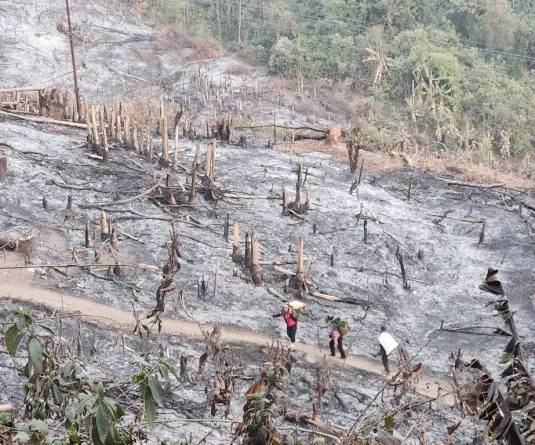
Photo Courtesy: Image by Arayro from Pixabay | For representational purpose only
Chanchibeni H Ngullie
Once shared around the fire, during family gatherings and through the voices of grandparents, traditional folktales are slowly becoming less familiar to younger generations. As the people who remember these stories grow older, an important question remains: who will tell them next?
Think about the last time you sat with your grandparents or an elder and listened to a traditional story. How many can you still remember- and could you narrate one from beginning to end today?
For many of us, childhood meant listening to elders tell stories after dinner, during family gatherings, or around a fire. Some were about animals, spirits, ancestors, strange happenings and the origins of traditions. What seemed like simple entertainment carried lessons, beliefs, memories and history. Today, with mobile phones, television and social media taking up so much of our attention, those moments happen far less often.
Each Naga tribe carries distinct folktales passed down mainly through oral narration. Unlike written records, these stories survive only when people remember and retell them, keeping the values, beliefs and experiences of earlier generations alive.
Across Nagaland, they reflect each community’s identity: the Ao tale of Jina and Etiben captures tragic love and separation, Angami stories of Zükhi and Neteya explore spirits and wit, and Phom oral history traces their origins to Mount Yinyushang, where a mother named Meihunyu gave birth to both a tiger and a man- helping the man escape when the jealous tiger attacked. These stories connect people to their past and show how earlier generations understood the world around them.
When storytelling was part of everyday life
Storytelling once wove naturally into daily family life without needing a special occasion.
A 49-year-old Lotha woman recalled hearing stories from parents, grandparents and elders after dinner, after returning from the fields and around a fire. She enjoyed relatable tales, such as fishing stories that still trigger fond memories whenever fishing season arrives, alongside stories of animals, spirits and nature. She remembered the trickster Apvühuo, who once tricked a man into trading his bull for a flute stuffed with sand, telling him not to play it until he walked away. Because he knows that he'll exchange it back if he finds it defect. Owning to it, the man played it after Apvüho disappeared it into the woods, but couldn't play it so he angrily smashed the flute on a rock.
Likewise, A 54-year-old Lotha man remembered stories at bedtime and family gatherings. One that stayed with him vividly is a mother exhausted by her relentlessly crying baby, asked for a scarf - tore it up, attached the pieces to her hands and toes, and flew up a tree crying "Müngya,
Müngya". By the time the child pleaded for her to come down, it was too late, and the baby cried to death beneath the tree.
What stands out in these memories is not just the stories themselves, but the way they were shared. Storytelling was not something that required a special programme or occasion before, it happened naturally, as part of family life.
A generation growing distant from its stories
Among eight people surveyed across the Lotha, Sangtam, Chakhesang and Phom communities- two older adults and six younger ones- familiarity with folktales varied widely.
Only two of the six younger participants felt fully familiar with their tribe's folktales, while three said their familiarity was incomplete and one left it blank. Half could narrate at least one story- such as a 23-year-old Lotha woman who remembered tales of ancestors and traditional beliefs from her grandparents, and a 25-year-old Phom man who recounted his tribe’s origin story from Mount Yinyushang, noting that Phom means "clouds" in his dialect. Others knew stories only in fragments or through family, school and books without feeling ready to narrate one on the spot.
Hearing a story occasionally is rarely enough to keep it alive. A story may still be known by name, yet fade if its full narration and meaning aren't retold.
A different world, a different way of listening
It would also be unfair to blame technology alone, as young people today have shifting priorities, responsibilities and cultural influences. Still, screens have changed how free time is spent. Modern life brings new priorities, educational demands and shifting cultural habits- as the 25-year-old Phom man pointed out, many young people today gravitate heavily toward Western culture.
The 49-year-old Lotha woman felt children today have shorter attention spans due to social media and technology. The 54-year-old Lotha man agreed phones and television have affected oral stories, though he noted some children still show genuine interest. Four of the six younger participants felt social media, television and modern entertainment influence how young people engage with storytelling, while others pointed to changes in presentation or how stories feel relevant today.
Perhaps young people have not lost interest in their culture- they simply get fewer chances to listen.
If hours can be spent watching stories created by people online, can we not also make time for our own?
What concerns me most is that many folktales exist mainly in the memories of elders rather than in books. As the 49-year-old Lotha woman reflected, elders today can feel like "the last generation who were born and brought up with all these things".
When an elder passes on without sharing a story, that piece of our Naga identity can be hard to recover.
All six younger participants supported documenting folktales through books, videos, audio or digital platforms, and all six wanted to learn a story from an elder.
As the 19-year-old Lotha woman put it, traditional stories should be preserved "not as fragile relics behind glass, but as living inheritance- listen deeply to the voices that carried them, retell the stories with honesty and courage, and pass them on hand to hand and voice to voice, because a generation that lets its stories fall silent loses not just its past, but the compass that guides its future."
Preservation does not need a grand festival. It can start at home- by asking grandparents about their childhood stories, recording elders' voices, writing and translating narratives, or hosting storytelling gatherings and competitions. Recordings keep the words, but telling and listening keep the tradition alive.
As the 54-year-old Lotha man asked: "What if a few years in the future someone asks you to narrate some stories from your tribe? If you don't learn now, what will you answer?"
We cannot bring back a story once it is completely forgotten. So, It is time we start listening again before the voices carrying them fall silent.