Home Secretaries of non-compliant states asked to appear; review committees ordered
Morung Express News
Dimapur | March 4
The Supreme Court has expressed serious concern over the lack of compliance by several states and Union Territories (UTs), including Nagaland with its earlier directions aimed at preventing child trafficking and ensuring faster prosecution of trafficking offences.
A Bench of Justices JB Pardiwala and KV Viswanathan was reviewing compliance with its April 15, 2025 judgment in Pinki v State of Uttar Pradesh, which laid down a nationwide framework to strengthen investigation, victim protection and trial processes in child trafficking cases.
During the February 26 hearing, the Court noted that several states/UTs had not filed compliance affidavits, while reports submitted by others were found unsatisfactory.
“Whatever has been reported is nothing but an eye wash,” the Bench reiterating its April 15 direction.
The Court recorded that 12 States and 2 UTs including Nagaland had not filed any compliance report as of February 25, 2026.
Taking a serious view of the delay, the Court directed that Home Secretaries of these states must appear before the Supreme Court through video conferencing on the next date of hearing if compliance reports are not submitted. The matter has been listed for further hearing on April 8, 2026.
Background
The directions stem from a case relating to a child trafficking racket in Uttar Pradesh, where the Court found lapses in investigation and prosecution.
In its April 15 judgment, the Supreme Court issued a series of binding nationwide guidelines to strengthen the criminal justice response to trafficking.
The Court emphasised that child trafficking is a grave social crime requiring coordinated action by governments, police agencies and courts, and cautioned that any laxity in implementing its directions could invite contempt proceedings.
Key directives to State/UTs
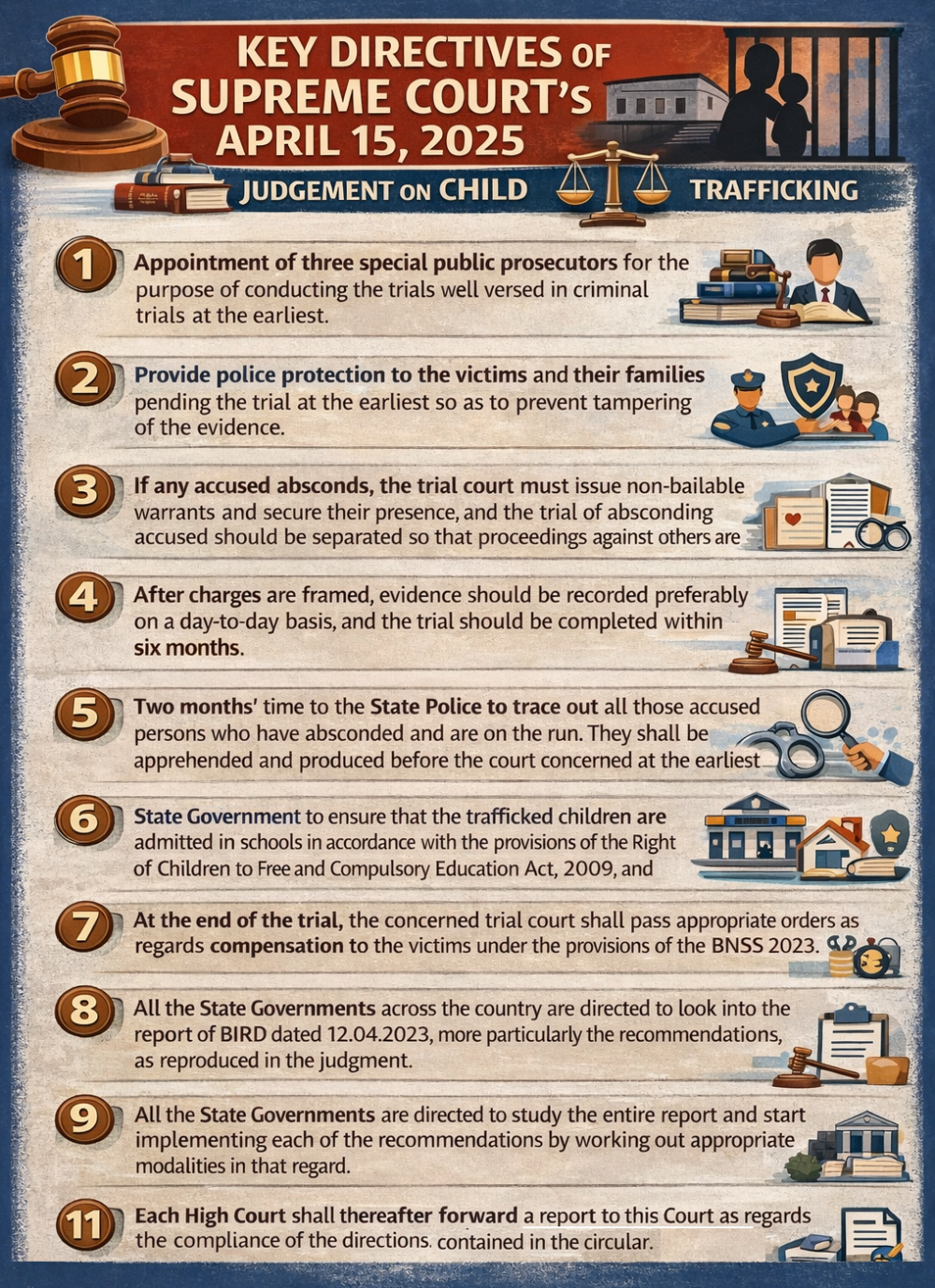
To this end, the Court issued several directives issued on April 15to State and UTs as well as High Courts across the country. Non-compliance may attract contempt proceedings, it added.
Among others, the directives to State/UTs included appointment of special public prosecutors experienced in criminal trials to handle trafficking cases.
It also called for tracing and apprehending of absconding accused persons within two months.
The Court also called for providing police protection to victims and their families to prevent intimidation or tampering with evidence.
The State/UTs Governments were also directed to ensure that trafficked children are admitted to schools under the Right of Children to Free and Compulsory Education Act and continue receiving educational support.
It also called for enduring that that trial courts pass appropriate compensation orders for victims under the BNSS 2023 and relevant victim compensation schemes.
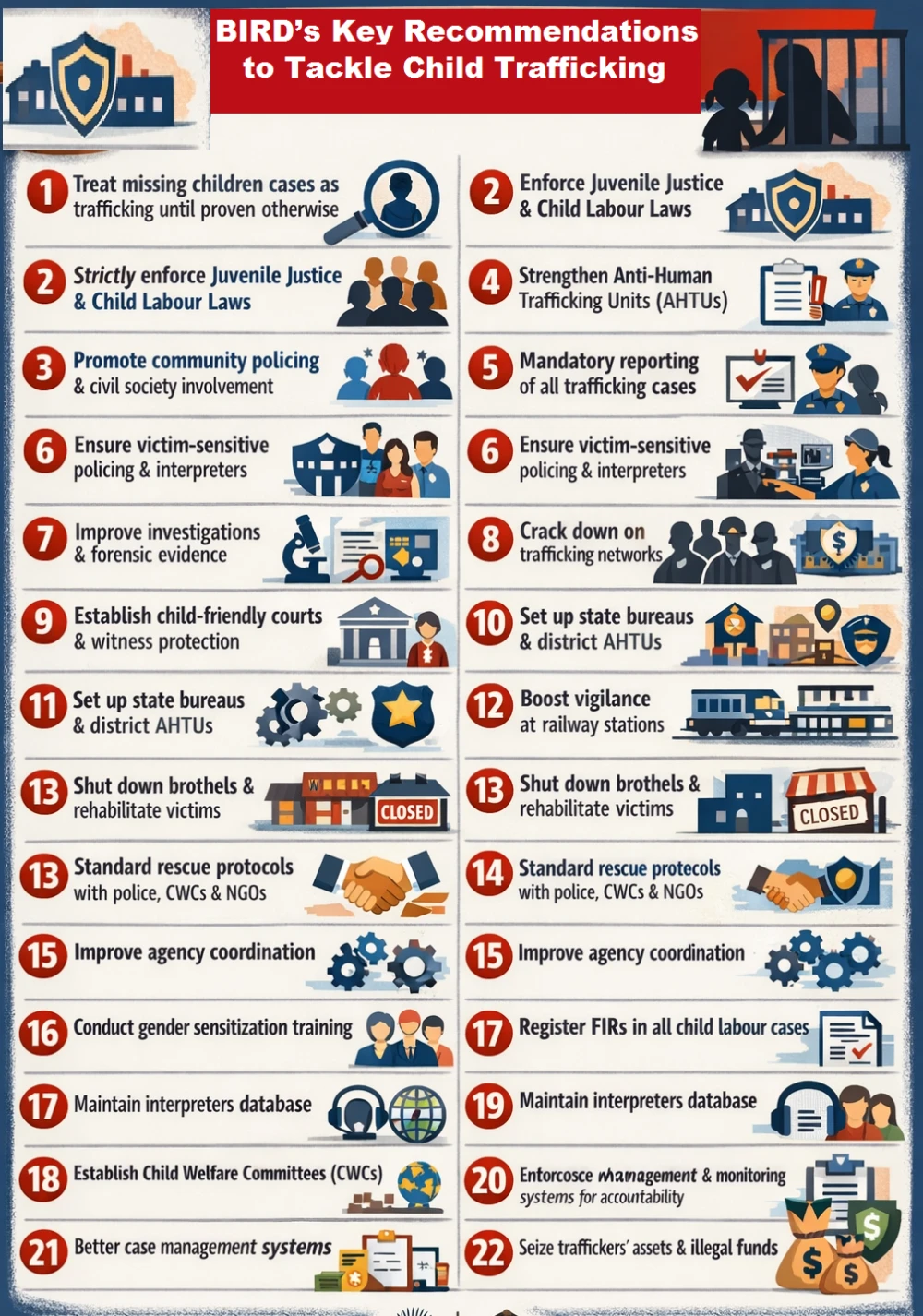
Further, the States and UTs were directed to study and implement the recommendations of the Bharatiya Institute of Research and Development (BIRD) report on preventing human trafficking.
These recommendations included strengthening Anti-Human Trafficking Units (AHTUs), improving investigation methods, ensuring witness protection, establishing child-friendly courts and strengthening rehabilitation mechanisms.
Monitoring by HCs
The Supreme Court also tasked High Courts with monitoring trial progress in trafficking cases including collection of data on the status of pending child trafficking trials within their jurisdictions.
HCs were also asked to issue administrative circulars directing trial courts to complete such trials within six months and instructed to ensure day-to-day hearings to prevent delays, where necessary.
During the review on February 26, the apex court observed that most HC except Patna, have partially complied with the Supreme Court’s directions.
The Guwahati High Court, which has jurisdiction over Assam, Nagaland, Mizoram and Arunachal Pradesh, reported 191 trafficking cases pending in Assam and 9 in Arunachal Pradesh. No cases were pending in Nagaland or Mizoram as of May 2025.
However, many HCs had not provided details on day-to-day trials or disposal within six months.
Constitution of review committees
On February 26, the apex court also directed all states/UTs to constitute review committees within four weeks to periodically examine trafficking trends and identify vulnerable areas prone to trafficking.
These committees are expected to monitor prevention strategies and coordinate responses among government departments, it said.
States/UTs were also tasked to submit fresh compliance reports in a structured format covering three areas: prevention (mapping vulnerable areas, migrant databases etc); rescue, rehabilitation and reintegration (SOPs for rescue, mental health services etc); and law enforcement (functional AHTUs, child-friendly courts etc).
The Court also noted that although trial courts have forwarded compensation claims to District Legal Services Authorities, compensation orders have not yet been passed in several cases, and stressed that these directions must be implemented.
The SC also asked the Union Government to submit a detailed report on implementation of the Assisted Reproductive Technology (ART) Act, 2021, including the number of cases registered under the law in the last five years and steps taken to prevent commercial exploitation in egg donation practices.
The matter will next be heard on April 8 when the Court is expected to review compliance by the states and other authorities.