

Photographer: Wiradej
Shakti Swarup Dash
In the dense forests of Meghalaya and Nagaland, darkness is never entirely dark.
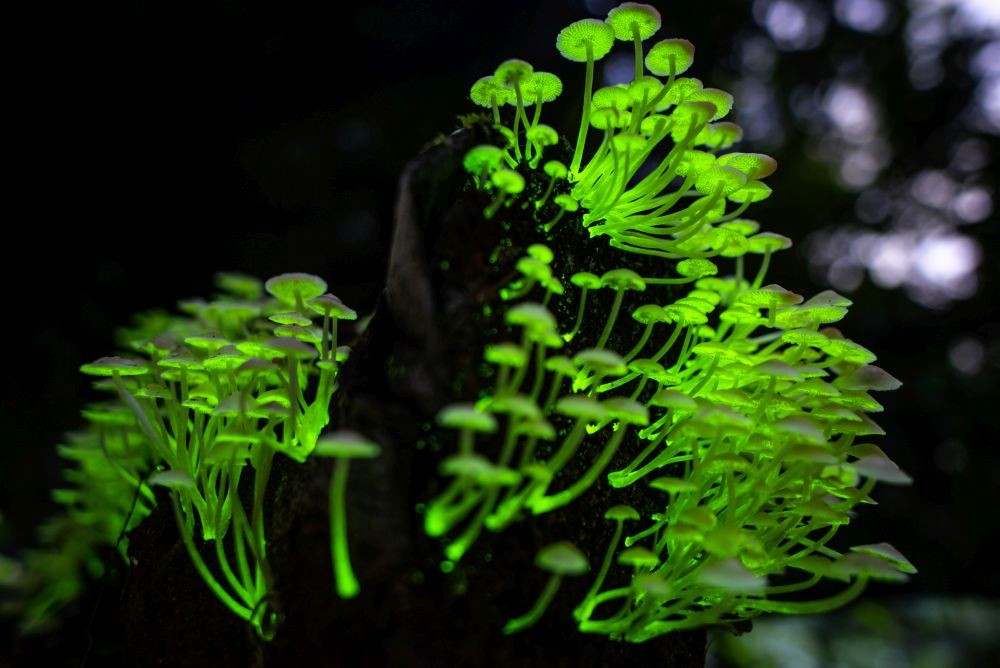
On certain damp nights after rainfall, when mist settles quietly between the trees and the forest floor smells of wet bark and earth, fallen logs can begin to glow.
The light is so soft that it can easily be mistaken for imagination. Villagers in some woodland regions once associated these strange green glows with wandering spirits or hidden supernatural presence. Travellers avoided touching the glowing logs at night, while children grew up hearing stories about forests that came alive after darkness. Long before scientists explained the phenomenon, the forests already had their own explanations.
The source of this eerie glow is bioluminescent fungi — rare fungi capable of producing natural light through chemical reactions within their cells. While most people associate bioluminescence with fireflies or deep-sea creatures, very few realise that parts of India’s wilderness possess this hidden ability as well.
These fungi usually appear on damp, decaying wood during humid conditions. Unlike plants, they do not produce their own food. Instead, they survive by breaking down dead organic matter. In doing so, they perform one of the most important yet overlooked tasks in nature: decomposition.
A forest does not survive only because trees grow. It survives because dead things disappear.
Without fungi, fallen branches, leaves, and dead trunks would continue piling up on the forest floor for decades. Nutrients locked inside dead wood would never return to the soil. Scientists often describe fungi as nature’s recyclers, quietly converting decay into new life.
What makes bioluminescent fungi especially fascinating is that science still does not fully understand why some species glow. One theory suggests that the light attracts insects, which then help disperse fungal spores across the forest. Another proposes that the glow is simply the result of internal chemical reactions during decomposition.
Some researchers have also observed that the glow becomes stronger in humid conditions, particularly after rainfall when moisture levels rise. In complete darkness, some glowing fungi are so faint that the human eye notices them only after several minutes in the dark. They can sometimes illuminate the edges of bark and moss with a dim green tint. The effect is delicate rather than dramatic, more like a fading ember than a lamp.
Globally, scientists have identified over a hundred species of glowing fungi, yet fungal biodiversity remains vastly understudied. In remote parts of Northeast India, researchers believe many fungal species may still remain undocumented. That possibility makes these forests even more extraordinary.
Unlike large mammals or colourful birds, fungi rarely attract attention. They are stepped over, ignored, or dismissed as signs of rot. Yet bioluminescent fungi reveal a different side of the wilderness — one that exists beyond daylight and beyond human notice.
They also challenge the way people define beauty in nature. Most forms of beauty are associated with growth: blooming flowers, towering trees, vibrant feathers. These fungi glow from decay. Their light emerges from rotting wood and damp silence. In a strange way, they prove that even decomposition can carry life, purpose, and wonder.
Today, forests are often discussed in terms of tourism, land use, or commercial value. But hidden within these landscapes are fragile natural phenomena that many people may never witness even once in their lifetime. A glowing patch of wood may seem insignificant beside famous wildlife species, yet it tells a deeper story about how little humans still know about the living world around them. Bioluminescent fungi do not roar like tigers or bloom like orchids. They survive unnoticed, glowing softly from fallen wood deep within the darkness.
For a brief moment, the dead wood shines—reminding the living that endings and beginnings often exist together. Somewhere tonight, after the rain, a fallen tree will glow again in the darkness, whether anyone is there to witness it or not.
Shakti Swarup Dash is a young nature writer with a special interest in biodiversity, forests, and the mysteries of the natural world.

