Photo Credit: Rofikul Islam
Tanvi Jadhav
DBSKKV College of Forestry, Dapoli
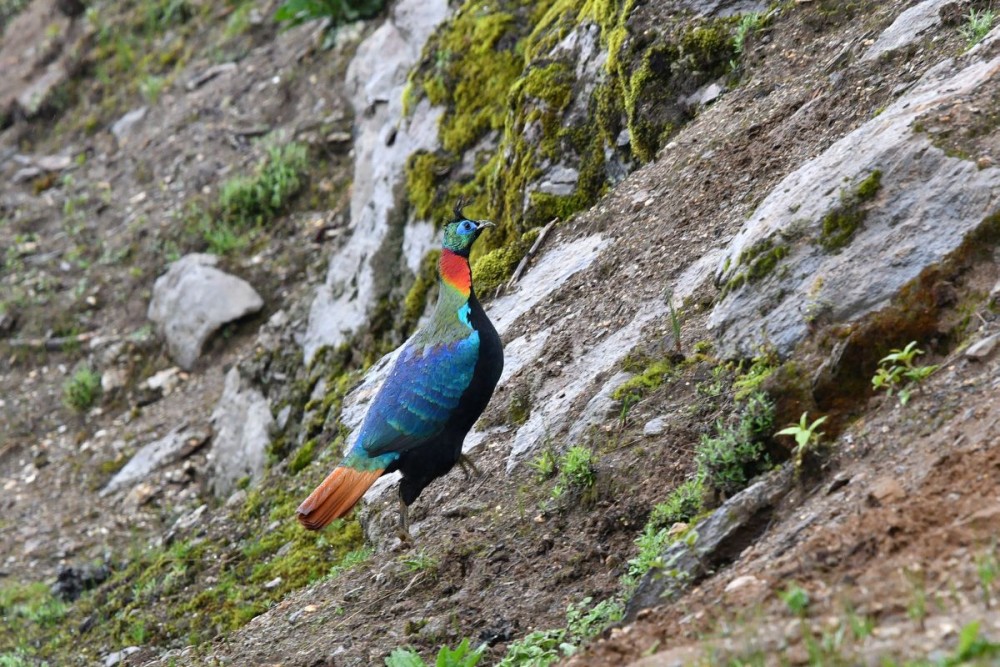
Among the snow-clad peaks, the mountains wear a crown of colours, shimmering in sunlight—the Himalayan Monal. The symbol of the region's rich biodiversity is often called the ‘Jewel of Mountains’. With the glow in shades of copper, gold, emerald and sapphire, this bird reminds us that nature is the greatest artist. But the bird is more than a spectacle of colours, it conceals a tale of survival in one of the world’s harshest landscapes. It is a quiet indicator of the health of fragile mountain ecosystems. The Himalayan Monal (Lophophorus impejanus) stands out as one of the most visually striking and ecologically significant birds.
The male monal is particularly noted for its iridescent plumage, which consists of green, blue, purple, and red colours. These colours do not result from pigments fixed in feather structure, but rather result from light refraction through microscopic structures. This causes a dazzling display of colour in sunlight.
The female monal is drabber in colour, as is common in many birds. The dull colours serve to camouflage the bird from predators in its rocky and wooded habitat. Sexual dimorphism in coloration is the result of evolutionary pressures whereby males display showy features to attract mates and females display cryptic plumage to protect them during nesting and brooding.
The Himalayan Monal thrives in sub-alpine and alpine zones between 2,500 and 4,500 meters. In Northeast India, it lives in temperate conifer forests and oak slopes, moving to higher meadows in summer. Its thick plumage protects it from extreme cold, while strong legs, a sharp bill, and sturdy talons help it forage for roots, berries, and insects. As an opportunistic feeder, it also aids seed dispersal, supporting Himalayan plant regeneration.
The Himalayan Monal is known for its distinctive calls. During the breeding season, males produce sharp notes and melodious whistles that echo through the valleys. These vocalizations help attract mates, mark territory, and warn predators. Researchers believe the timing and tone of these calls may reflect environmental changes or breeding status, suggesting a complex communication system still being studied.
Seeing the Himalayan Monal in the wild turns an ordinary forest walk into a memorable moment. Through its foraging, it disperses seeds and aerates the soil. Its digging mixes organic matter into the ground, improving nutrient cycling and plant growth—vital processes in ecosystems where life exists in delicate balance.
Beyond ecology, the Himalayan Monal holds deep cultural value. It is the state bird of Uttarakhand and features in local folklore, symbolising the beauty and resilience of the Himalayas. In Nepal, where it is the national bird, it represents beauty, health, and prosperity. Many mountain communities believe its call brings good news, and its presence is seen as a blessing from the mountain gods.
Despite its importance, the Himalayan Monal faces growing threats. Deforestation, overgrazing, and human encroachment are shrinking and degrading its habitat, while climate change is altering fragile high-altitude ecosystems. Conservation efforts focus on protected areas, community awareness, and research. Lasting solutions depend on cooperation among local communities, governments, NGOs, and international agencies.
The Himalayan Monal is more than just a colourful bird—it is an indicator of healthy mountain ecosystems. Protecting it means preserving the fragile balance of the Himalayas themselves. As pressures on these ecosystems continue to grow, safeguarding species like the Himalayan Monal becomes a shared responsibility, reminding us that natural beauty and ecological stability go hand in hand.