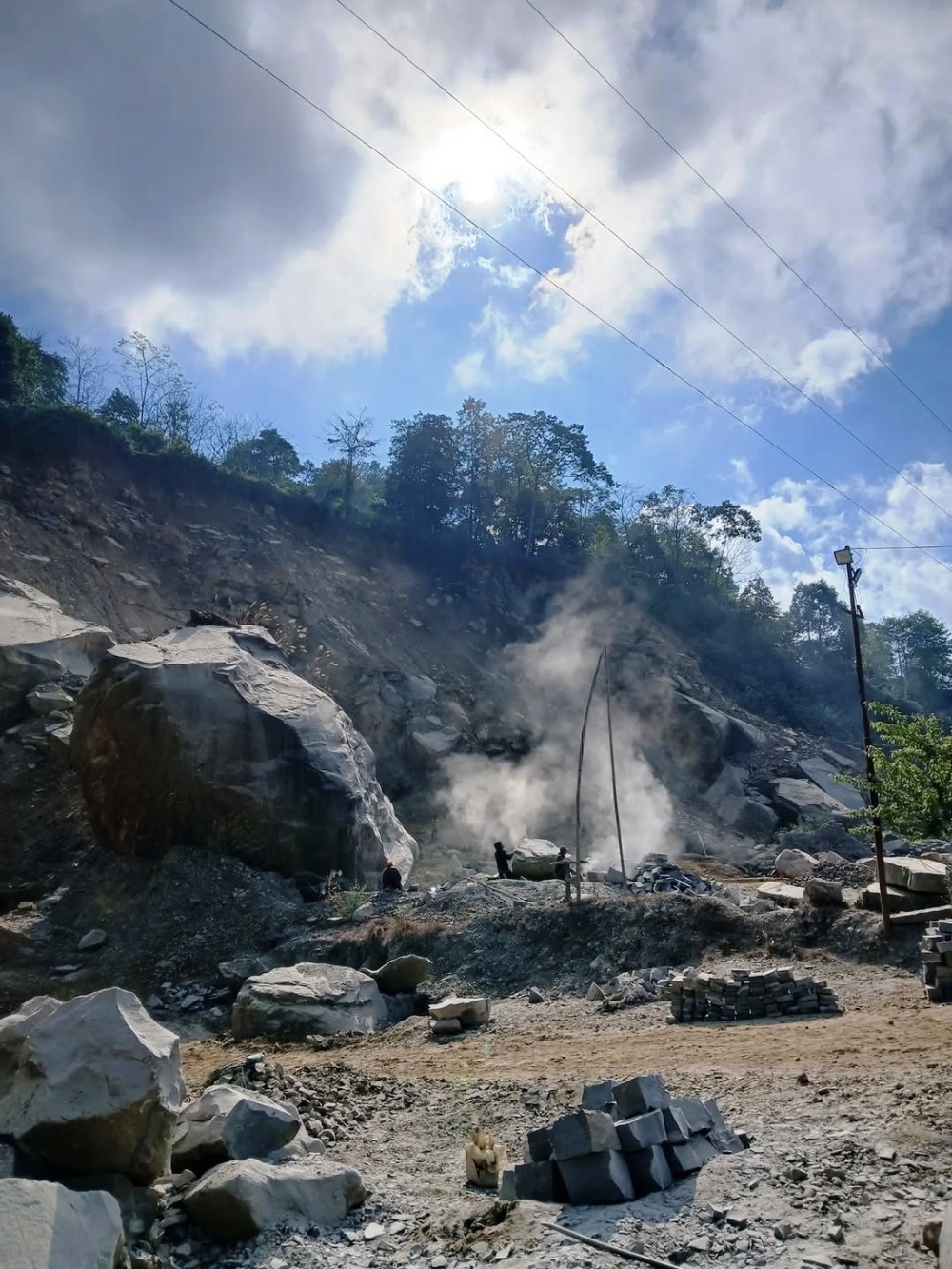
The stone quarry in Longsa under Wokha district. (Morung Photo)
LH Thangi Mannen
Director and Founder, Earth Alliance Nagaland
As we mark World Environment Day 2026 (WED-2026), under the theme #NowForClimate, humanity stands at a definitive crossroads, to a casual observer, June 5th might seem like just another date on the calendar. But for those witnessing the rapid, violent transformation of our ecosystems, this day carries unprecedented weight. It is no longer a day for mere celebration; it is a global reckoning with our responsibility to the only home we have. For decades, the climate crisis was told in the future tense—a series of distant warnings, abstract targets, and elusive deadlines muffled by the “noise” of political delay, corporate distraction, and public denial. But nature does not negotiate. Today, the planet speaks a brutal language of extremes: rising seas, melting glaciers, aggressive wildfires, devastating landslides, destructive floods, and erratic and extreme weather patterns that push human endurance to its absolute limits. We once spoke of 1.5°C as a distant boundary line; today, we are actively crossing it.
Yet, if we listen closely, a different signal is also rising beneath the noise. Worldwide, positive tipping points are beginning to outweigh the negative. We see solar arrays reclaiming rooftops, wind turbines lining horizons, systematic urban redesigns prioritizing people over pollution, and massive reforestation efforts taking root. However, while global progress offers a glimmer of hope, the reality in Nagaland is far more immediate and visceral. Here, the abstract “noise” of climate change has been replaced by the roar of flash floods, the sudden collapse of mountain highways, and the silent, cracking earth of unseasonal droughts. The theme for World Environment Day 2026 focuses squarely on climate change and the signals we choose to send back to Earth. The question is no longer whether change is coming—the crisis is already here. Our recent scars show us that we have moved from seasonal expectations to a state of constant vigilance. The true test is how fast we move, and whether we possess the collective courage to steer a world already in motion towards survival.
The Data of Disaster: Nagaland’s Intensifying Emergency
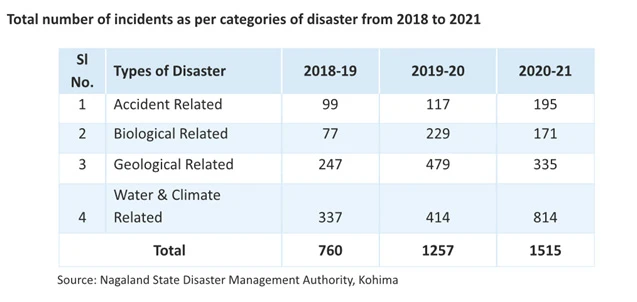
While international summits debate future targets, the first Nagaland Disaster Statistics Report 2023, and the subsequent reports of 2024 and 2025 released by the Directorate of Economic & Statistic, Government of Nagaland, provides a sobering reality check. Our state is in the grip of a rapidly accelerating climate emergency. Between 2018 and 2021, water and climate-related incidents in Nagaland surged by a staggering 200%, climbing from 337 annual incidents to a record 814.
The empirical evidence paints a terrifying picture of our new climate reality:
• The 393% Rainfall Surge: Extreme cloudbursts and flash floods have evolved from rare anomalies into consistent seasonal threats. In a historic deluge during the 2025 monsoon, the India Meteorological Department (IMD) recorded that Nagaland received 49.8 mm of rain in a single 24-hour window compared to the normal baseline of 10.1 mm—firmly placing the state in the “large excess” category. These events triggered devastating flash floods in Dimapur and Niuland, submerging homes and livelihoods.
• The Capital as a Frontline: In Kohima, the frequency of cloudbursts exploded from just 7 incidents in 2018–19 to 49 in 2020–21. According to the Centre for Science and Environment’s (CSE) Climate India Report 2025, Kohima also recorded the highest number of warm monsoon days among all Indian state capitals, with higher-than-normal minimum temperatures occurring on 98% of the monsoon days. This trend culminated in July 2025, when the capital experienced a staggering 10°C spike in minimum temperatures compared to historical averages. This dramatic shift indicates that Kohima is experiencing rapid urban climate warming and severe ecological disruption.
• Thermal Extremes and Anomalies: Paradoxically, while summers burn hotter, official data highlights an escalating trend of cold wave incidents in several high-altitude districts. Concurrently, hailstorms rose from 26 cases in 2018–19 to 55 in 2020–21, with Mokokchung district bearing the highest volume of hailstorm-induced destruction.
• A Landscape in Motion: Landslides are now a permanent structural crisis rather than an occasional inconvenience. In 2023 alone, Nagaland recorded 964 active and reactivated landslides. This geological instability continued unabated through 2024 and 2025, highlighted by the tragic September 2024 landslide series on National Highway-29 that claimed six lives and completely severed the vital lifeline between Dimapur and Kohima. Furthermore, landslides are aggressively eating away at food security, destroying 412.5 hectares of paddy land between 2022 and 2025, with the damage scaling exponentially each year (47.79 ha in 2022–23; 143.99 ha in 2023–24; and 220.7 ha in 2024–25).
• The complex water crisis: In a cruel paradox, a state battered by excess rainfall faces a water-stressed future, as ground water levels in urban centers are dropping rapidly and rural natural springs are drying up, leaving the state to alternate between extreme dry season water shortages and destructive monsoon flash floods. Water levels are decreasing due to a combination of climate induced erratic rainfall, which causes high run off on steep terrain and the drying mountain springs due to deforestation. Unchecked urbanization and ground water over extraction in hubs like Dimapur, paired with Kohima’s aging leaky infrastructure, severely worsens the regions water crisis. Compounded by heavy waste contamination Nagaland’s once pristine rivers and streams our only source of sustainable water, have degenerated into open sewage and garbage drains. As per the Nagaland Action Plan on Climate Change and Human Health, drought across Nagaland are likely to increase by 25-50% by 2050. While the reform-linked Memorandum of Understanding (MoU) signed on June 2, 2026 under the Central government’s Jal Jeevan Mission 2.0 framework is a highly welcome structural intervention, the ongoing depletion of local water sources threatens its long-term viability. Without proactive groundwater replenishment and watershed protection, newly installed rural pipeline infrastructure risks becoming a network of empty, non-functional fixtures rather than reliable utilities.
• Agricultural and Biological Disruption: From the high-altitude apple orchards to the low-lying rice terraces, farmers report completely disrupted harvest cycles and the sudden emergence of novel pests. Centuries-old traditional ecological knowledge is being broken by a climate that no longer follows the old rules. Biological epidemics and pest infestations are now frequently triggered by these volatile climate shifts. The most recent incident reported is the 40% maize yield loss feared in Mokokchung due to the invasive Fall Army Worm (FAW).
• Unregulated Stone Quarrying and River bed stone and Sand Mining: The localized boom in construction has triggered rampant, unregulated surface mining along critical ecological zones. Hillside stone quarrying and riverbed stone/sand mining operate with minimal environmental oversight, particularly along vulnerable river channels and steep highway corridors. Stripping hillsides destabilizes fragile geological formations, directly accelerating the frequency of devastating landslides. Simultaneously, deep riverbed mining alters natural river hydrology, triggering severe downstream erosion and intensifying flash floods during heavy downpours.
The Convergence of Vulnerabilities
These disasters do not exist in a vacuum. Nagaland’s climate crisis represents a dangerous convergence where fragile geological conditions meet rapid unplanned population growth, a lack of resilient infrastructure, and the systemic disregard and destruction of our natural resources and land. Compounding this vulnerability is a severe ecological deficit. Nagaland has recorded one of the highest rates of forest cover loss in India, losing approximately 800 square kilometers of forest between 2013 and 2023—representing roughly 6.11% of the state’s total forest area. Driven by unsustainable shifting cultivation (Jhum), infrastructure expansion, and timber harvesting, this rapid deforestation degrades local biodiversity, triggers massive carbon emissions, and accelerates soil erosion, which directly fuels the landslide crisis. Nagaland is thus experiencing severe land degradation, with approximately 47% to 50% of its total geographical area classified as degraded or highly vulnerable to risk. [Source: Down to Earth]
These recurring destructive patterns clearly demonstrate that we are facing the harsh realities of climate change. While these shifts are largely driven by global trends, we must recognize that localized environmental degradation plays a significant role too. Acknowledging our internal impact is essential if we are to implement effective, proactive measures to mitigate these natural disasters
Harnessing ELIONA: Moving from Predictive Data to Strict Enforcement
The Nagaland State Disaster Management Authority’s (NSDMA) recent launch of ELIONA, an AI-driven disaster intelligence supercomputer, marks a revolutionary shift from reactive rescue to proactive mitigation. By delivering a 48-to-72-hour window of hyper-local, predictive data, ELIONA provides Nagaland with a mathematical blueprint for survival and rapid financial recovery through parametric insurance. Yet, a stark reality remains: the world’s most advanced technology is only as good as the human action following it. Precise prediction cannot prevent a catastrophe if human-induced environmental destruction goes unchecked. Translating ELIONA’s simulations into real-world safety requires absolute political will and strict local enforcement. Concerned authorities can utilize the supercomputer’s dynamic hazard maps to enforce unyielding, evidence-based building bans on “structurally unsafe” urban patches across steep terrains like Kohima and other hill areas as well as in low lying areas, firmly resisting commercial and political pressures. Urban planners can also leverage these virtual simulations to audit existing infrastructure, identifying and retrofitting roads, bridges, and buildings that actively choke critical natural drainage paths. Crucially, the state can regulate unscientific hill-cutting, quarrying, and riverbed mining for stone and sand, which destabilize mountain slopes, alter river courses, and directly trigger the flash floods and landslides that ELIONA is trying to predict. While ELIONA offers the perfect tool for simulation-driven governance, stopping human-induced environmental degradation remains a policy and community enforcement challenge. The 72-hour data window is an invaluable asset, but its ultimate success hinges on how effectively we rewrite our building codes, protect our slopes, and enforce accountability on the ground.
Ownership as the Anchor for Resilience
Sustaining life in Nagaland requires moving beyond simple environmental awareness; it demands a radical, structural redesign of our relationship with the land. Because 88.3% of the land in Nagaland is community/private-owned, rigid, top-down climate mandates are fundamentally designed to fail. The state’s ecological survival strategy must hinge entirely on decentralized, community-centric models. To align with India’s 2030 carbon sink targets, targeted internationally funded initiatives are actively collaborating with indigenous institutions to transform traditional, short-cycle Jhum cultivation into sustainable, climate-resilient agroforestry ecosystems. Concurrently, the strategic expansion of Community Conserved Areas (CCAs) proves that local clans and village councils remain the most effective guardians of regional biodiversity. It is hoped that these targeted, localized interventions provide a scalable roadmap to systematically regenerate our depleted forest cover, stabilize fragile terrains, and restore the vital balance of our state’s ecosystems.
The Transition: A Signal Still flickering.
Amidst these challenges, Nagaland is struggling to send a clear “signal” back through the adoption of green technology. While the global trend leans toward Electric Vehicles (EVs) to reduce carbon footprints and noise pollution, our local transition remains frustratingly slow. A stark example of this “noise” is the recent procurement of 43 new buses by the Nagaland State Transport (NST) department—all of which remain dependent on diesel engines rather than electric power. Despite talk of “green initiatives,” our largest public investments are still fueling the very crisis we seek to escape.
The Missing Link in Dimapur
Nowhere, is this policy gap more apparent than in Dimapur. As the state’s commercial hub and a primary victim of urban heat and congestion, Dimapur should be the flagship for zero-emission public transport. Yet, Dimapur remains without a functional city bus service. The absence of a public transport system—let alone an electric one—forces a total reliance on private, high-emission vehicles, worsening the city’s air quality, traffic congestion and heat stress. A 100% EV public transport mandate for both government and private operators is not just a suggestion for Dimapur; it is a necessity for urban survival. The theme #NowForClimate is not a suggestion—it is a deadline. We must ask our leaders: When the next budget is drafted, will we continue to invest in the “exhaust” of the past, or will we have the political courage to provide the people of Dimapur with the electric, public lifelines they deserve as well as a gradual transition in other districts?
A Battle for Survival: The “Greening Dimapur” Appeal
While the hills of Nagaland face a landscape in motion, Dimapur is fighting an entirely different beast: an escalating “heat disaster.” Driven by rapid concrete urbanization, vehicle emissions, and the devastating loss of our green canopy, our city’s ambient temperatures are skyrocketing to unbearable, hazardous limits. The formal push to declare urban heat stress as a state specific disaster in Dimapur reached a critical policy stage following the submission of working white paper titled “From Heat to Action: Rethinking Urban Resilience in Dimapur”. Released in early 2026 by Earth Alliance Nagaland (EAN), and the National Youth Climate Consortium (NYCC) in collaboration with DMC, the paper outlines the severe environmental and public health risk triggered by rapid concrete expansion and shrinking green cover. The primary objective of notifying heatstress as an official “disaster” is to move from a siloed, fragmented approach to institutional action for urban resilience, while also legally unlocking state and national funding mechanisms to implement climate mitigation protocols such as Heat Action Plans. One such key intervention EAN is steering is the Greening Dimapur, aimed at increasing green cover across the city. This is not a passive government project—it is a collective rescue mission for our city. We are calling on every individuals, colony chairman, youth organization, school, and business owners across Dimapur to step up and claim ownership of this movement through:-
• Plant with Purpose: Cultivate indigenous, shade-giving, and hardy varieties that can withstand urban heat and actively cool our streets.
• Adopt Your Sector: Every colony committee and youth club must identify barren roadside patches, concrete traffic islands, and vacant public plots to transform them into micro-urban forests.
• Commit to Aftercare: Planting a sapling is only 10% of the job; the remaining 90% is survival. Guard your plants and water them during brutal dry months.
• Green Your Footprint: Replace concrete paver blocks with natural soil or grass lawns to allow the earth to breathe. Utilize rooftop gardens to lower household temperatures naturally.
Dimapur is our home, and right now, it is burning. We cannot sit in air-conditioned rooms and wait for the climate to fix itself. The “Greening Dimapur” initiative is our collective shield against an unlivable future. Join us today. Plant a tree, protect a sapling, and reclaim our city’s climate before the concrete completely takes over
While Dimapur remains the primary epicenter of severe urban heat risk in the state, Chümoukedima and Niuland are also emerging as major area facing severe heat stress. For the last two consecutive years {2025 and 2026), the Government has issued state wide advisories for implementing urgent preventive measures for occupational safety, health and welfare during extreme heat waves. Such directives were entirely unprecedented in Nagaland, serving as a stark warning that climate change is an active reality today.
A Citizen Action Blueprint for Nagaland
To survive an era of accelerating climate volatility, Nagaland must rapidly transition from passive climate awareness to active, organized defense. We must remain deeply sensitive to our changing times and the urgent need for future survival strategies that safeguard our fragile ecosystem. Designed to unite both urban and rural communities, this strategic framework could drive grassroots civic adoption while simultaneously urging government policy to pivot toward sustainable, climate-resilient development. To secure our future, communities and policymakers could act on the following some strategic pillars:
1. Adopt Rainwater Harvesting: Secure water during lean months by installing household-level rooftop catchment systems to combat unseasonal droughts. Government may consider making this mandatory, especially for new constructions.
2. Support Community Conservation: Empower village councils to protect private forest lands, expand Community Conserved Areas (CCAs), and extend Jhum fallow periods.
3. Practice “Hill-Friendly” Waste Management: Keep plastics out of natural mountain nullahs (drains) and steep gorges to prevent catastrophic urban flash floods.
4. Preserve Indigenous Seeds: Plant local, drought-resistant, and pest-resilient crop varieties that are naturally adapted to severe climate shifts.
5. Green Transit: Support and advocate for the deployment of reliable, electric public transport and e-rickshaw network in a phase manner.
World Environment Day 2026 asks us to recognize that while change is inevitable, the speed and direction of that change remain in our hands. Every action—from a local policy shift to a personal lifestyle change—is a signal sent back to the planet that it is finally being heard. Climate change is a present crisis demanding immediate, collective respond. Will Nagaland choose to listen to the fury of a changing climate and pioneer a positive ecological push or wait till our rivers and lands are permanently lost?