'They do not fly to kill people': Pilots' body challenges preliminary findings in AI-171 crash, seeks judicial probe. (IANS Photo)
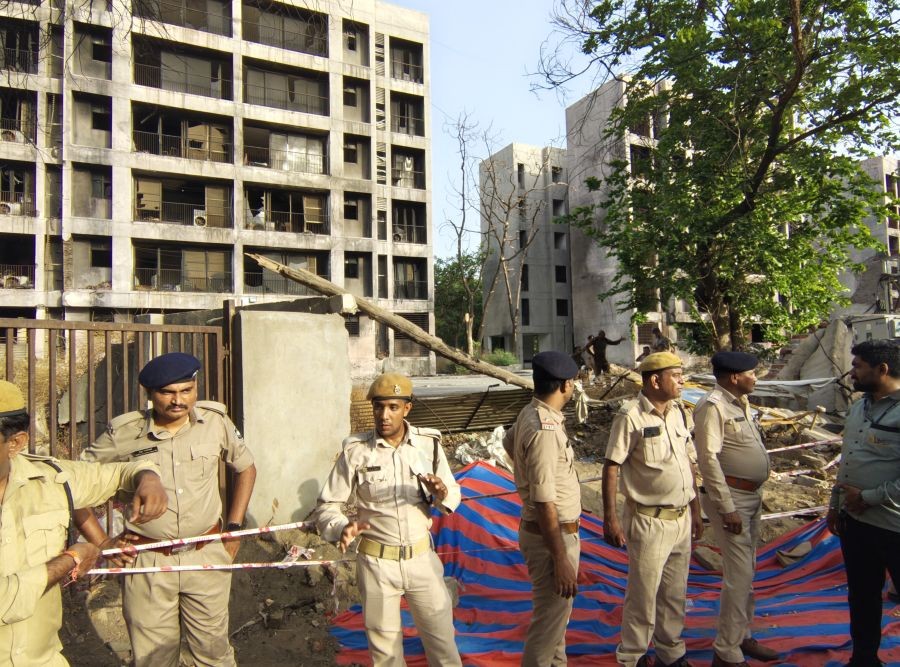
Mumbai/Ahmedabad, June 19 (IANS): The Federation of Indian Pilots (FIP) on Friday called for a transparent judicial enquiry into the Air India AI-171 Boeing 787 crash that claimed over 260 lives, arguing that pilots do not fly to kill people and independent technical evidence raises significant questions about the theory that pilot actions caused the disaster.
Speaking at a press conference in Mumbai, FIP President Captain C.S. Randhawa said the organisation had approached the Supreme Court of India seeking an independent investigation and maintained that all possible technical, electrical and systems-related causes must be examined before any conclusions are reached about the role of the flight crew.
"Justice must be ensured for all passengers, crew members and families affected by the crash," the pilot body said.
It raised concern about the current investigation process and objected to what it described as "premature attempts" to attribute responsibility to the deceased pilots.
Central to the FIP's position is its challenge to the timeline outlined in the preliminary investigation report.
The organisation said, "Certified simulator testing conducted under the supervision of attorney Mike Andrews of Beasley Allen Law Firm had produced results that did not align with the sequence described in the report."
According to FIP, the preliminary report indicates that the aircraft's hydraulic system became active approximately four seconds after the engine shutdown sequence at 08:08:43.
However, the federation said 10 independent test runs carried out on a certified Boeing 787 Level D six-axis simulator certified by the European Union Aviation Safety Agency showed that the Ram Air Turbine (RAT) would require about 18 seconds to deploy and generate hydraulic pressure.
"The process involved approximately 12 seconds for the high-bypass turbofan engines to spool down below flight idle and a further six seconds for the RAT deployment mechanism, citing Hamilton Sundstrand technical training documents," the FIP asserted.
The organisation argued that the discrepancy warranted a transparent simulator validation exercise by investigators.
The federation also disputed suggestions that the pilots intentionally moved the aircraft's fuel control switches to the cut-off position. It noted that the preliminary report stated that the switches had "transitioned" rather than explicitly concluding that they had been physically moved by the crew.
"Investigators should examine the possibility of an uncommanded technical or electrical failure involving aircraft computer systems, including systems associated with Full Authority Digital Engine Control and Thrust Control Malfunction Accommodation," they said.
The federation argued that an electrical fault affecting shock absorber micro-switches could theoretically return the aircraft to ground mode during flight and trigger a computer-driven fuel cut-off.
As part of its argument, FIP referred to a 2019 incident involving an All Nippon Airways Boeing 787 in Osaka, Japan, where it said "both engines experienced an uncommanded shutdown event associated with air-mode logic after touchdown".
The federation further highlighted concerns regarding previous Boeing 787 technical issues.
It said there had been 31 documented instances globally of uncommanded RAT deployment linked to faulty internal shuttle valves and claimed that "19 Air India Boeing 787 aircraft were operating with unmodified versions of those components".
The FIP also cited an October 2025 incident involving Air India Boeing 787 aircraft VT-ANO on a flight from Amritsar to Birmingham, in which it said an uncommanded RAT deployment occurred three months after the aircraft had undergone servicing.
The organisation additionally referred to concerns regarding Air India's maintenance and safety systems, citing what it described as "an official whistleblower audit" that identified more than 357 adverse safety findings and reported repeated technical snags affecting seven out of every 10 airframes reviewed.
"All available crash evidence, including aircraft health-monitoring data, cockpit information, flight recorder material and witness testimony, should be fully disclosed and independently examined," they emphasised.
The federation questioned, "Why were 11 system maintenance codes transmitted through the Aircraft Health Monitoring System between 07:07:53 and 08:09:00 not included in the preliminary report? Those codes could only be decoded by the aircraft manufacturer."
The organisation also pointed to reports of abnormal sounds and electrical disturbances before the crash.
It referred to testimony from the sole survivor, who reportedly described hearing a "big bang" from the rear of the cabin accompanied by flickering lights shortly before impact.
The FIP further claimed that the forward Digital Flight Data Recorder was recovered covered in soot but undamaged, while the rear recorder was reportedly destroyed by an electrical fire despite the tail section and auxiliary power unit doors remaining intact.
The federation also cited what it described as inconsistencies involving a crew member's uniform and a passenger's mobile phone recovered from the wreckage.
Beyond the technical issues, the federation raised concerns about the structure of the investigation.
"The enquiry should include experienced commercial aviation professionals, Boeing 787 examiners, airline pilots, systems specialists and simulator experts," they said.
The FIP argued that the six-member Aircraft Accident Investigation Bureau (AAIB) panel lacked Boeing 787-specific expertise and noted that "the Director General heading the panel previously served in the Air Force with a technical background in missile defence systems".
The organisation also questioned the participation of Directorate General of Civil Aviation (DGCA) officials in the investigation, stating that the presence of two serving DGCA members on the enquiry panel could create a conflict of interest under international civil aviation investigation standards.
"Experienced Boeing 787 examiner and former Director of Operations Captain R.S. Sandhu had been sidelined from the active investigation despite initially being assigned to the panel," they alleged.
The federation also voiced concerns about the treatment of victims' families. It alleged that some families had reported difficulties obtaining responses from Air India and Tata Group management after raising questions about the crash.
"Families should not be pressured into signing settlement or release documents without first obtaining legal advice and understanding their rights," the pilot body said.
It referred to provisions under the Montreal Convention, stating that airlines are subject to strict liability up to 150,000 Special Drawing Rights, which it estimated at approximately Rs 1.82 crore.
The organisation said additional compensation claims could depend on factors including the age, income and dependency circumstances of individual victims and alleged that some legal representatives were linking ex gratia payments to broad liability waivers.
The FIP also urged the Central Government to establish a judicial enquiry under Rule 12 of the Aircraft Rules, arguing that a broader public investigation was necessary to examine technical, regulatory, maintenance and operational issues independently.
"Pilots do not fly to kill people. The dignity of the deceased pilots and the rights of the victims' families must be protected. FIP will not accept any attempt to blame pilots without complete technical proof. Immediate simulator tests must be conducted by the AAIB to verify the actual technical sequence and timeline. This matter requires a transparent, independent, and judicial enquiry under Rule 12 so that the truth comes out and justice is done for every person who lost their life in this crash," the federation said.