Tradition Vs statute: HC distinguishes Putu Menden from Village Council in Nagaland
Moa Jamir
Dimapur | November 1
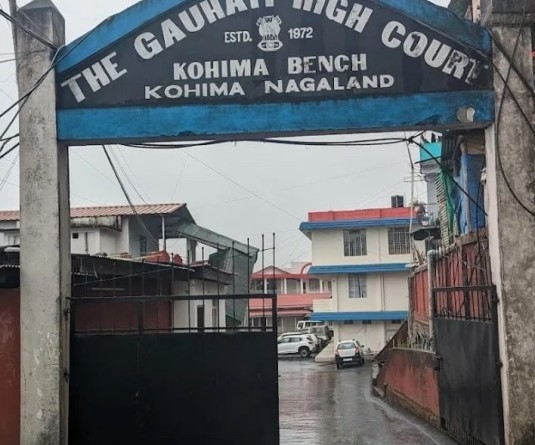
In a landmark judgment, the Gauhati High Court Kohima Bench (GHCKB) struck down sweeping excommunication orders issued by a village in Mokokchung, ruling that customary institutions cannot infringe upon constitutional guarantees of liberty, equality, and free movement.
In a judgment pronounced on October 27, Justice Yarenjungla Longkumer set aside four orders and announcements issued by the Yaongyimsen Riongsanger Putu Menden and the Yaongyimsen Senso Mungdang, holding that their actions violated Articles 14, 19 and 21 of the Constitution.
The court held that both institutions were amenable to writ jurisdiction under Article 226, even if they did not qualify as “State” under Article 12, as their decisions affected legally protected interests and involved a public-law element.
Case background
As per Court’s records, the dispute centred on the establishment year of the Chümoukedima Yaongyimsen Union, with one group claiming it was formed in 1989 and another asserting 2001.
On March 14, 2024, the Putu Menden dissolved the existing union and directed the 2001 group to form a new one, prompting opposition from supporters of the 1989 formation year.
On April 4, the Putu Menden issued an information excommunicating three petitioners and their children from Yaongyimsen village citizenship.
On October 21, the Senso Mungdang announced the excommunication of 42 people residing in Chümoukedima, including the 38 petitioners and their families in an Ao language daily. The Putu Menden affirmed the decision the following day through a separate notice in the same paper.
A December 10 ‘information’ from the Senso Mungdang, conveying a decision taken at an emergency meeting on November 26, cautioned permanent excommunication if those affected did not return to the village within seven days, alongside additional restrictions.
The petitioners approached the High Court (WP(C) 90/2025), seeking to quash the four communications and protection against unlawful action by village authorities.
Putu Menden and Village Council distinction
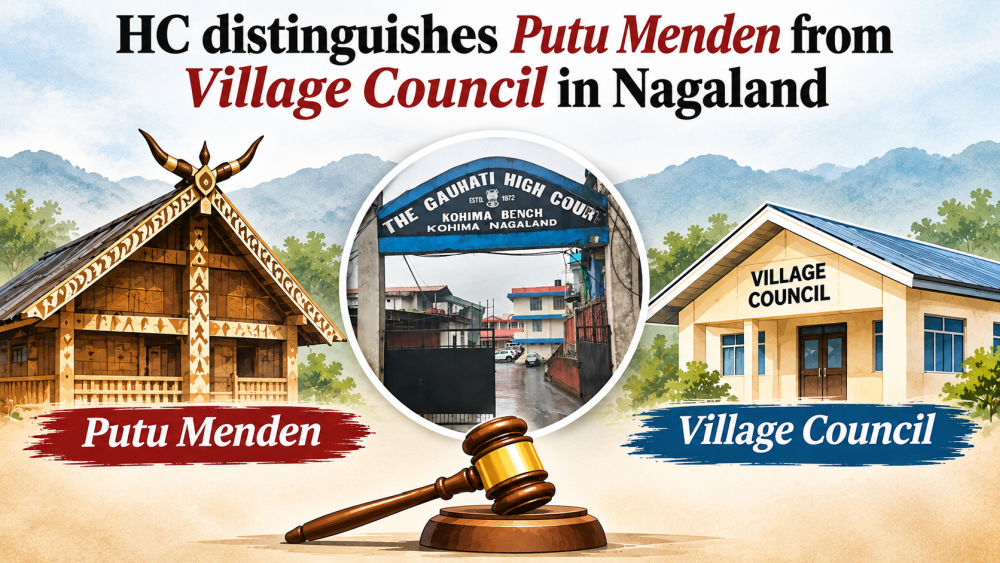
The judgment also delineated the distinct roles of Putu Menden, the highest customary authority in an Ao village, and the Village Council, a statutory institution constituted under the Nagaland Village and Area Councils Act, 1978, which recognises the traditional system of village governance in Naga society.
The single-bench judgment by Justice Yarenjungla Longkumer referred to The Village Republic: A Case Study of the Ao Naga by Bendangkokba, IAS; Naga Society and Culture by N Talitemjen Jamir and Prof A Lanunungsang; and The Ao Naga Oral Tradition by Prof Temsula Ao.
Referring to these works, the court observed that Putu Menden is the highest authority in an Ao village and that the institution existed before the 1978 Act.
It noted that, under Ao custom, a Putu Menden usually functions for about 30 years before being succeeded by another Putu (generation), with five Putus succeeding one another in a pattern the court said had continued since time immemorial.
The judgment stated that Putu Menden is a traditionally established institution whose members uphold customs and traditions and enforce customary law, while the Village Council is a statutory body constituted under the 1978 Act.
The court observed that the two institutions sometimes overlap in Ao villages. Members of Putu Menden may also serve on the Village Council, although not all Village Council members necessarily belong to Putu Menden.
Some Ao villages have two or more Putu Mendens, depending on their Khels. As a village can have only one Village Council, selected members from the different Putu Mendens may constitute the council.
The court also distinguished the institutions on the basis of tenure and the State government’s powers over their membership.
Under the 1978 Act, the Village Council has a five-year tenure, and the State government has the power to remove its members. No equivalent power is vested in the State government to remove members of Putu Menden, who are inducted in accordance with Ao customary laws and traditions.
The judgment noted that Section 6 of the 1978 Act recognises the traditionally established Putu Menden, which continues to function according to the respective customs and usage. It held that the two remain separate institutions despite possible overlap in membership.
Can customary authority be judicially reviewed
The respondents contended that the petition was not maintainable under Article 226 because Putu Menden and Senso Mungdang were customary or private institutions and did not qualify as “State” under Article 12.
Rejecting this argument, the court held that writ jurisdiction extends to bodies whose actions affect legally protected rights and involve a public-law element. Relevant considerations included whether their authority was recognised by custom and whether their decisions affected civil status, identity documents, public benefits or other interests beyond a voluntary association.
Describing the Senso Mungdang as a private association exercising control over Yaongyimsen villagers, the court relied on principles laid down in Board of Control for Cricket in India, Andi Mukta Sadguru and Muthoot Finance. It held that amenability to writ jurisdiction depends not solely on a body’s status under Article 12, but also on its functions, the duty involved and the nature of the impugned action.
The court found that the excommunication decisions had consequences for the petitioners’ civil status as Yaongyimsen villagers, access to public benefits and identity documents, including Scheduled Tribe and indigenous inhabitant certificates. It accordingly held both Putu Menden and Senso Mungdang amenable to writ jurisdiction under Article 226.
On the merits, the court held that the excommunication orders and associated restrictions violated Articles 14, 19 and 21 of the Constitution. It further held that Articles 29 and 371A did not provide blanket immunity from judicial review for customary sanctions infringing fundamental rights.
The court distinguished Sardar Syedna Taher Saifuddin Saheb v. State of Bombay, cited by the respondents, as concerning a religious body rather than a traditional institution such as Putu Menden.
The High Court quashed all four impugned communications and announcements, leaving the dispute over the union’s formation year to be decided by the appropriate forum.
The ruling is not the first time the Kohima Bench has held customary authority in Nagaland subject to constitutional scrutiny. In Mangyang Lima v. State of Nagaland and others, 2019 the court recognised that customary bodies exercising extensive control over villagers could be amenable to writ jurisdiction and that banishment and excommunication orders were not beyond judicial review. The Yaongyimsen judgment also relied on T Chalukumba Ao v. State of Nagaland (March 21, 2024) and K Tia Longkumer v. State of Nagaland (June 23, 2026) to support the amenability of Putu Menden and customary orders to writ jurisdiction.
HC draws on Nagaland, SC rulings
The Court has drawn on earlier rulings from Nagaland and the Supreme Court to reaffirm that customary institutions cannot claim blanket immunity from constitutional scrutiny when their decisions infringe fundamental rights. The ruling brings into focus a central legal question: to what extent can traditional institutions exercise customary authority when their decisions affect people’s civil status, freedom of movement and access to rights and public benefits?
Nagaland precedents establish limits on customary authority
The court’s reasoning drew on earlier rulings concerning customary institutions in Nagaland, particularly Mangyang Lima v. State of Nagaland and others (2019 (1) GLT 409), T. Chalukumba Ao v. State of Nagaland (WP(C) No. 128/2023, decided March 21, 2024) and K. Tia Longkumer @ K. Tialiba Lkr. v. State of Nagaland and five others (WP(C) No. 169/2025, decided June 23, 2026).
In Mangyang Lima, the court addressed the authority of community bodies to impose severe social sanctions, including banishment and excommunication. It recognised that such bodies may perform functions affecting the wider community and can, in appropriate circumstances, be brought under the High Court’s writ jurisdiction. The ruling also established that sanctions restricting individual freedoms may violate Articles 19 and 21, and that Article 371A does not place customary decisions beyond judicial review.
The other two Kohima Bench rulings reinforced the principle that traditional institutions such as the Putu Menden can be subject to writ proceedings. They also support the broader proposition that customary proclamations carrying serious consequences for individuals, including social exclusion and restrictions on movement, are not automatically beyond the reach of the courts.
Taken together, these Nagaland-specific precedents provided a legal basis for examining not merely whether the institutions were exercising customary authority, but also the nature and consequences of that authority.
Public functions can bring non-State bodies under Article 226
A key aspect of the judgment was its consideration of whether the Putu Menden and Senso Mungdang could be subjected to writ jurisdiction even though they did not qualify as “State” under Article 12 of the Constitution.
The High Court relied on the Supreme Court’s ruling in Board of Control for Cricket in India v. Cricket Association of Bihar (2015) 3 SCC 251, which established that the question of writ jurisdiction is not determined solely by whether an organisation falls within the definition of “State”. The nature of its functions and duties, and the public consequences of its actions, are also relevant.
Similarly, in Andi Mukta Sadguru Shree Muktajee Vandas Swami Suvarna Jayanti Mahotsav Smarak Trust v. V.R. Rudani (1989) 2 SCC 691, the Supreme Court clarified that the reach of Article 226 extends beyond government departments and statutory authorities where a body has a public duty to perform.
The High Court also referred to Shobha v. Muthoot Finance Ltd. (2025 INSC 501) in considering the “function test”—an approach that examines what a body actually does and the relief sought against it, rather than relying exclusively on its public or private character.
The significance for the Yaongyimsen dispute was that the two institutions were not acting only as voluntary associations managing their internal affairs. Their decisions affected the petitioners’ claimed status as village citizens, identity documentation and access to legally protected benefits. The court therefore held that their actions were amenable to judicial review under Article 226.
Article 371A does not provide blanket immunity
The judgment also examined the limits of customary practices when they come into conflict with constitutional protections. In doing so, it drew on N. Adithayan v. Travancore Devaswom Board (2002) 8 SCC 106 and Lakshmibai v. Bhawantbuva (2013) 4 SCC 97, which support the principle that custom cannot automatically prevail when it is inconsistent with constitutional guarantees, applicable law or public policy.
For Nagaland, the issue has particular significance because Article 371A provides constitutional protection in specified matters relating to Naga religious or social practices, customary law and procedure, and the administration of civil and criminal justice involving decisions according to Naga customary law.
The High Court did not deny the importance of customary institutions or the constitutional protection afforded to Naga customs. Instead, it rejected the proposition that this protection creates blanket immunity from judicial scrutiny when decisions adversely affect fundamental rights.
The judgment thus distinguishes respect for customary autonomy from the unrestricted exercise of authority. The existence of a customary practice, by itself, does not settle whether a particular sanction is constitutionally permissible.
Religious excommunication precedent distinguished
The respondents had also relied on Sardar Syedna Taher Saifuddin Saheb v. State of Bombay (AIR 1962 SC 853), a Supreme Court decision concerning the excommunication powers of the head of the Dawoodi Bohra religious community and the protection of religious freedom under Articles 25 and 26.
The Kohima Bench distinguished that case from the Yaongyimsen dispute. The former concerned authority exercised within a religious community in the context of religious faith, while the present case involved a traditional village institution imposing sanctions affecting individuals’ social and civil status.
The distinction was material because the court was not dealing simply with the internal religious discipline of a faith community. It was examining the exercise of customary authority by institutions whose decisions had consequences extending into the petitioners’ legal and civic lives.
The judgment also noted that Sardar Syedna had been referred for reconsideration by a larger Constitution Bench following Central Board of Dawoodi Bohra Community v. State of Maharashtra (2023) 4 SCC 541.
Court leaves union formation dispute open
Applying these principles, the High Court quashed the four communications and announcements relating to the excommunication of the petitioners and their families, finding the sanctions in violation of Articles 14, 19 and 21.
However, the judgment did not determine whether the Chümoukedima Yaongyimsen Union had been established in 1989 or 2001. It left that dispute to be resolved by the appropriate forum.