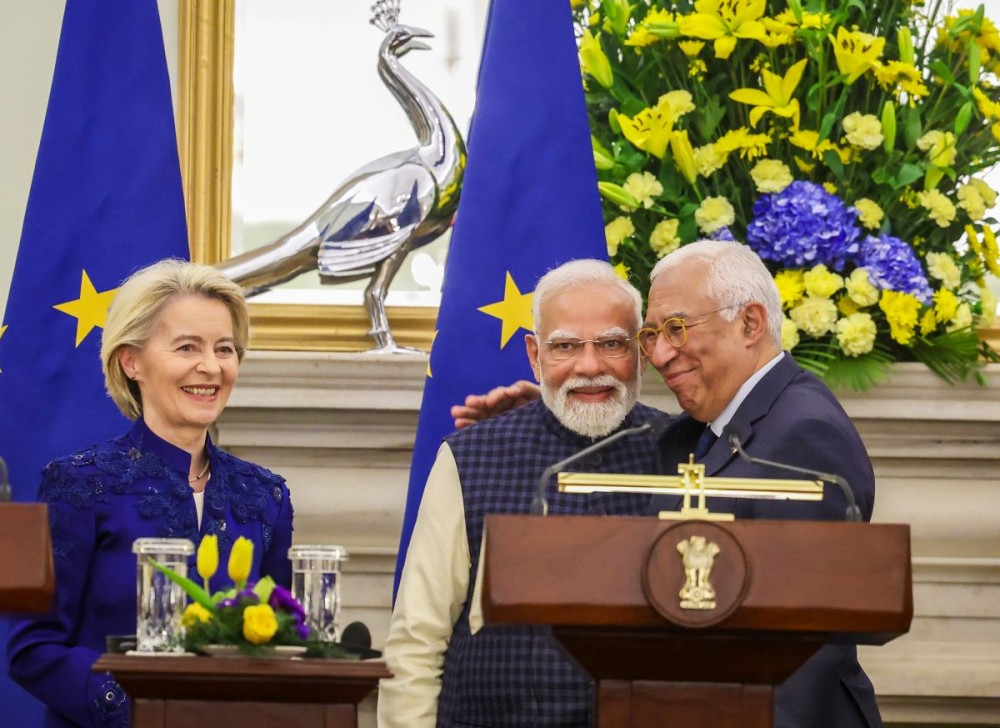
Prime Minister Narendra Modi, President of the European Council António Costa, and President of the European Commission Ursula von der Leyen during the exchange of MoUs between India and the European Union at Hyderabad House, in New Delhi, Tuesday, January 27, 2026. (IANS Photo)
New Delhi, January 28 (IANS): The tariff turmoil unleashed by US President Donald Trump as part of his "America First" trade policy has been an important factor in speeding up the historic free trade agreement just concluded between India and the European Union, according to reports in the western media.
"Concluded after nearly two decades of on-again, off-again negotiations, the pact unites two of the world’s largest markets in a free trade zone of about two billion people, roughly a quarter of global GDP," a report in America’s Newsweek stated.
Experts told Newsweek that the US tariffs of 25–50 per cent on steel, aluminium and other Indian exports, and the collapse of US-India trade talks last year, pushed New Delhi to hedge its bets.
European allies, meanwhile, felt the strain of transatlantic spats, with Trump even threatening to impose tariffs over Europe’s refusal to sell Greenland. "Trump’s tariffs gave us a useful tailwind in the homestretch," an EU diplomat told Newsweek, suggesting that fear of US trade wars helped India and the EU overcome final sticking points.
European Council President Antonio Costa framed the deal as a direct counterpoint to Washington’s tariff wars. He lauded it as a "geopolitical stabiliser" that upholds the international, rules-based trading order in an era of unilateralism.
"The pact thus stands as a reaction to the new US trade policy: rather than follow Washington into protectionism, Brussels and New Delhi chose to strike the biggest free trade deal either has ever signed; underscoring that the global economy will not wait," the report stated.
Equally, the partnership, experts in New Delhi feel, is aimed as a counterweight to China’s influence. Both India and the EU have grown wary of China’s near-monopoly in critical supply chains and its expansionism in Asia.
"We will grow our strategic relationship to be even stronger," European Commission President Ursula von der Leyen said, emphasising that diversifying away from single sources is a key motive.
The new pact includes the first-ever India–EU Security and Defence Partnership (SDP), a parallel agreement inked alongside the trade deal.
This "overarching" security framework will deepen cooperation in maritime security, defence technology, cyber security, space, and counter-terrorism, among other areas.
The agreement also opens the way for European companies to shift some production to India in key areas such as batteries or specialty chemicals without fear of Chinese components sneaking in to undercut the tariff benefits, the report pointed out.
"The announcement of the deal served as a powerful stage for the leaders who delivered it. Indian Prime Minister Narendra Modi hailed this FTA as 'the biggest free trade deal in history', underscoring its scale and significance. Modi emphasised how the pact would benefit ordinary Indians; from farmers and small businesses gaining export access, to consumers enjoying cheaper goods, thereby solidifying his image as a leader who can elevate India’s economic standing globally," the report observed.