

Meyu Changkiri
Whenever people see me riding a motorcycle, I can almost feel their theology wobble a little. Heads turn. Eyes linger. Smiles appear. And sooner or later, the question arrives - sometimes whispered, sometimes confidently announced to everyone nearby:
“Pastors ride bikes?”
I am often tempted to reply, “Yes - and so far, heaven has not objected,” but I usually choose to remain pastoral.
It is not a rude question. Most people ask it with genuine curiosity and a bit of amusement. Some look relieved when they realise I am serious. Others look slightly concerned, as if a pastor on a motorcycle might be a sign that something has gone terribly wrong somewhere. I have learned to smile at these moments, not because the question is foolish, but because it reveals something deeply human about us.
We like things to fit neatly into categories. We feel more comfortable when roles are clearly defined and expectations firmly set. Pastors are expected to live one kind of life. Bikers are expected to live another. Certain joys are considered acceptable for some people and questionable for others. Once those boxes are sealed, anyone stepping outside them feels unusual - even suspicious.
Christmas, however, has never been comfortable with our boxes.
The first Christmas did not arrive with dignity, ceremony, or careful planning. It came quietly, unexpectedly, and without permission from human assumptions. God chose a stable instead of a palace, shepherds instead of scholars, and vulnerability instead of power. From the very beginning, Christmas disrupted expectations and invited people to see differently - to notice God at work in places they had not been looking.
This reflection grows out of that spirit - through motorcycles, through people often misunderstood, and through the quiet truth that the real meaning of Christmas is always on the move.
Christmas Breaks Our Boxes
My journey with motorcycles began long before I ever entered pastoral ministry. I learned to ride when I was sixteen. Like many young people, I loved the freedom of the open road, the sense of independence, and the joy of discovering places beyond the familiar. Riding gave me space to think and room to breathe. There was something about the wind, the rhythm of the engine, and the ever-changing landscape that made life feel open and full of possibility.
Over time, riding taught me more than I expected. It taught balance - literal and metaphorical. It taught patience, because rushing on a motorcycle is never wise. It taught attentiveness, because even a small moment of distraction can have serious consequences. On a motorcycle, carelessness is not an option. You must stay alert - not only for your own safety, but for everyone else on the road. Responsibility becomes an inseparable part of the ride.
I enjoy driving my car, and over the years I have come to realise that I am a better driver because I also ride a motorcycle. Riding sharpens awareness. It teaches humility on the road. It makes one attentive to blind spots, vulnerable moments, and the shared responsibility we all carry as travellers. When you have experienced the road from the exposed seat of a bike, you drive a car differently - with more patience, more caution, and more respect for others.
There are some things in life that can only be understood from within. You understand what it means to ride only when you have ridden - when you have felt the balance required, the vulnerability involved, and the discipline it demands. In the same way, you understand what it means to shepherd the flock only when you have walked closely with people, shared their joys and sorrows, prayed with them in quiet rooms, and carried the often unseen weight of pastoral responsibility.
Experience has a way of softening our judgments and deepening our compassion. It teaches patience, enlarges understanding, and reminds us that every calling carries its own disciplines and joys. When we take time to step into another person’s world - even briefly - we learn to see life with greater grace.
As life moved forward, responsibilities increased. Family life deepened. Ministry demanded more time and energy. Yet the love for riding never disappeared. It simply waited quietly.
In time, that quiet waiting was met with gentle encouragement. My family and close friends walked with me through the thought, the timing, and the discernment. For a season, it even became part of our prayers - unhurried, unforced, entrusted to God. When the day finally came to own the bike I now ride, it felt less like a decision made and more like a gift received. Not everything we pray for arrives dramatically; some answers come quietly, wrapped in peace and shared conviction. In that sense, the bike carries more than motion - it carries gratitude, memory, and the assurance that even simple joys can be held reverently when they are shaped by prayer and community.
Some years ago, before my dear friend R. G. Lyngdoh passed away, I shared with him a simple dream - to own a bike again and ride alongside other riders. He understood life in its many layers and complexities and never saw riding as something strange or irresponsible. To him, it was simply another honest expression of a life lived fully and responsibly.
There is an irony that still stays with me. I was the one who had to conduct his funeral. He did not live to see that simple dream come true - the day I finally bought a bike and began riding alongside other bikers. And yet, in a quiet way, his encouragement never left me. His words stayed with me.
Perhaps that, too, is part of the Christmas story - that even in loss, hope does not end, and what is planted in love continues to move forward in ways we do not always see.
After I had bought the bike and begun riding again, my wife shared something that made us pause - and then smile. A lady from Shillong mentioned that she had heard, through someone in Bengaluru, that the pastor had bought a very powerful and expensive bike. The bike was real, of course. What followed revealed how easily unspoken expectations shape our thinking - about simplicity, calling, and what faithfulness is supposed to look like from the outside.
What stayed with me was not the machine, but the quiet reminder of how quickly assumptions form when we observe from a distance, and how easily joy becomes something that needs explanation.
Christmas gently challenges that mindset. It reminds us that faith is not about withdrawing from life, but about living it with integrity, gratitude, and responsibility. The incarnation itself is God’s declaration that ordinary life matters - that bodies matter, journeys matter, and relationships matter.
What has remained with me through this journey is the reminder that misunderstanding can sometimes arise even within familiar and faith-filled spaces. Those who share our language of theology and our commitment to the church often do so with sincerity, yet experience life from different angles. Over time, I have learned that formation in faith is shaped not by training alone, but also by lived experience - by walking roads together, sharing ordinary joys, and allowing grace to widen our understanding of one another. Christmas gently invites us into that widening, calling us not only to think deeply, but to see generously and walk humbly together.
Bikers Are Often Misunderstood
Bikers, too, are often misunderstood - too easily judged and too quickly labelled. They are sometimes seen as reckless or rebellious. But anyone who truly rides knows that riding demands discipline. It requires respect - for the road, for life, and for fellow travellers.
There is a strong sense of brotherhood among riders. They look out for one another. They understand risk, and therefore they value responsibility. Too often, we notice the machine and miss the person. We see the helmet but forget the heart beneath it.
This Christmas season offered a different picture.
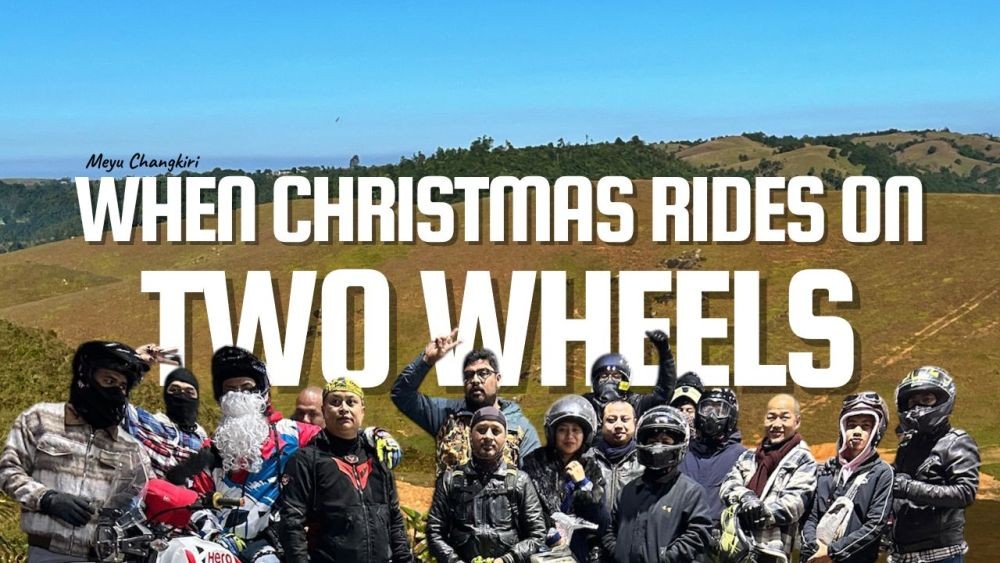
A group of Christian bikers from Shillong came together for a charity ride. They pooled their resources, raised funds, and purchased rations and blankets. Then they rode out to villages far from the comfort and convenience of the city - places where winter nights are long and resources are limited.
There were no banners. No stage. No applause. There was only presence.
For the families who received those supplies, the gesture meant warmth, dignity, and reassurance. It was Christmas lived out quietly - without performance, without publicity, and without expectation of return.
Along this journey, I have not ridden alone. A dear friend and fellow pastor, Pastor John Chang, shares the same love for riding and ministry. Together, we have travelled through villages and around the city - not merely to cover distance, but to be present among people, to listen, to pray, and to share the Gospel in simple and unhurried ways. On two wheels, conversations often open more easily, and ministry feels closer to the rhythms of everyday life.
Through Pastor John, I was also introduced to a group of passionate Christian riders in Shillong - men who see riding not as escape, but as calling. Among them is a close associate of mine, Uttam Thankhiew, whose quiet commitment and steady faith reflect a discipleship rooted in action rather than display. Being with them affirmed something deeply personal to me: that the Gospel is not confined to pulpits or programmes. It moves with people, travels through relationships, and finds its way into ordinary roads where hearts are open and lives are being lived.
On another evening, the same group rode through the streets of Shillong, praying and proclaiming the joy of Christmas - the joy of the coming of Jesus Christ, who brings hope to the hopeless and light to those walking in darkness. There were no pulpits or microphones. Their message travelled through movement, unity, and visibility.
Their engines did not drown out the message.
They carried it.
Christmas Is Always on the Move
Christmas is not a static event. It is movement - God moving toward humanity, love moving toward need, and light moving into darkness. It is about presence, not performance. About crossing boundaries, not staying comfortable.
In that sense, a motorcycle becomes an unexpected but fitting symbol. It goes where roads are narrow. It travels paths that are rough. It demands attentiveness. It reaches places others may not easily reach.
Christmas reminds us that goodness often travels quietly. It does not always arrive in familiar forms or through expected people. Sometimes it comes with the sound of an engine. Sometimes it comes wrapped in a blanket. Sometimes it arrives through people we may not have fully understood.
At the heart of Christmas is an invitation - quiet, personal, and transformative. It is the invitation to allow Christ to enter our lives, not as an idea to admire from a distance, but as a presence that reshapes how we see, how we choose, and how we live. When that happens, faith no longer remains confined to words or seasons. It begins to show itself in movement, in compassion, in responsibility, and in the way we journey with others.
The roads may remain the same, but the direction changes. And slowly, often unnoticed, life begins to carry a different light.
Conclusion
As I look back on this journey - of riding, remembering, and reflecting - my hope is simple.
That we learn to slow down.
To listen more carefully.
To understand before we assume.
So when you see a motorcycle pass by this Christmas, pause before you decide what story to tell. There may be prayer in that ride, service in that journey, and hope on the move.
Because the true spirit of Christmas does not stand still.
It moves toward people.
It carries light.
And sometimes, it rides on two wheels.

