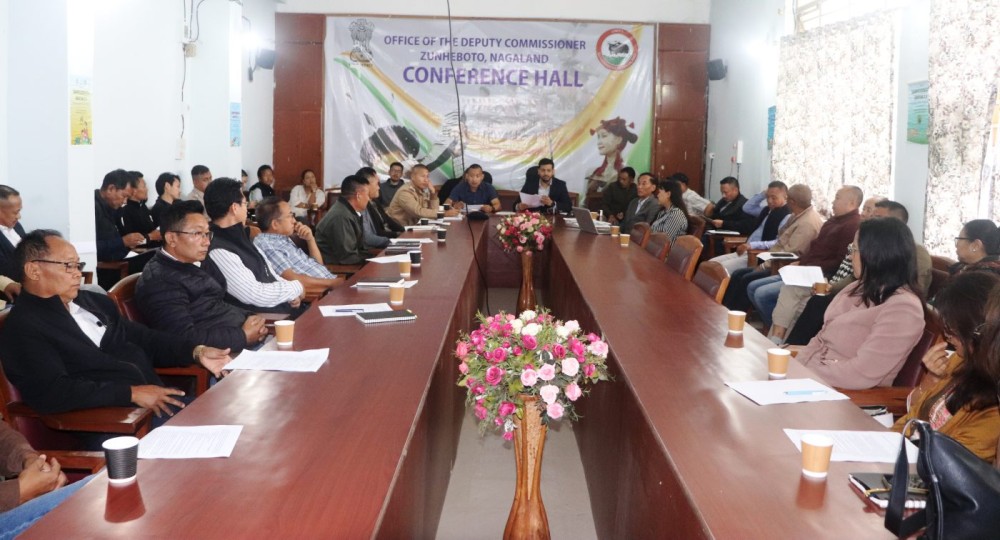
Zunheboto DPDB held at the Deputy Commissioner's conference hall, Zunheboto, under the chairmanship of Vice Chairman, DPDB and Deputy Commissioner Dharam Raj, IAS on August 5. (DIPR Photo)
Morung Express News
Zunheboto | August 5
The Zunheboto District Planning and Development Board (DPDB) held on Wednesday at the Deputy Commissioner's conference hall, Zunheboto, under the chairmanship of Vice Chairman, DPDB and Deputy Commissioner Dharam Raj, IAS.
The meeting reviewed the minutes and action taken report of the previous DPDB meeting and welcomed a new member to the Board.
Among the key matters reviewed were development proposals already approved and forwarded to the Government, including the Green Initiatives proposal, establishment of a Fire and Emergency Services Station at Akuluto, setting up of a Public Health Engineering (PHE) office at Satakha, and construction of the District Welfare Office at Zunheboto.
The Board also approved the organisation of the 13th Intra-Departmental Tournament, scheduled to be held from September 17 to 19, featuring six sporting disciplines to promote healthy competition among government departments.
With no fresh agenda for discussion, Additional Deputy Commissioner Shaying Sheu, NCS, briefed members on departmental responsibilities and work distribution for the smooth conduct of the forthcoming Independence Day celebrations.
A major highlight of the meeting was a presentation by the District Rural Development Agency (DRDA) on the Viksit Bharat–Guaranteed Rozgar for Augmenting Rural Missions (VB G-RAM-G) Scheme, outlining its objectives, implementation strategy and expected impact on rural livelihoods.
The scheme guarantees 150 days of wage employment annually for eligible rural households, an increase from the existing 100-day provision under MGNREGS, with an additional 50 days focused on private agricultural and allied infrastructure. It also provides 4–5 days of employment during the lean agricultural season to strengthen livelihood security and reduce distress migration.
According to the presentation, 318 categories of works have been identified under the scheme. These include 107 water security projects, 90 core rural infrastructure works, 96 livelihood infrastructure projects, and 25 activities related to water harvesting and disaster mitigation. Permissible works cover construction of individual and community water conservation structures, rural roads, livestock infrastructure, and food relief shelters.
The funding pattern will follow the existing MGNREGS framework, with 60:40 Centre-State cost sharing for general states and 90:10 for Northeastern and Himalayan states, including Nagaland.